
Richard Arlin Walker
Special to ICT
The Washington state Department of Transportation’s desecration of an ancestral village and burial site was still an open wound in 2005 when the Lower Elwha Klallam Tribe last hosted the Intertribal Canoe Journey, an annual gathering of Northwest Indigenous canoe cultures.
Tribal officials had warned the state that the place the Klallam knew as Tse-whit-zen was there, that people were living at Tse-whit-zen when Rome was founded, that the land held the memories of 2,700 years of life.
By the time the state stopped its work – preparing the site for construction of parts for a bridge replacement project – the damage was done. Archeologists would recover a total of 335 human remains and more than 100,000 artifacts from the site.
“I think about Lummi, about Muckleshoot, about Skokomish, about all these different tribes that stepped up when we called them and asked them for help,” said Mark Charles, cultural coordinator for the Lower Elwha Klallam Tribe, whose territory lies along the northern Olympic Peninsula. “They came and stood with us in snow and rain.”
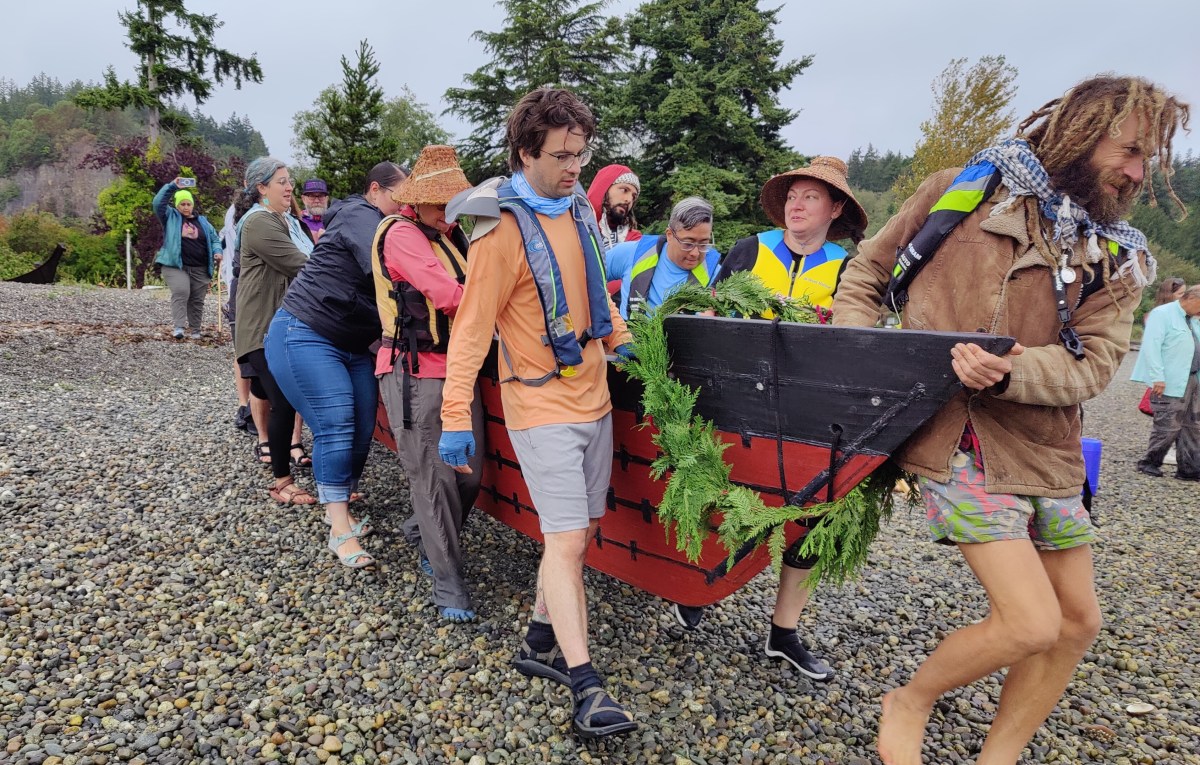
Eight months later, the people gathered again on Klallam lands, this time for the Intertribal Canoe Journey. Hosting was a tall order after the trauma at Tse-whit-zen. But the gathering was medicine for a healing nation.
“When we’re all together, we stand stronger,” Charles said.
When the Lower Elwha Klallam Tribe hosts the Canoe Journey for a second time – July 31 to Aug. 5 – the event will be as much a reminder of work that needs to be done as it will be a celebration of all that has been accomplished.

Elwha’s hosting takes place 20 years after the desecration of Tse-whit-zen was stopped and nearly 15 years after deconstruction began on two salmon-blocking dams on the Elwha River. It also begins 13 days after a fuel truck overturned near a creek that feeds into the river, spilling 1,400 gallons of fuel that, Elwha Chairwoman Frances Charles said, killed thousands of salmon fingerlings.
“The dams have been removed and the river is being restored, but everything with the dams coming out is still a healing process,” Mark Charles said. “We have to restore the fish population. That’s huge for our people, making sure that we do that. If we don’t take care of the river and the salmon, how’s it supposed to take care of us? That’s something that we have to do, something we’ve always done.”
Many participants in the Intertribal Canoe Journey say the event is a metaphor for life: The state tried to take away the people’s languages and kill their cultures, but the languages and cultures survived. Treaty rights are challenged, but tribal nations stand ready to defend them in courts. Dams were built that block salmon passage, and the people stand tough until the dams are brought down. Muscles get sore and the sea gets rough, but canoe pullers endure.
Through all of life’s challenges – whether on land or sea, in courtroom or in canoe – the people stand together. And their lifeways live on.
“I get to where I’m tired, but not to the point where I want to give up, because I don’t want to slow us down and be the only one not pulling,” said Lorelei Tillotson, a member of the Samish Nation’s canoe family, which will travel 44 nautical miles to Elwha for the gathering, stopping at tribal nations along the way.
“I get tired, but it never occurs to me to stop,” Tillotson said.
The Intertribal Canoe Journey was spurred by the Paddle to Seattle, which took place in 1989 as part of the State of Washington’s centennial celebration. Centennial committee member Emmett Oliver, a Quinault culture bearer and retired U.S. Coast Guard officer, organized the Paddle to Seattle to ensure the Indigenous nations that share geography with Washington state were represented. Fifteen Coast Salish canoes participated.
The Paddle to Seattle was a shot in the arm for Indigenous peoples whose cultural lifeways had long been suppressed by government assimilation policies (the U.S. government’s Termination Era policies ended only 19 years earlier, and the American Indian Religious Freedom Act was only 11 years old). These waters were the ancestors’ marine highway and the canoe was the vehicle – ocean-going, sea-going or nearshore, depending on where you lived and your destination. Families traveled by canoe to visit kin, attend celebrations and ceremonies, and harvest resources.
The Paddle to Seattle brought all of that back: the art of canoe carving; the languages, dances and songs that had been suppressed when assimilation was federal policy; the potlatches that had been banned in the grandparents’ time in the U.S. and Canada.
“It’s a huge part of bringing back the culture,” Charles said of the Canoe Journey. “Some of our elders didn’t get to do what I get to do today. Like, anytime I feel like picking up my drum – anywhere – I’ll pick it up and sing if I feel the need to sing a song.”
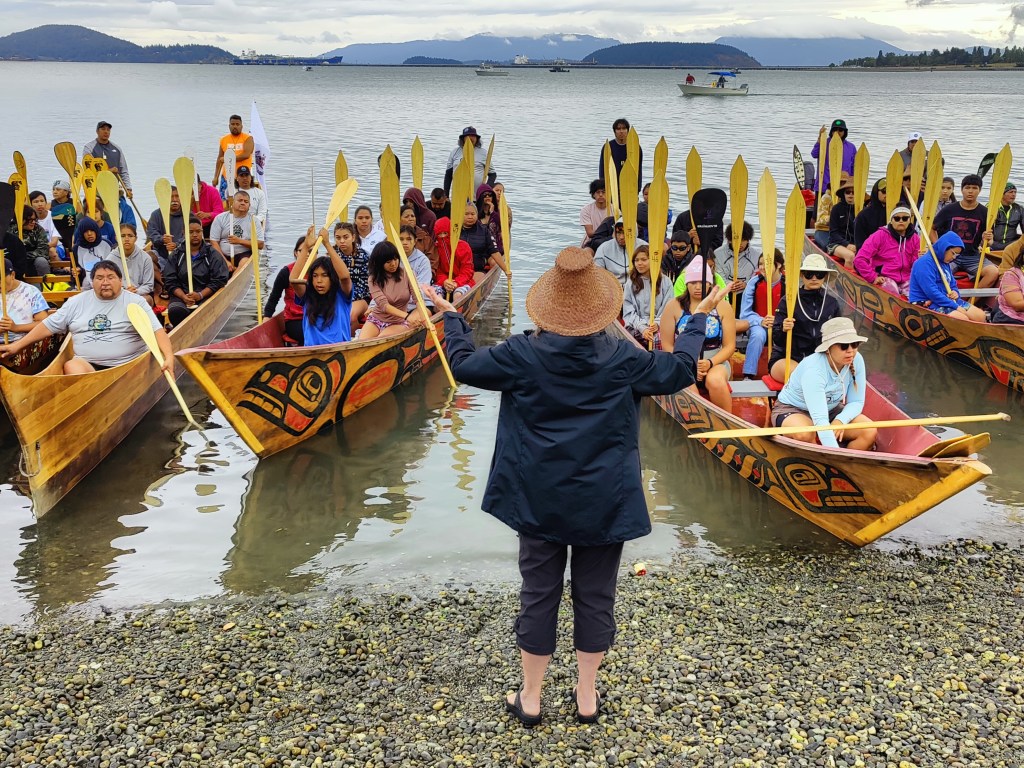
The first annual Canoe Journey took place in 1993, hosted by the Heiltsuk First Nation, and grew to include more than 100 canoes before being derailed in 2020 and 2021 by the COVID-19 pandemic. The Canoe Journey resumed in 2022, with events hosted in the San Juan Islands and in Kettle Falls, Washington.
Charles, who’s commonly known as Hammer, said more than 100 canoes are expected to land on his tribal nation’s shores. A five-day potlatch will follow with dancing, singing, honoring and gifting. Traditional foods, including salmon, clams and Dungeness crab, will be served.
In the potlatch arena in presentations known as protocol, each visiting tribal nation will take the floor and share songs, dances and teachings. Women and men will wear regalia, often featuring intricate beadwork and articles woven of cedar and mountain goat wool; some regalia items are inherited and quite old. They’ll speak in their languages.
“It’s exciting to see how much the Journey has grown since we last hosted 20 years ago,” Charles said. “I think we had 76 or 79 canoes last time, and we’re over 100 this time. People like to come to Lower Elwha for the Journey. We’re known for hosting and for great food, so this is something that we all are working on to make sure that it gets done.”
‘The elders brought it back’
This year’s Journey is the 30th since 1993. Each Canoe Journey is a logistical feat for the host nation; it commonly costs at least $1 million to host, feed and accommodate guests, according to past coordinators. And tribal nations often invest in site improvements that have enduring use.
For its hosting in 2011, the Swinomish Tribe developed a new waterfront park with three pavilions covered by roofs resembling cedar hats. For its hosting in 2013, the Quinault Nation further developed a site on higher ground that is a safe haven during storm events and tsunami warnings. This year, Lower Elwha Klallam prepped 10 acres for the potlatch tent, vendors and parking.
The Canoe Journey also has served a scientific purpose. For several years, canoes – which are non-polluting modes of transportation – carried U.S. Geological Survey equipment that recorded pH levels, turbidity and other conditions in the waters in which they traveled. The USGS used the data to identify areas of environmental concern in the Salish Sea.
The Journey is also a remarkable athletic feat, testing each puller’s physical and mental discipline. Most canoe families travel great distances to get to the host nation, visiting other Indigenous nations along the way. Extreme northern locations include Bella Bella, British Columbia (Heiltsuk First Nation); in the south, Pendleton, Oregon (Umatilla Tribes); in the west, Taholah (Quinault Nation).
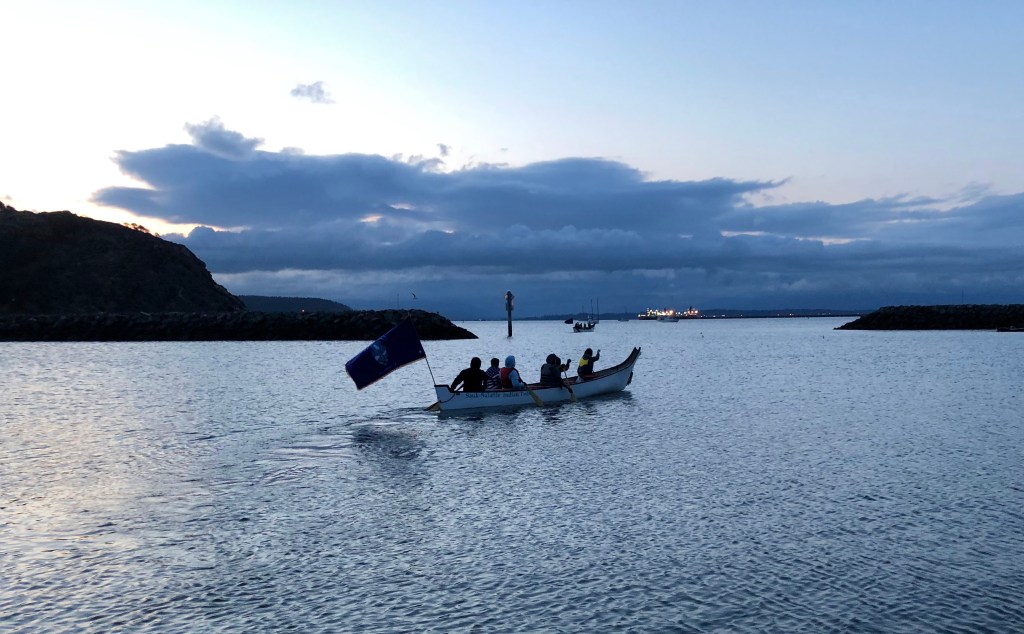
Canoe families train and practice regularly, but the sea can nevertheless be unpredictable.
Jailee James, Swinomish, remembered making a crossing in growing swells off the coast of Lopez Island during a past Canoe Journey. “There were two other canoes with us,” she said. “A wave went up and the skipper of the other canoe was gone” – gone, thankfully, meant out of view until the swell subsided. “It was a crazy day.”
Anabel Baker, Samish, was in the stroke position – setting the pace and rhythm of the paddling stroke for the rest of the crew to follow – during a crossing in heavy swells. “I pushed my paddle down as far as it would go and it didn’t touch the water,” she said. “We’re power pulling and I’m yelling numbers in Samish and paddling the air and hoping that everybody’s following behind me.”
Baker is part of a cultural continuum. Her late grandfather, David Blackinton, was a longtime Samish canoe skipper. His forebears traveled by canoe throughout the region – to and from Xws7ámeshqen (Samish Island), Qweng7qwengila7 (Guemes Island), Séyenglhnelh (Cypress Island), Sx’wálech (Lopez Island), and Xwchsónges (Deception Pass). Now, as he stepped down as skipper, his granddaughter was stepping in as a puller.
“I’m sort of the window between my grandpa skippering and me pulling,” Baker said. “I think it was almost a year or two after he stopped skippering that I started pulling. He’d be there at the landings and he got to see me do that. It was really cool.”
Baker said traveling on the marine highways of her ancestors gives her a glimpse into how her ancestors viewed their world.
“I think that’s one of the most important things – moving from place to place in the same way our ancestors did, seeing things from the perspective of our ancestors, when our ancestors went on travels on the Salish Sea,” Baker said.
“I feel like in the modern day, we don’t see places from that perspective of being on the water, seeing land from water and traveling distance. And it’s a really important perspective that we continue to have, knowing how that travel works and how we see the land from where we are on the water.”
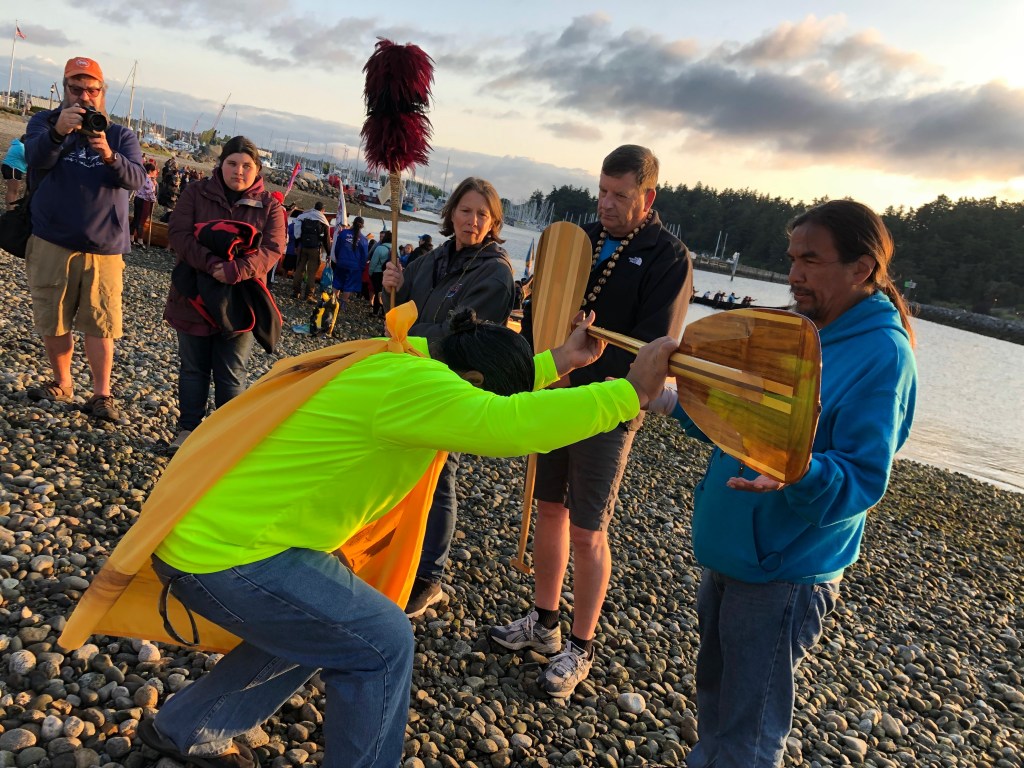
The Canoe Journey, too, is part of the continuum. Tribal nations step forward and offer to host the Journey each year. The Nisqually Tribe, which shares geography with the state capital city of Olympia, will host in 2026.
Charles said he’s grateful he can help carry – and pass on – the teachings.
“Our elders are the ones that had to remember the teachings and bring them back,” he said. “We’ve got to thank our women for being the language keepers. They’re the ones that pretty much kept our language alive.”
He added, “Guys like me who sat down and listened to the teachings – for me to be able to do what I do, it’s all for our ancestors.”

