
Renae D. Ditmer
Special to ICT
Lake Superior Academy was designated a Montessori Green School because of its strong environmental focus when it opened in 2015 in Sault Ste. Marie, Michigan.
Today, 85 students — a third of them from the Sault Tribe of Chippewa Indians — attend the school in an area that, until recently, had been a quiet, picturesque part of Michigan’s Upper Peninsula.
The school, which offers Pre-K through 5th grades, was in many ways nestled in a Walden of educational settings, a hushed, lush, forested presence. All that changed in late February, when the interminable buzzing noise started.
School founders Susie Schlehuber, the school leader, and her husband, Roger, a Sault Tribe member, had little notice. Cloverland Electric Cooperative, the only electricity provider in the Eastern Upper Peninsula, had requested an easement to run an electrical wire through school property for an undisclosed purpose, which the school turned down in 2024.
Somewhere around the end of January 2025, Cloverland invited the school board of directors to an “informational session” where they announced that a “bitcoin operation” was going to be installed on the 10 acres across the road from the school. Within days, the noise started.
Susie Schlehuber told ICT that they got “unusual vibes – all kinds of shady” from the presenters.
She characterized the project as having been “veiled from them from the beginning.” It felt like a betrayal. Labeling the project as a “bitcoin operation” made it sound like it was something that belonged in an office park. In fact, it was a blockchain mining operation with a series of generators with cooling fans that produced up to 78 decibels all day and all night long.
The academy has now filed a lawsuit in Chippewa County Circuit Court, and has drawn support from the Sault Tribe and EUP Solidarity, an activist group that describes itself as a chapter of the progressive Indivisible organization.
The dispute is now left to the legal system. Chippewa County Circuit Court Judge James Lambos has issued a restraining order that has halted operations temporarily, and the parties were unable to reach an agreement in initial discussions in mediation on Friday, Oct. 17.
Protecting Mother Earth
The Sault Tribe stepped in to protect not only its students but also the birds and fish that would be impacted by the noise and heavy anticipated water use, said Robert McCrorie, the Unit 1 representative on the tribal board and the tribe’s point person on the issue.
“The Sault Tribe Board of Directors was unaware of the project until Lake Superior Academy brought it to the tribe’s attention,” McCrorie told ICT.
McCrorie’s initial reaction was to offer a compromise to the owner, described in court documents as Odessa Partners of Florida, so that operations could be moved away from the school. But when he took the proposal to the Sault Tribe board, Chairperson Austin Lowes pointed out that the noise might also disrupt the peninsula’s diverse bird population and that the water usage could change the water temperature, reducing the fish population.
There was even more than that at stake. The tribe’s service area covers seven counties of prime real estate in the Eastern Upper Peninsula that might also be at risk. Tribal leaders have learned that Cloverland was soliciting additional blockchain mining sites to locate in the Eastern Upper Peninsula, which contains some of Michigan’s most precious natural resources and serves as a haven for tourists from all over the world.
The question then became how to fight a project that was considered a “done deal,” McCrorie said. “We essentially chose to use public relations and legal means to fight back,” he said.
The Sault Tribe Board of Directors reacted quickly and unanimously, deciding on July 11 to write a letter to tribal students’ parents to oppose the blockchain mining operation.
“It is my belief that the Tribe has an obligation to protect and defend each Sault Tribe Child’s right to a high quality and uninterrupted education, regardless of where they attend school,” McCrorie wrote in the letter.
“It is also my belief that the Sault Tribe has an inherent duty to protect Mother Earth and the environment,” he said. “The Bitcoin operation poses an immediate disruption to our students’ education as well as potential long-term damage to the surrounding environment and ecosystems; therefore, it is my position that the tribe has grounds to intervene on the school’s behalf to oppose the mining operation.”
Noisy neighbor
Lake Superior Academy filed the lawsuit against Odessa Partners, described in court filings as a foreign corporation based in Florida that owns or operates the cryptocurrency mining operation in Chippewa County.
Odessa Partners is owned by Michael Carbonara of Boca Raton, Florida, who registered the company in Chippewa County. Carbonara is chief executive of Ibanera, LLC, registered in the Bahamas. Carbonara is also associated with Elias Industries, LLC, and Valletta Corporation, LLC.
Ibanera is a financial technology platform that facilitates digital banking, payments, and currency exchange for international business transactions. Carbonara is currently being sued by Deltec Bank in federal court in Florida for alleged theft of $18 million.
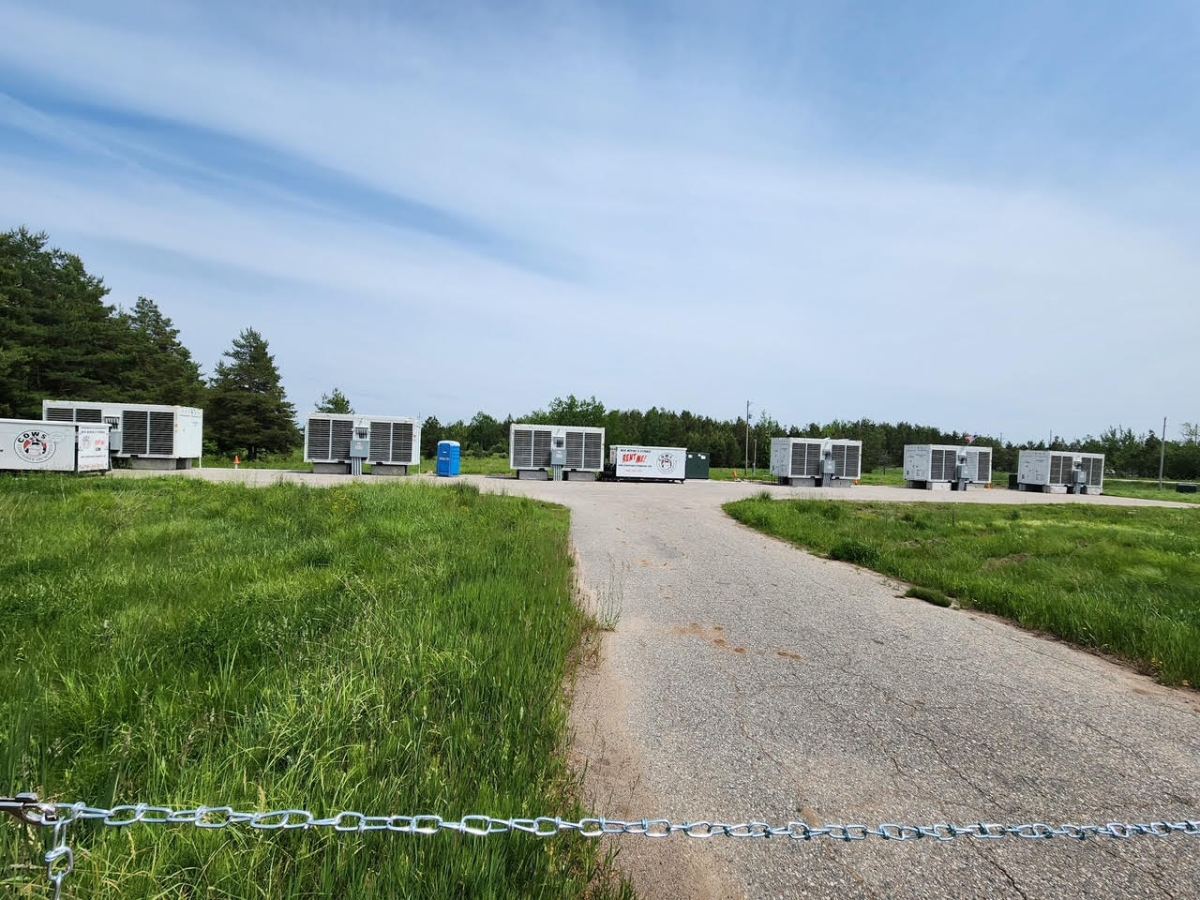
The operation in Chippewa County is not a brokerage office for cryptocurrency, or bitcoins, but rather a so-called blockchain generating operation that consists of six high-powered electrical units and two trailers as close to the property line as legally permitted . The placement near the property line minimizes the distance between the generators and the electrical substation close by.
The generators operate around-the-clock verifying cryptocurrency exchanges. They draw heavy loads of electricity, often driving up prices for other customers in areas where they are located, and they can require significant amounts of water to keep the electronic equipment cool.
And the odd “rent me” signs on the Chippewa County site? They appear to be designed to make the business a legitimate storage facility to meet the township land use policies.
The operations generate a “very loud, constant buzz” that has measured as high as 78 decibels, according to Susie Schlehuber.
According to the Centers for Disease Control and Prevention and the Environmental Protection Agency, operations that produce a noise level that approaches 80 decibels can result in permanent hearing loss over time.
School families were outraged over the noise and reached out to Bob Brown, the supervisor for Dafter Township and zoning coordinator for both Dafter Township and Chippewa County. Susie Schlehuber found him dismissive of their concerns about the noise and the failure to receive a heads up about the project until it was already operational.
School officials and local residents were also surprised to learn that the Cloverland Electric Cooperative already had a blockchain operation on its own property churning out noise there. It is located on South Meno Trail in Sault Ste. Marie, with no owner/operator listed, according to Inside Climate News in an Oct. 10 article.
At the Chippewa County site, the company has since brought in 220 bales of hay to try to mitigate the noise, dropping the levels to about 50 decibels but without removing the constant buzz. The hay bales appear to have already begun to rot, however, and school officials are worried that the heat produced by the generator fans could start a fire in drier weather.
Opponents are skeptical that officials will make good on their recent promises.
Brown never showed up at a special township zoning meeting that drew 100 concerned attendees from the area surrounding the blockchain operation or a “cantankerous” May 2025 meeting. ICT reached out to Brown but he did not respond.
“He told us the one next to the academy was already there and that the company would work with them on mitigating the noise level,” Schlehuber said.
Cloverland directed ICT to review its public statements online.
“As part of our long-term strategy to stabilize rates and manage rising infrastructure costs, we have supported efforts to attract large-load members, including data centers, to our region,” Cloverland said in its July 31 newsletter. “These efforts align with our responsibility to provide equitable service to all members while sustaining financial health for the cooperative. We also recognize the importance of listening to concerns and working together to find community-minded solutions.”
Looking ahead
The temporary restraining order, which expired briefly while the case transferred in and out of federal court, is now in force again, and the operations have been halted.
For now, however, Lake Superior Academy has canceled plans for an expansion to accommodate 40 more students this school year.
And as the case works its way through the legal system, the Sault Tribe and EUP Solidarity are working to make sure the scenario doesn’t repeat itself across Michigan’s Upper Peninsula.
Rumors are circulating that more blockchain operations are being solicited for the Great Lakes area because of cheap electricity and the water supply. Cloverland Electric is running YouTube ads that talk about the cheap land and cheap hydroelectric power available for high energy enterprises.
In the meantime, the school and the tribe have proposed an interim solution that involves lifting the temporary restraining order as long as the company agrees to implement an architecturally engineered way to manage the noise, specifically to keep it below 50 decibels. EUP Solidarity wants the entire project halted.
Unfortunately, neither the township nor the county has a noise limitation policy in place, a gap they are also trying to close.
Update: This article has been updated to note that no agreement was reached in initial mediation talks, and to clarify that EUP Solidarity does not support allowing the operation to continue with further noise mitigation. The organization wants the projects halted.

