

Dan Ninham
Special to ICT
WINONA, Minnesota — A couch with a Dyani White Hawk blanket welcomes visitors to the Minnesota Marine Art Museum’s show of Indigenous artists, “Once Upon a Shore.”
A Jonathan Thunder illustration from the book, “Bow Wow Pow Wow,” hangs on the wall above the sofa. A collection of books by Indigenous authors on the coffee table includes “Songs, Blood Deep” and “Follow the Blackbirds,” by Gwen Westerman; “Mni Sota Makoce: The Land of the Dakota,” by Westerman and Bruce White; and “Native Love Jams,” by Tashia Hart.
It’s an unusual introduction to an art exhibit, but curator Heid E. Erdrich, Turtle Mountain Band of Chippewa, says there’s a reason she installed lounges at the exhibition and at prior exhibitions, “Boundless,” at the Mead Art Museum at Amherst College.
“My reason for having couches in ’Once Upon a Shore’ and ’Boundless’ [with] the reading room and reading areas, [that] was my way of inviting guests to yes, rest, and more importantly, to read,” Erdrich told ICT.
It’s a vision she shares with other Indigenous artists such as White Hawk, Sičáŋǧu Lakota, who has an ongoing solo show, “Dyani White Hawk: Love Language,” at the Walker Art Center in Minneapolis.
“It might help to know that often my Indian art colleagues, which includes Dyani White Hawk, but starts with the late Jim Denomie, and most closely with Andrea Carlson and Rosy Simas, are engaged in ‘interventions’ that demand institutional spaces be more open to guests who don’t usually enter them,” Erdrich said.
“Creating an installation that is inviting to all includes making the space familiar, comfortable and accessible,” said Erdrich. “Dyani has done a tremendous job in this manner.”
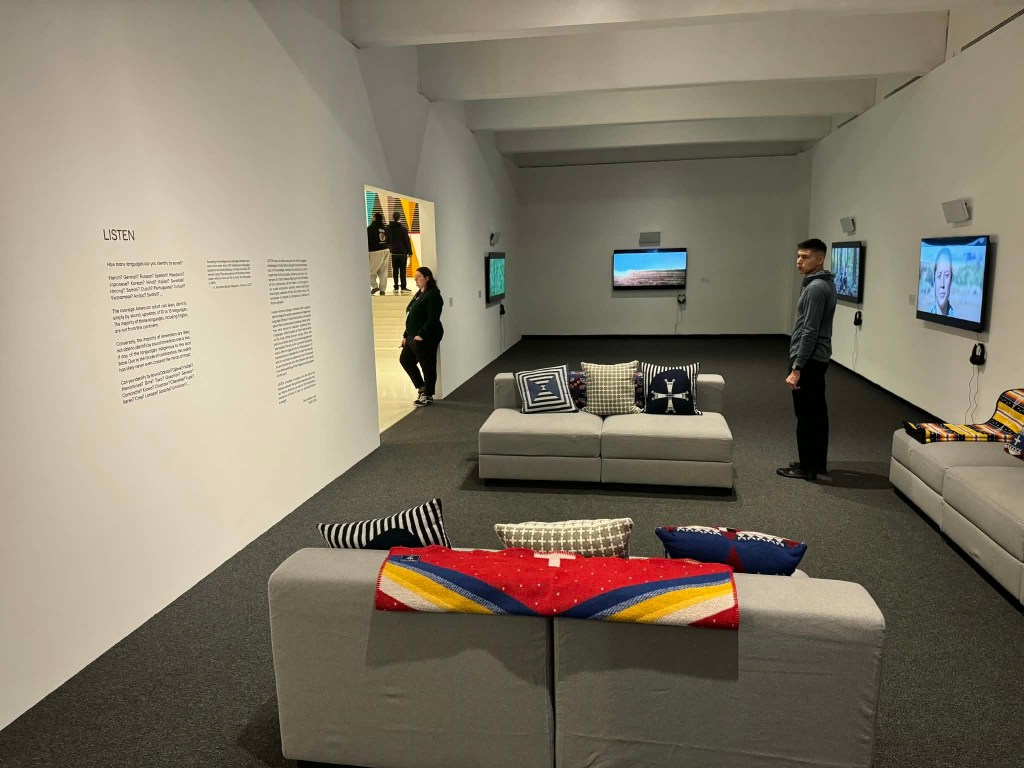
The lounge areas were planned independently by Erdrich and White Hawk. Although the art galleries are only 118 miles apart and the exhibitions are being held at the same time, the curators say they didn’t influence each other to provide lounge areas.
“My choices on the seating throughout the exhibition were a comprehensive effort to ensuring that the Native community, and each and every visitor to the exhibition, feels welcomed and our humanity supported,” White Hawk told ICT.
“Considering the past harmful events that created fissures between the Native community and the Walker, it was very important to me that our community felt honored, warmly welcomed, and comfortable in the galleries,” White Hawk said.
“Once Upon a Shore” opened in January 2025 and runs through Jan. 4, 2026. The Dyani White Hawk exhibit runs through Feb. 15, 2026.
‘Once Upon a Shore’
“Once Upon a Shore’ features five multidisciplinary Dakota and Ojibwe artists, who share common themes among their work, including a strong relationship with bodies of water. They’re also storytellers.
The artists and authors featured in the exhibit are Tashia Hart, Red Lake Ojibwe; Courtney M. Leonard, Shinnecock Nation; Cole Redhorse Taylor, Prairie Island Indian Community/MdewakantunwanDakota; Jonathan Thunder, Red Lake Ojibwe; and Gwen Westerman, Sisseton Wahpeton Dakota/Cherokee Nation of Oklahoma.

According to the museum website, the exhibition is “a water’s edge meeting place where authors, illustrators, artists, and guests converge to share stories. From the pre-history of Dakota country, to dogs headed to the powwow, this exhibition tells stories for visitors of all ages from an Indigenous perspective.”
The exhibit includes a range of storytelling.
“I wanted there to be audio so people could listen to a story. I wanted there to be children’s age works and the books there for them to sit down on a couch and snuggle up with a book,” Erdrich told Minnesota Native News in a recent radio broadcast.
“The collaboration as a curator is often to be able to represent people the way they want to be represented, to listen to them and make sure the show shows them in the light that their work was meant to be seen,” she said.
Hart, for example, used a video short in her installation. Her 2024 work, “Clay Woman Falls in Love with the Lake,” exemplified the medium use of a video short in the exhibition.
“That inspiration for ’Clay Woman Falls in Love with the Lake’ came from living on the shore, going through all the emotions of what it’s like to … be a human being and … take in the energy and the sights and the life that is on the shore there,” Hart told Minnesota Native News.
The exhibition also includes books. “The Good Berry Cookbook,” 2021, written by and with photos by Hart, sits on a shelf, as do “Gidjie and the Wolves,” written and illustrated by Hart, and ”Native Love Jams,” a story by Hart with cover art by Jonathan Thunder.
The children’s bilingual book, in Ojibwe and English, ”Bow Wow Pow Wow,” a 2018 book from the Minnesota Historical Society Press, also sits on a shelf. The illustrations are from Thunder, the text was written by Brenda Childs, Red Lake Ojibwe, and it was translated by Gordon Jourdain, Lac La Croix Ojibwe.
“The Lighthouse,” a 2021 work by Thunder, is a video animation of an original painting that is displayed on a wall. Thunder addressed the painting in an Instagram post on July 6, 2021.
“The 2021 painting ’The Lighthouse’ has its historical precedent in the well-known 19th century painting, ‘Washington Crossing the Delaware’ by Emanuel Leutze. An all-black-white-gray painting, the occupants of the boat are misled by a leader resembling the Hamburglar, Marvin the Martian, and other Looney-esque characters trying to make their way; only a lone woman with child notices the lighthouse in the opposite direction from which they are going,” he wrote.

Erdrich addresses the need for a new approach to exhibits in her most recent book, “Boundless: Native American Abundance in Art and Literature,” co-edited with Lisa A. Crossman and published by Amherst College Press in 2025. The book was inspired by two exhibitions that Erdrich curated at Amherst’s Mead Art Museum.
“I am a poet, and many of my projects start with an image, so I have learned to pay attention when one comes,” Erdrich writes in a chapter in ”Boundless.”
In addition to the reading area with the sofa and coffee table, “Once Upon a Shore” includes additional reading areas. One in the next room feature an Ojibwe floral-designed throw on a couch next to a coffee table, with exhibition-represented literary works on top of it. A Cole Redhorse Taylor ledger illustration hangs on the way above the couch.
‘Dyani White Hawk: Love Language’
Rooted in intergenerational knowledge, White Hawk’s art centers on connection — between one another, past and present, earth and sky, according to the institution’s press release.
By foregrounding Lakota forms and motifs, she challenges prevailing histories and practices surrounding abstract art. Featuring multimedia paintings, sculpture, video, and more, ”Love Language” gathers 15 years of the artist’s work in this major survey.
The galleries are transformed into a communal space with blankets and cushions designed by White Hawk, and Indigenous-focused resources, inviting deep engagement with her work, that centers Lakota culture, challenges art history, and fosters connection through themes like “See, Honor, Nurture, Celebrate,” offering respite and critical reflection on Indigenous presence and history.
The multichannel video installation ”LISTEN” (2020–ongoing) features contemporary Indigenous women speaking in their Native languages on their homelands.
The lounge areas are so significant that the following notice is located on the exhibition webpage announcement: ”Visitors are encouraged to engage with ’Love Language’ as a community space. The galleries offer lounging areas with interpretive materials, educational resources, and cushions and blankets designed by the artist.’”
The purpose is to create a welcoming, nurturing environment and promote compassionate understanding. Visitors can hear conversations in Indigenous languages with listening areas in the lounge areas.

In 2017, the Walker Art Center had a controversial large installation by Sam Durant, “Scaffold,” with wooden gallows depicting where the Dakota 38 were hanged in nearby Mankato, Minnesota. Then-President Abraham Lincoln, soon after he signed the Emancipation Proclamation, ordered the largest mass execution on U.S. soil, of 38 Dakota men. The structure was eventually torn down by Dakota people.
Erdrich and White Hawk built on a trend that had already arrived. They used digital projections and audio on the walls as well as in the lounge spaces to connect with the artwork. The immersive technologies included blending physical art with digital innovation to focus on cultural engagement. This was a shift from passive viewing to active participation through interactive and multimedia elements.
It’s an approach endorsed by the design industry. Studio Caramel maintains that furniture design and spatial design are not isolated disciplines. They use ergonomics, the science of designing furniture that complements the human body’s natural movements and postures, promoting comfort and preventing strain.
“Architects and interior designers must see furniture as an integral part of their overall vision, considering how pieces communicate with the architecture, the space’s flow, and the visual narrative of the environment,” according to the Studio Caramel website. “This holistic approach ensures that furniture and space are in dialogue, creating cohesive and immersive experiences.”
White Hawk said the lounges were designed with visitors in mind.
“We designed the benches to accommodate elders,” said White Hawk. “They are a height that our elders can comfortably sit down and get back up from. The cushions are intentional. There are arm rests for this reason on many of them as well.”
She continued, “We wanted the exhibition to signal that you can be there, you can spend time, you can rest and visit. The blankets and pillow throughout [the gallery] further this messaging. The beanbag chairs in the ‘RELATIVE’ video room extend this offering, really encouraging people to get comfortable and stay, and especially for kids as well.”
The table and wall shelves include reading material from White Hawk and other Indigenous authors. The interactive head sets allow visitors to view White Hawk’s “Between Worlds” Art21 video.

“The show is big,” White Hawk said. “There is a lot of content to take in. Having moments throughout the exhibition when one can rest and reset is important to me.”
Throughout the galleries, Native elders, artists, and scholars share their perspectives on White Hawk’s work in a series of audio and video recordings. Videos of the featured speakers are paired with each section of the exhibition. QR codes on artwork labels are scanned to allow visitors to access the free digital guide on Bloomberg Connects. The language is also important to the exhibit.
“The T-shirts that greet people in L/Dakota, staff trained on how to greet people in Dakota, and how to pronounce Lakota titles, it was all intentional in centering our people and culture in a space that is both our homelands, but also has carried a history of harm,” White Hawk said.
“All of it collectively, the programming as well, educational outreach etc., is an act of agency, reclamation, and meant to be a collective love letter to our communities and all who visit,” White Hawk said. “The technology that supports the installation of ‘LISTEN’ is important in communicating the concept of the work, and the ability to share the variety of Native languages with visitors.”
The trend in other public spaces, however, is not to have seating, including in grocery stores and shopping malls, perhaps to keep people moving and not congregating.
“The whole exhibition, from the intention of the work, to the content bringing in the voices of our relatives, to the exhibition design, the station at the end where you can sit and watch videos or draw and write about your experiences, is all meant to be nurturing for all visitors,” White Hawk said.
Correction: This article has been updated to clarify that the blanket on display in the lounge area of the art exhibition, “Once Upon a Shore,” at the Minnesota Marine Art Museum, is by artist Dyani White Hawk, Sičáŋǧu Lakota. The information was incorrect in an earlier version of the story.

