This story was originally published by South Dakota Searchlight.
John Hult
South Dakota Searchlight
South Dakota officials should talk to tribal leaders more often, but lawmakers aren’t prepared to make them.
That was the message from two bills — one that passed, one that didn’t — considered Feb. 9 in Pierre by the House of Representatives’ State Affairs Committee.
The winning proposal, House Bill 1232, is a policy statement that says South Dakota “recognizes” the importance of accountability, cooperation, collaboration, and early and regular communication with tribes when its state agencies develop or administer programs “that have the potential of affecting tribal members.” The agencies should also understand and respect tribal sovereignty, the legislation says, and “the government-to-government relationship between the state and each tribe.”
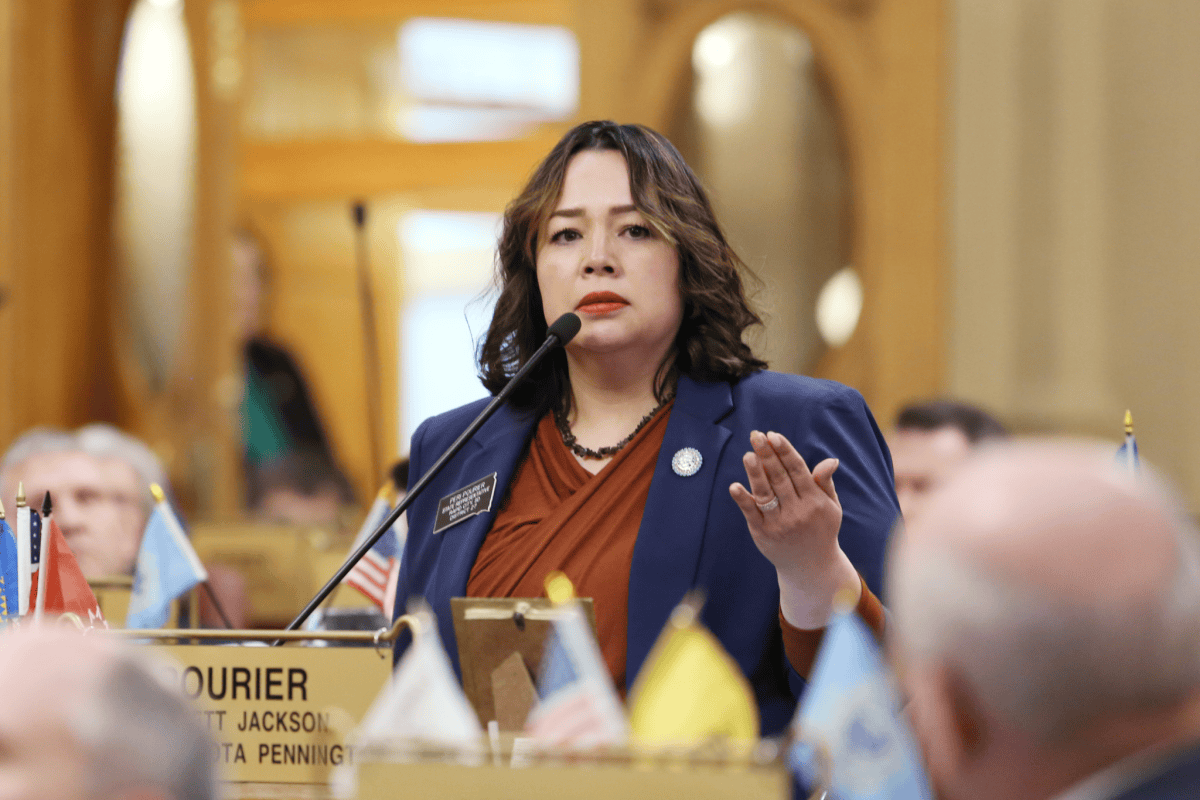
The bill came from Rapid City Republican Rep. Peri Pourier, a citizen of the Oglala Sioux Tribe.
Some of her bill’s language, such as its requirement that state agencies document their consideration of its principles, was removed before its passage on a 12-0 vote.
Initially, the bill said agencies “shall recognize” the principles.
“We wanted these to be guiding principles and not necessarily be construed as some sort of mandate that could potentially spin up litigation,” said Jon Hansen, R-Dell Rapids.
The committee first heard the bill earlier, but held back its vote until Monday, Feb. 9. Pourier thanked Hansen for “helping me find the language that we would hope that the state would agree to.”
A ‘no’ to mandated meetings
Shortly after passing the Pourier bill, the committee took up House Bill 1190.
Its sponsor, Rosebud tribal citizen and Democratic Rep. Eric Emery, wanted committee members to endorse the creation of a South Dakota tribal consultation commission that would meet four times each year.
The Legislature has a State-Tribal Relations Committee, Emery said, but its scope and membership are limited. Under his proposal, the new commission would include the governor or a representative of the governor, the secretary of the Department of Tribal Relations or a designee, a representative from each of the nine tribes in South Dakota and members of the state House of Representatives and Senate.
Regular meetings, Emery said, would benefit citizens on and off tribal land in South Dakota.
“When the tribes succeed, the state succeeds as well,” Emery said. “And that’s the whole intention of this piece of legislation.”
Emery’s bill had support, through testimony, from the Oglala Sioux Tribe, Rosebud Sioux Tribe and Sisseton-Wahpeton Oyate.
Kevin Killer, a former lawmaker and citizen of the Oglala Sioux Tribe, said similar conversations about ways to improve relations between the state and tribes through regular meetings were taking place when he was first elected as a state lawmaker in 2008.
“It’s almost 20 years where we’ve been asking for a place to have this kind of conversation,” Killer said.
Algin Young, a citizen of the Oglala Sioux Tribe and current secretary for the state Department of Tribal Relations, testified against the bill. Gov. Larry Rhoden “has said publicly” that he’s willing to meet with any tribal leaders on any issue as needed, and Young said that fluid, open lines of communication are the best way to address tribal issues.
“The truth is you can’t legislate relationships,” Young said.
Emery, in his initial remarks and rebuttal, said he’s been pleased with Rhoden’s efforts to improve relations with tribes since his ascent to governor last year when former Gov. Kristi Noem left to lead the U.S. Department of Homeland Security.
Even so, he said, the lack of a formal structure for consultation leaves relations open to change with each gubernatorial administration.
Rep. Marty Overweg, R-New Holland, wanted to know why the bill would mandate four meetings a year.
“That sounds very extensive, and a lot of meetings,” he said.
Emery replied that the idea was to ensure one meeting per quarter.
Rep. Leslie Heinemann, R-Flandreau, said he’s been impressed with the policies proposed this year by the State-Tribal Relations Committee and that “we should let that have a chance to work.”
The bill failed on an 8-4 vote. One of its supporters was Spearfish Rep. Scott Odenbach who, like Emery, serves on the State-Tribal Relations Committee. Odenbach referenced one of that group’s meetings last year, where citizens of the Standing Rock Sioux Tribe pointed out that North Dakota has a formal, quarterly meeting structure similar to what Emery’s bill proposes. Tribal members said South Dakota could learn something from North Dakota’s approach.
Regular meetings seemed to improve relations for that state, said Odenbach, who said he’s seen little improvement here.
“My whole political career, the conversations just end with people throwing up our hands,” Odenbach said.
Information sharing approved
A third bill dealing with collaboration between state and tribal agencies, House Bill 1175, cleared the House Judiciary Committee later that morning.
That bill also came from Pourier, who called it a “cleanup” bill. It amends current statute, which directs the state Division of Criminal Investigation to furnish national criminal background check information to the Sisseton-Wahpeton Oyate upon request for a person applying to work for the tribe or hold positions on tribal committees or commissions.
“What I am proposing is that instead of just one tribe, we open it up to any tribe,” Pourier said.
Rep. Matt Roby, R-Watertown, wanted to know why current law only mentions one tribe.
Pourier said she’s not certain, but that new federal background check requirements came into effect in the 1990s, and that the Sisseton-Wahpeton Oyate have “always had a mutual benefit and great relationship with the state.” She assumed the law was meant to help the tribe with “compliance issues.”
Rep. Will Mortenson, R-Fort Pierre, said his research into the current law suggested that the tribe was engaged in setting up a commercial enterprise at the time of its passage, in 1998.
“I don’t know what sort of commerce they were trying to do, but the DCI had the ability to get background checks done for those that maybe they needed that,” Mortenson said.
Every member of the committee present on Monday morning voted to support the bill.