Sandra Hale Schulman
Special to ICT
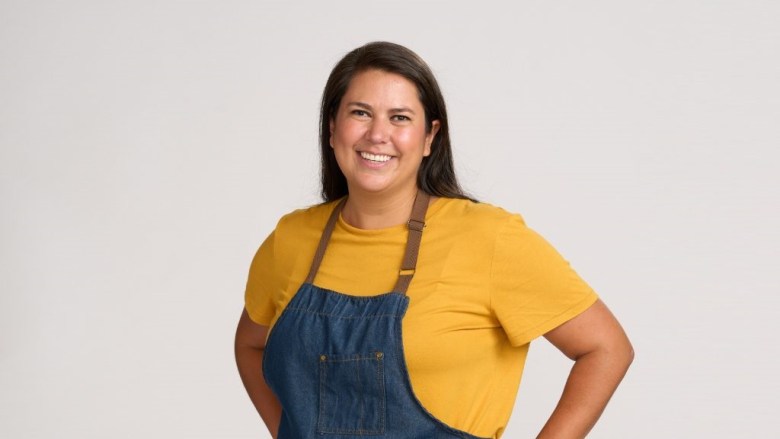
Growing up in her ancestral homelands on Lake Coeur d’Alene, Maria Givens saw and tasted the important foods in her community.
She learned first through her father, a lawyer fighting for the ownership of the Coeur d’Alene lake as a means of food production for the reservation. And then fishing for salmon and picking berries with her mother in the Idaho mountains.
SUPPORT INDIGENOUS JOURNALISM. CONTRIBUTE TODAY.
Now, years later, she will be competing on PBS against eight other talented home cooks in Season 2 of “The Great American Recipe,” a competition that celebrates the multiculturalism that makes American food vibrant and unique.
Hosted by Alejandra Ramos, each episode challenges the cooks to showcase two of their signature dishes as they compete to win the national search for “The Great American Recipe.” The season premieres on Monday, June 19, and runs each Monday through Aug. 7.

Givens will be facing other chefs with varied backgrounds — Guyanese, Greek, Libyan, Lithuanian, Caribbean, Midwestern, and traditional Hawaiian.
“I’ve been cooking since I was probably 10 years old,” Givens told ICT via Zoom recently. “We’re a busy family of four and learning how to cook was just part of the gig. I’ve just fallen in love with cooking. I love cooking, cooking for my friends, my family. There’s so much to learn and so much to create when you’re cooking. That’s where it started.”
Salmon for the soul
In college, Maria chose the close-to-home degrees in political science and American Indian studies at the University of Washington. She then went to Washington, D.C., to work on salmon legislation in the U.S. Senate and then the Native Farm Bill Coalition with the National Congress of the American Indian.
That’s when it all came into focus, she said.
“It was there where I realized,” she said, “all these things that I really care about are connected through food —environment, economic development, just cooking and culture and hanging out with people could all be connected through food.”
That’s when she decided to get a master’s degree in the environment and sustainable food systems from the University of Colorado at Boulder.
“That opened up this whole big world of food and food systems and I have fallen in love with it,” she said.
Salmon has been the central food element in her political work as well as her culture and personal life.
“I’m Coeur d’Alene, and so salmon is part of our culture,” she said. “We’re salmon people and salmon is what we would always have. If I was feeling a little bit sick, my mom would say, ‘Here, have some salmon.’
“Whenever I’m feeling down in one way or another, salmon can get me out of it,” she continued. “I cook it on the show, and it was interesting because the way that we cook it at Coeur d’Alene is very — I guess some people would call it plain— but it’s just respecting the food as it is.”
There is also a deeper element to the fish in her culture.
“I was always taught that the salmon, if you are eating the food, the animal chose you, and chose you to have its nutrients and you have to respect it by not putting a ton of brown sugar on it or something like that,” she said.
She said her cooking techniques follow traditional ways – with some semi-modern twists.
“So, Coeur d’Alene, we usually cook it over a wood fire, basically taking the filet and sticking a big stick down the middle and a few sticks on the side and then just leaning it up against a big fire to cook it,” she said. “Sometimes people get inventive and cook it over bed springs. That’s what my family did at my parents’ wedding, was cook it over bed springs. Actual bed springs from a stripped-down box spring. You can cook a whole lot of salmon on a king-size bed!”
As a condiment, she uses another food she learned to make from her childhood.
“I grew up going huckleberry picking every summer with my family and that’s one of my favorite times of the year,” she said. “You totally unplug, you’re totally out of service and you’re just present there with the huckleberries, and you get into a Zen state of just picking, and then your hands turn all purple.”
Then they make jam for the winter.
“It might be the middle of December, with three feet of snow on the ground, and you get to have some huckleberry jam with your oatmeal or toast,” she said. “It’s so nice. That just brings you back to those hot August days when you’re picking.”
Given said there are ways to make the sauce.
“You can do it any kind of way,” she said. “On the show, they had frozen huckleberries and I used the frozen huckleberries and mixed it in with some maple syrup and some brown butter and made almost a caramel out of it. That was a fun one, and I’m experimenting more with that sauce. You can put it on a cheesecake or serve it with meat.”
Indigenous roots
How Givens got on the “Great American Recipe” show is a cyberspace story.
“I’ve had a food Instagram called ‘Native Soul Food’ for the last five or six years,” she said, “where I share some photos of the food that I’m cooking and somewhere buried deep in my DMs there was a message from a casting agent from Los Angeles.”
She continued, “They couldn’t really tell me what the show was or anything, but they said, ‘Are you interested in being on TV and cooking Native foods?’ And I said, ‘Yeah, sure. That sounds great.’ Then after a bunch of rounds, I finally found out what that show was on PBS and that I’d be heading to Virginia for a month to go cook.”
She says the experience was eye-opening.
“I think meeting the other folks on the show was the most exciting part,” she said. “We all got super close in the bus on the way to the set, and there’s a whole lot of downtime when you’re shooting a TV show. The judges have time where it’s only them on camera and we can’t be there, so we’re hanging out in our little room or we’re waiting for the cameras to get set up. We really got to know each other. We were just hanging out for hours on end.”
They formed a bond, she said.
“They are definitely some of my closest friends now, because we all have this common thing, food, and that everyone is such a good cook and everyone improved during the course of the show,” she said. “It was a competition, but everyone was rooting for each other and that was one of the best parts of it. We shared tips like, ‘Ddon’t forget to salt the food or to cut your things in this way.’ We were all trying to help each other out.”
Until the show airs, she is back to her real life, working for Tahoma Peak Solutions a Native woman-owned consulting firm that works on strategic communications.
“I really love my day job,” she said.
Givens is sworn to secrecy about the outcome of the show, as the winner will be announced in the final episode. But she is excited about sharing her culture and food.
“I know that the primary audience isn’t going to be Native people or Indigenous people,” she said. ”I wanted to educate throughout the show and let them know that so many of these foods that they love actually have Indigenous roots, like corn and salmon and squash and beans and all of those types of foods have an Indigenous root here, because of Indigenous people.”

Our stories are worth telling. Our stories are worth sharing. Our stories are worth your support. Contribute $5 or $10 today to help ICT carry out its critical mission. Sign up for ICT’s free newsletter.