
Felix Clary
ICT + Tulsa World
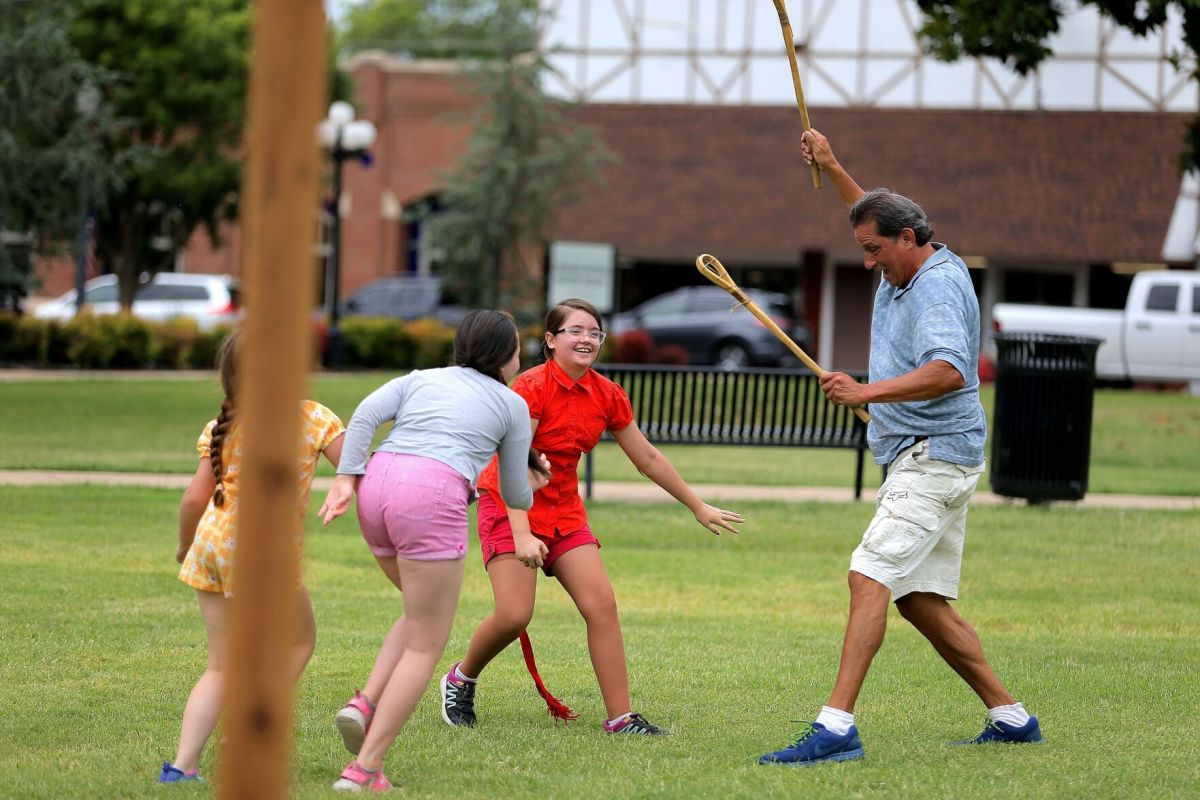
July 5 marked the second First Friday Traditional Games Day of the year for the Cherokee Nation, where Cherokee citizens and other community members were taught to play stickball and traditional games at the Cherokee National History Museum in Tahlequah.
The first game day was held in June, and one more will be held in August.
JP Johnson, a Cherokee language teacher and stickball player, said he wants stickball to be a “gateway drug” into Cherokee culture. If a young person falls in love with the game, Johnson said they might fall in love with the ceremonies and traditions that surround it.
“I want them to be hooked on their identity. I don’t want there to be missing links to who we were. I hate saying, ‘We used to do this or that.’ Why is it ‘used to?’ We shouldn’t have to say that anymore. The government is not breathing down our necks with dances and ceremonies. We have religious freedom to do what our ancestors did,” Johnson said in an ICT and Tulsa World interview.
After 20 years of trying to get Cherokee citizens interested, Johnson revitalized the traditional Cherokee style of stickball in which no other tribal teams in Oklahoma participate.
Johnson started the first Cherokee-style stickball team in the state. His team spent the beginning of October in their homelands in North Carolina, playing against four brutal stickball teams from the Eastern Band of Cherokee Indians.
They played one game a day for four days. They fasted the night before each game and held ceremonial singing and stomp dances by water each night before the game. Moments before, the teams engaged in ceremonial scratching of the limbs and torso with animal bones or thorns to purify the skin. The wounds are washed with medicinal tea, and the players are cleansed with the smoke of tobacco. Scratching not only is meant to purify the players and keep them safe on the field, but it gets the adrenaline pumping.
This was the first of another annual tradition for the Cherokee Nation in Oklahoma.
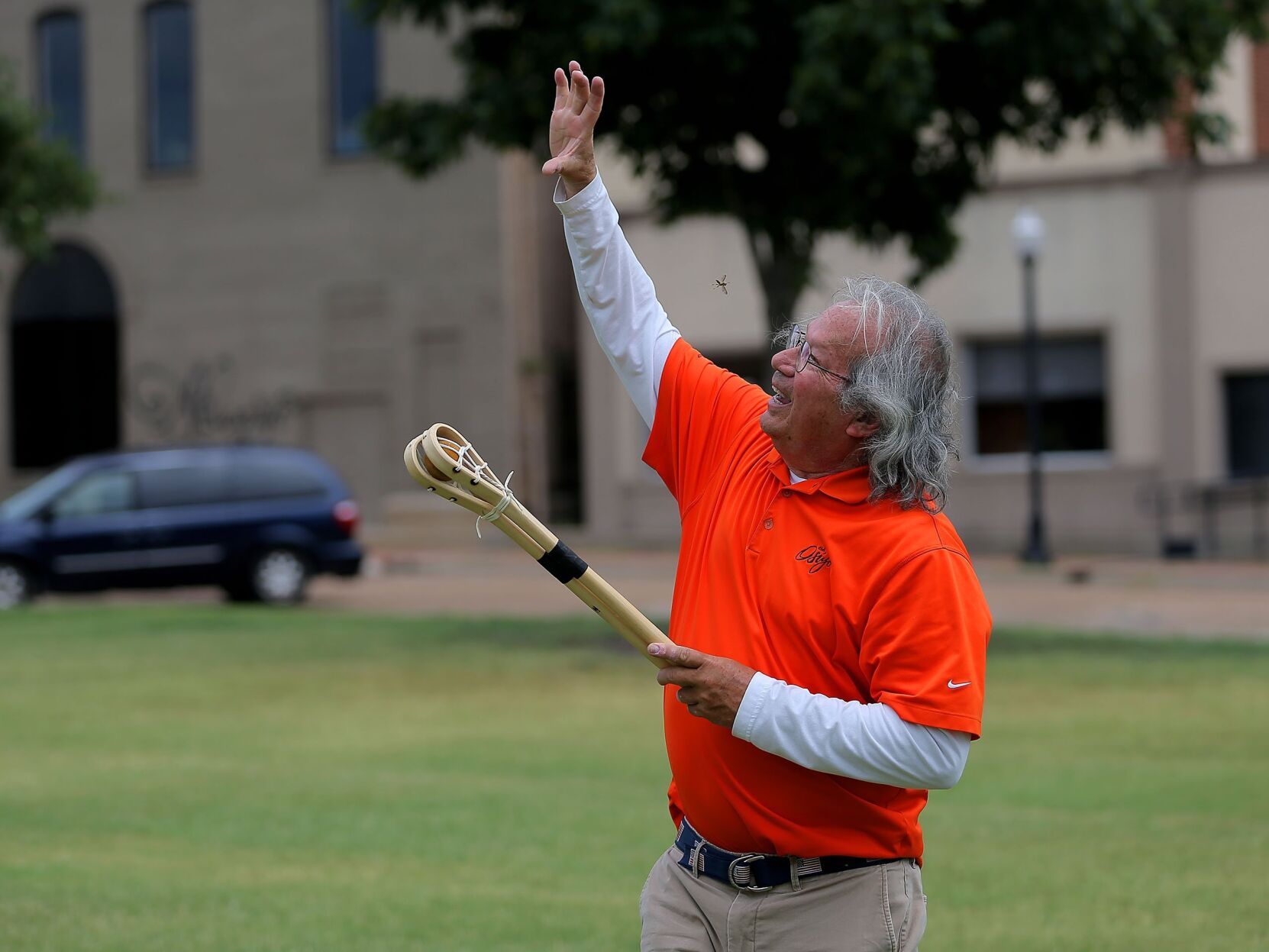
Johnson said that at First Friday game days, attendees have the option to watch or participate in stickball, and multiple styles of the game may be taught at the events.
“In Oklahoma, there are five ball games that exist: Cherokee, Muskogee, East-West, Choctaw and the social game,” Johnson said.
East-West is played by the Chickasaws, which Johnson said is a little less violent than the Cherokee style, but more similar to it than Choctaw style.
The social game is men versus women, with one single pole in the center. Women get to use their hands to throw the ball and aren’t limited to throwing it with sticks like the men are. Sometimes a social game consists of a simple shootout, which is an offshoot of the Choctaw game, where there is one pole in the center of the field, and two people with sticks throw the ball at the pole trying to outscore the other person.
The Choctaw style is the most common in Oklahoma.
“It’s the most like a regular sporting event. They have four 15-minute, timed quarters,” Johnson said. “They play with a single 12-foot wooden pole at each end of the field to score points on. The Cherokee style of the game is played with saplings at each end of the field, and you have to run the ball through to score points.”
Johnson said that the Choctaw version has a lengthy rule book.
“You can’t tackle someone that doesn’t have the ball. You’re supposed to throw your sticks down before you tackle, no late or early hits, only when they are holding the ball can you tackle them. The Cherokee game isn’t like that,” he said.
Choctaw style is also secular, meaning no ceremonies or dances are held beforehand.
There are two Cherokee words for stickball that Johnson mentioned. The first one is “anetsodi,” which means “to wrestle.”
“I don’t have to get up and leave a player. I can hold him to the ground as long as I need to and wrestle him in order to benefit my team,” said Johnson.
The other word for stickball is “usdi danawa.” “Danawa” means “war,” and “usdi” means “little.” Stickball was traditionally considered a “little war,” or sometimes referred to as, “the little brother of war.”
The game was not traditionally used for entertainment. It was used to settle disputes between groups or tribes that were disagreeing over land ownership, or some other conflict. This is why the ceremonial dances and scratching were held before a game, because it was considered a battle.
“The game was maintained for a long time by the Eastern Band of Cherokee Indians in North Carolina,” Johnson said. “But we lost it in 1911 in Oklahoma. So it didn’t exist here until recently. This game is rougher. You cannot wear shirts, shoes or extra protective gear like gloves. It’s basically our mixed martial arts.”
He said it is used to train young men to be warriors. “Back then, it was not unheard of to have a death on the field, and so these days, major injuries happen on a semi-regular basis.”
For this reason, Johnson said, it took decades for him to get Cherokee men interested in the game, as it is scary to even witness. “But it has a beauty to it that you can’t really explain unless you play it. When you do, you understand what a young man might get out of it.”
He said it would not have been uncommon for transgender men to play in this man-to-man sport, as the Cherokee people pre-colonization did not define gender by the shape of someone’s body. Allowing Two-Spirit and trans men in the game again is another long-term goal that Johnson has.
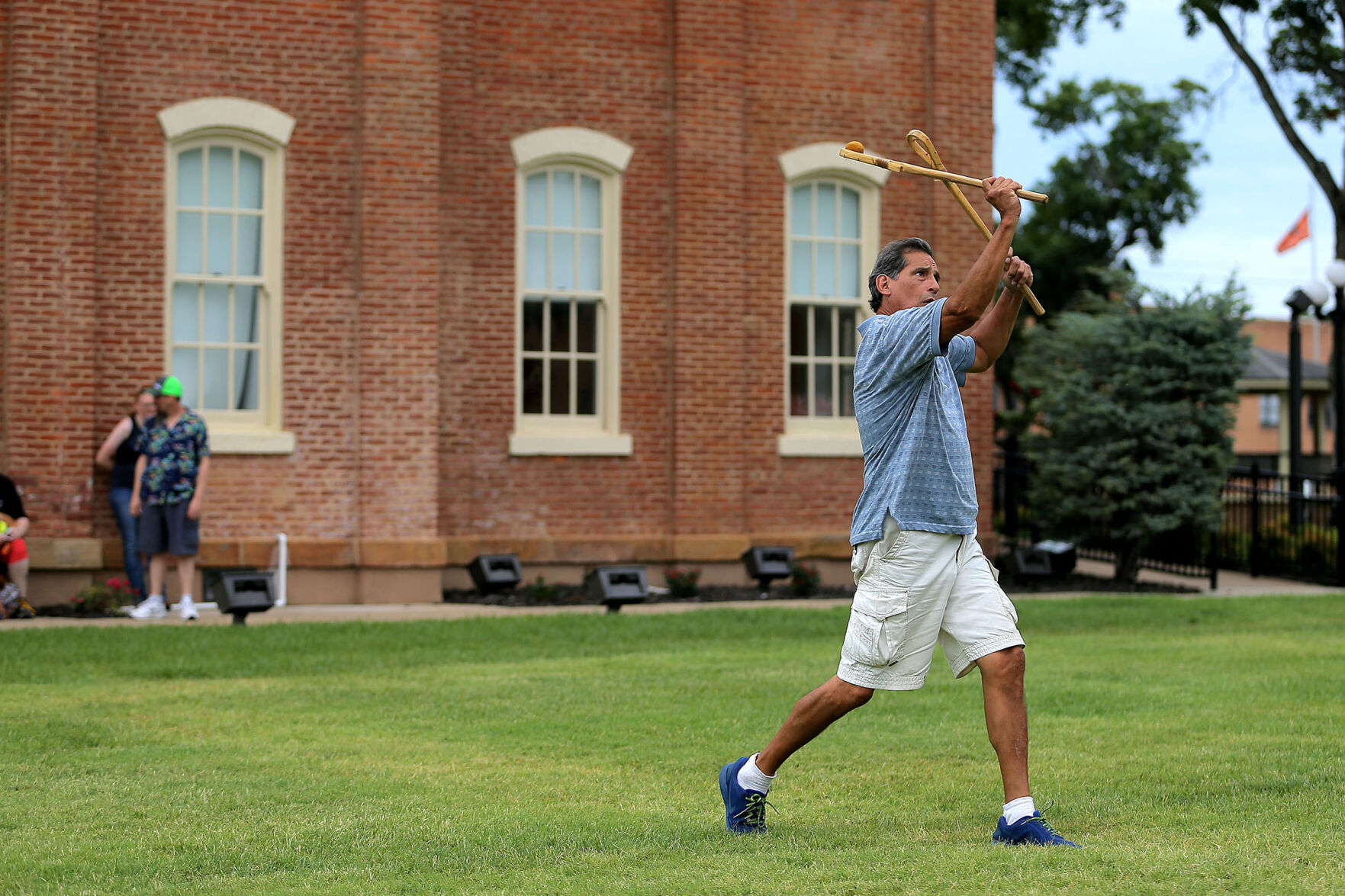
The Cherokee Nation in Oklahoma has three community teams now. The team that Johnson plays for is called “Wudeligv,” which means “West.” They also have a teenager team and a little boys team. Altogether, the teams consist of 50 players total.
“I’m trying to hold to our traditions instead of substituting somebody else’s. To me, it’s acculturation if people pass off the Choctaw game as a Cherokee game. I’m kind of a Cherokee purist,” Johnson said.
Johnson hopes the First Friday game days will inspire young men and women to get involved in not only stickball and traditional games, but Cherokee culture in general.
This style of stickball that Johnson has revitalized is inspired by one of his favorite elders who passed away recently named Bossy Cummings.
“He was a Vietnam veteran who escaped from a tiger’s cage, a legit tough guy. When he passed away, I told him that I wanted to build a team, and I did,” said Johnson.
“Every team that we went up against last year were very well-established, tough, tough, mean guys. They were rough, but we did not waiver or back down, even though we knew we wouldn’t win. It was historical. The guys we played against would smash us, but then gave us a hand to lift us back up. And after the game, we would hug, because it was the real deal. It was one of the most profound games I can remember.”

This story is co-published by the Tulsa World and ICT, a news partnership that covers Indigenous communities in the Oklahoma area.
Our stories are worth telling. Our stories are worth sharing. Our stories are worth your support. Contribute $5 or $10 today to help ICT carry out its critical mission. Sign up for ICT’s free newsletter.

