
Amelia Schafer
ICT + Rapid City Journal
Leonard Peltier was released from a four-day hospital stay on Monday, July 16. The Anishinaabe elder’s diabetes has caused him to develop open wounds and tissue death on his toes and feet.
Currently, there is no exact diagnosis for what is affecting Leonard, said Peltier’s lead attorney Jenipher Jones.
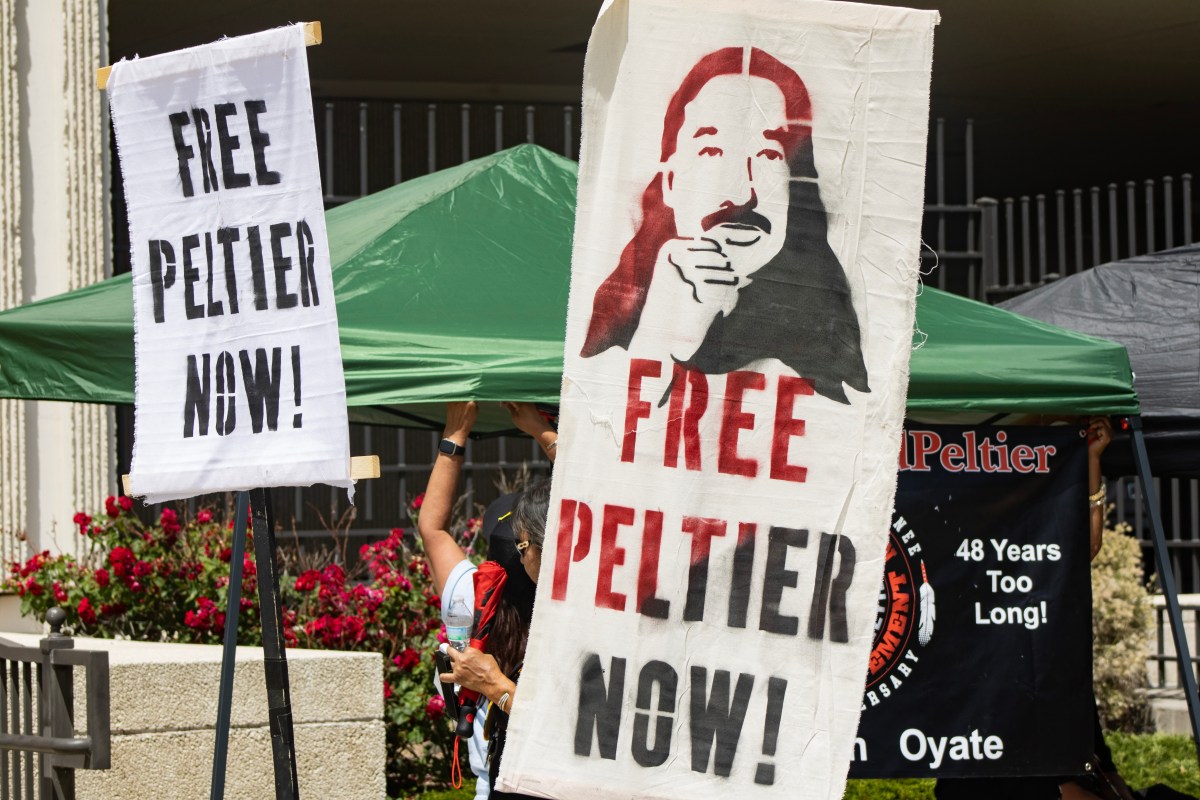
Peltier is currently serving two consecutive life sentences in connection to the deaths of two FBI agents in South Dakota in 1975. Peltier is currently serving his time in the Coleman I Maximum Security Prison in Coleman, Florida, and was recently denied parole.
In January, Peltier’s legal team filed an urgent appeal to the United Nations Working Group on Arbitrary Detention regarding Peltier’s medical treatment in prison.
The UN did not respond to a request for comment from ICT and the Rapid City Journal.
Earlier this week, another prisoner pointed out that one of Peltier’s toes was purple, though at that point, Peltier was not in pain.
In a July 16 press release, Peltier’s team said the Bureau of Prisons deliberately ignores Peltier’s medical needs and has at times withheld his insulin.
Peltier currently has an open wound in his foot. He has a heart condition, kidney disease, diabetes, high blood pressure, degenerative joint disease, injuries to his jaw and is experiencing vision loss. Advocates said each condition requires ongoing medical care, which advocates say the Bureau of Prisons has not been providing.
The Bureau of Prisons said it can’t comment on the status of any particular inmate, but did provide general information.
“The FBOP makes every effort to ensure the physical safety and health of the individuals confined to our facilities through a controlled environment that is secure and humane,” said public affairs director Benjamin O’Cone in an email.
O’Cone said the Bureau of Prisons has an Administrative Remedy Program for incarcerated individuals to seek formal review and redress over any incarceration concerns.
“For a person with diabetes, a foot wound is dangerous. An infection could quickly lead to amputation or death,” said Dawn Lawson, assistant director of the Leonard Peltier Ad Hoc Committee, in a press release. “That is how Leonard lost his father, Leo. One piece at a time.”
Peltier’s father, Leo Peltier, died from diabetes complications.
The Ad Hoc Committee asked for submissions to the Bureau of Prisons website requesting an emergency medical transfer for Leonard Peltier, prisoner #89637-132.
“Even the parole examiner suggested that the BOP evaluate Leonard for a medical transfer. As there is currently no meaningful oversight, it was merely a suggestion,” Lawson said.

This story is co-published by the Rapid City Journal and ICT, a news partnership that covers Indigenous communities in the South Dakota area.
Our stories are worth telling. Our stories are worth sharing. Our stories are worth your support. Contribute today to help ICT carry out its critical mission. Sign up for ICT’s free newsletter.
