
Kevin Abourezk and Stewart Huntington
ICT
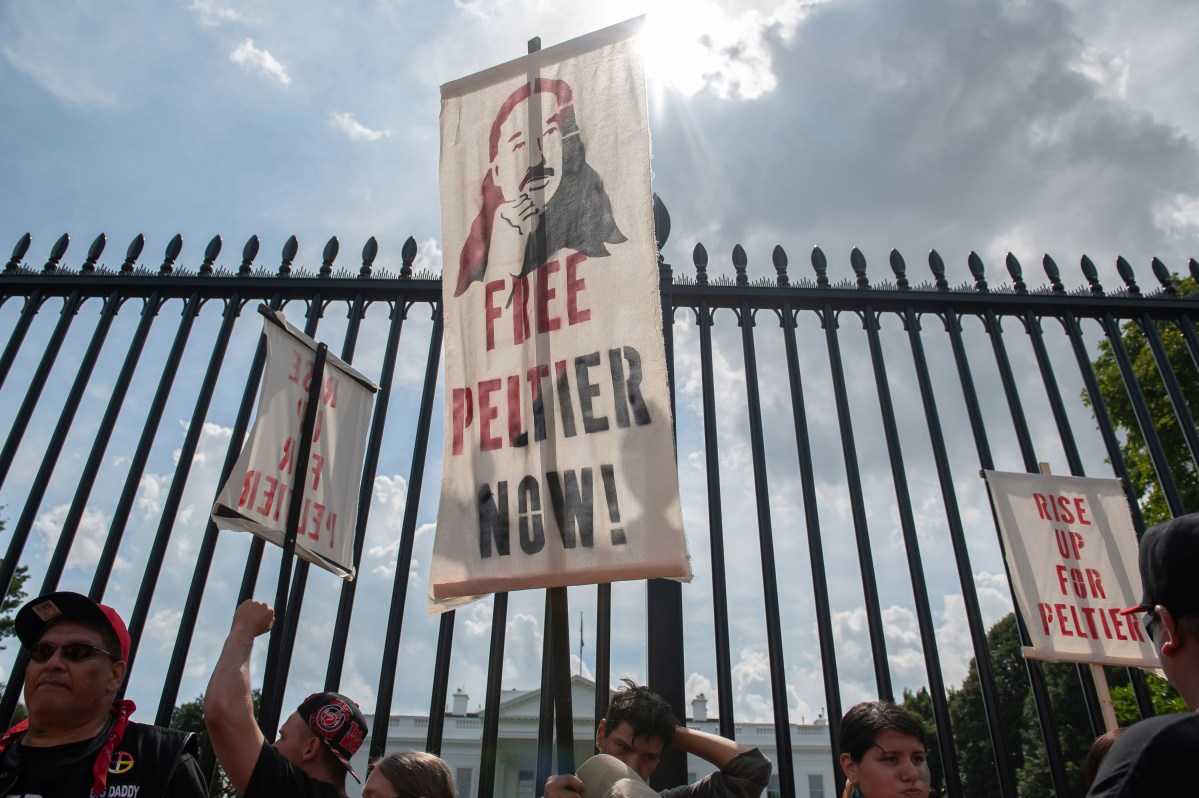
From Pine Ridge, South Dakota, to the U.S. penitentiary in central Florida, those who fought for decades for the release of Turtle Mountain Chippewa activist Leonard Peltier celebrated former President Joe Biden’s decision Monday to grant him clemency.
“Tears of joy. Tears of joy,” said Ivis Long Visitor, a 70-year-old Oglala Lakota man who was at the scene of the June 26, 1975, shootout between members of the American Indian Movement and two FBI agents. “I’m so happy. I never really thought they’d let him out.”
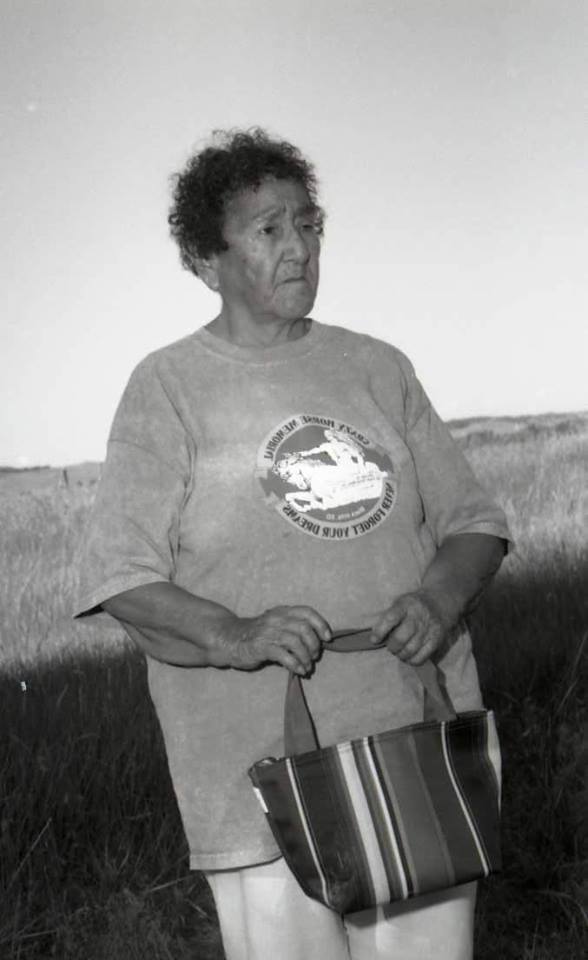
Long Visitor’s grandparents, Harry and Cecelia Jumping Bull, owned the land where the shootout occurred, and Long Visitor lived there with his family. He and his family were forced to escape the federal cordon around the scene that day, and he has advocated for Peltier’s release ever since. He said his mother, Roslyn Jumping Bull, was among Peltier’s staunchest defenders until her death in 2015.
“It’s been a long road for that man,” he said, fighting back tears. “The grandmas are happy up there in the spirit world. … They really were for Leonard all their lives.”
In nearby Pine Ridge, shouts and tears of joy began erupting spontaneously in homes and public spaces as news spread through the community via the “moccasin telegraph,” said Tiny Decory, an Oglala Lakota citizen and director of a youth suicide prevention program.
“Celebrations are starting. They already are,” she said. She expressed gratitude to Biden, saying, “A lot of people won’t remember what Biden did. They’re going to remember he pardoned Leonard Peltier.”
Decory said Peltier, 80, has defied the odds, managing to continue his fight for freedom for nearly 50 years despite seeing eight presidents leave office without pardoning him or commuting his sentence.
“Look at the resilience he had,” she said. “He would not let them take his spirit. … We can learn from that.”
Outside the Florida prison where Peltier has lived since 2014, members of the Native nonprofit organization, NDN Collective, gathered with Peltier’s lawyers and others.
“All of your fighting for him mattered, and he loves you all,” said Nick Tilsen, founder and chief executive officer of NDN Collective. “It’s a good day for Indigenous people and human rights defenders everywhere.”
He called Peltier’s day of clemency “a day of victory.”
“It’s a day of liberation for our people because of everything we have fought for,” Tilsen said.
Peltier’s daughter, Kathy Peltier, shared a short video statement on Facebook confirming the news of her father’s release.
“Just thought I’d go on here and express all my gratitude to everybody who has been working on this case,” she said. “I don’t know what to tell you guys all still but thank you for your support and now we’ll see Leonard Peltier as a free man. So I just wanted to confirm all that because some of you are questioning it and I’ve been, I saw the news and I’ve been called upon it. So, I just encourage everyone to give him more support because he’ll need it even more so. Alright, thank you all, love you all.”
Mark Trahant, former editor of ICT who has covered Peltier’s story since the 1980s, said other presidential administrations debated releasing Peltier but ultimately chose not to do so. With Peltier’s health in decline, Trahant – who has called for Peltier’s release – expressed support for the decision.
“I think the time is right,” he said. “No other president I guess had the guts to do it.”
But he acknowledged those who have attempted to implicate Peltier in the December 1975 murder of Mi’kmaq activist Annie Mae Aquash. Two former AIM members, Arlo Looking Cloud and John Graham, were indicted and convicted of murdering Aquash.
Trahant said, despite researching an alleged link between Aquash’s murder and Peltier, he has never been able to find evidence that Peltier was involved in her murder.
He said Peltier’s imprisonment has long been considered politically motivated and reinforced by federal authorities angry over the death of FBI agents, Jack Coler and Ronald Williams. As a result, he said, Peltier’s release likely will be seen as an act of justice by many in the global community. At the same time, advocates of prison reform also have called on Peltier’s release considering his unusually long prison sentence for aiding and abetting, and his failing health.
“There’s a real problem with the whole federal prison structure,” Trahant said. “You see prisoners in walkers and it just makes no sense.”
Denise Pictou-Maloney, slain activist Annie Mae Aquash’s daughter, expressed disappointment in Peltier’s release. Pictou-Maloney was featured in the recently released four-part HULU documentary “Vow of Silence: The Assassination of Annie Mae,” which examined Aquash’s murder and AIM’s involvement.
“My mother was murdered for daring to speak up against corruption and abuse that ran rampant within the American Indian Movement,” Pictou-Maloney said on Facebook. “Her tenacity and commitment to Justice and the cause for our nations was unwavering and it cost her her life.”
Some in the missing and murdered Indigenous women movement also have alleged Peltier was complicit, if not partially responsible, for Aquash’s murder.
“In the last 48 hours I have been called hater, angry, bitter, negative and colonized by a few because I dared to continue sharing the ugly truth of the complicity of members of AIM including Leonard Peltier who held their tongues and or lied and conspired to hide the truth,” Pictou-Maloney said. “Because someone dies the facts and the truth do not change. People are in pain, they are hurt to discover such betrayal and brutality about individuals within AIM they heralded as hero’s for so long.”
On Monday, former North Dakota state legislator Ruth Anna Buffalo, who has visited Peltier and long advocated for his release, also expressed gratitude for those who fought for his release.
“I’m just super thankful,” she said. “Thankful for everyone who worked for his release. There are people (who worked for his release) who have died before they could see this day.”
Buffalo, a citizen of the Mandan, Hidatsa, and Arikara Nation, said she hoped to see Peltier when he returned home to North Dakota – but only when that was appropriate. “I want to make sure his friends and family see him first,” she said.
Kevin Sharp, the former chief judge of the U.S. District Court for the Middle District of Tennessee, handled the legal effort to free Peltier before the NDN Collective took up the effort. Sharp filed two petitions for clemency for Peltier – one during the first Trump administration and one under Biden.
He said he greeted the commutation news with a “mixture of excitement and relief.”
“Relief because finally, finally a modicum of justice was being served and relief because I was getting a little nervous that maybe this wasn’t going to happen,” he said.
Sharp said he learned about the case from Connie Nelson, Willie Nelson’s ex-wife, who gave him the case files. “As a former federal judge and someone who understood the rules of evidence, I could understand ‘how’ this happened,” he said.
“But over the next five years I learned the ‘why.’ It led me down the path to understanding the unequal treatment Native Americans have experienced under the law.”
Sharp said Biden’s move to free Peltier went beyond just one person’s case.
The prosecution, conviction and incarceration of Peltier was “a symbol of all the injustices that have been visited on Native Americans at the hands of the United States,” he said.

Our stories are worth telling. Our stories are worth sharing. Our stories are worth your support. Contribute $5 or $10 today to help ICT carry out its critical mission. Sign up for ICT’s free newsletter.

