
Mary Annette Pember
ICT
Six Michigan tribes have withdrawn from federal discussions over the controversial Enbridge Line 5 project after learning that the U.S. Army Corps of Engineers are fast-tracking approval for the massive oil tunnel under the Straits of Mackinac.
The escalation of the project follows an executive order declaring a “national energy emergency” issued by President Donald Trump on Jan. 20, his first day in office.
On March 21, the six tribes — the Bay Mills Indian Community, Little River Band of Ottawa Indians, Sault Ste. Marie Tribe of Chippewa Indians, Grand Traverse Band of Ottawa and Chippewa Indians, Match-E-Be-Nash-She-Wish Band of Pottawatomi, and Nottawaseppi Huron Band of the Potawatomi — sent a letter to the U.S. Army Corps of Engineers office in Detroit stating their decision to withdraw from the agency’s creation of the environmental impact statement for the oil tunnel.
SUPPORT INDIGENOUS JOURNALISM. CONTRIBUTE TODAY.
In the letter, tribal leaders noted that they had participated in the Corps’ review process and meetings under the National Environmental Policy Act as cooperating agencies providing their input and expertise. But they said they were told at a March 20 meeting with the Corps that the agency is likely to issue an emergency permit to fast-track the Straits of Mackinac project.
Tribal leaders called the action “unacceptable” in the letter.
“We participated in the process, we followed the rules, we provided the case law, we submitted the evidence, and we trusted that our voices and our treaty rights would be respected,” said Bay Mills Indian Community President Whitney Gravelle in a statement issued by Earthjustice, a nonprofit environmental law organization.
“Yet, once again, the federal government has cast us aside and failed us,” Gravelle said in the statement.
In an interview with ICT, Gravelle noted that tribes have been providing input and expertise to the Corps since 2021.
“This is a Canadian pipeline running through Michigan for Canada. We are simply the highway that they are taking advantage of in order to have a shorter route,” Gravelle said. “The executive order declaring a national emergency is intended to be used on fuel for the U.S. by the U.S. Line 5 doesn’t meet that standard.”
In an email to ICT, Ryan Duffy, media spokesperson for Enbridge, said Line 5 is “critical energy infrastructure.”
“We value our relationships with all the communities and community members in areas where Enbridge has assets,” Duffy said. “As we continue to move closer to construction on the Great Lakes Tunnel Project, we remain committed to including tribes and tribal citizens in this incredibly important and consequential project and welcome constructive dialogue and engagement.”
He said the State of Michigan has already provided environmental permits for the project, and the Michigan Public Services Commission approved the new pipeline segment under the Straits of Mackinac.
“Line 5 is critical energy infrastructure,” Duffy said. “Enbridge submitted its permit applications in April 2020 for the Great Lakes Tunnel, a project designed to make a safe pipeline safer while also ensuring the continued safe, secure, and affordable delivery of essential energy to the Great Lakes region …However, after nearly five years, the project still awaits action by the U.S. Army Corps of Engineers on an environmental impact statement and a permitting decision.”
Carrie Fox, public affairs specialist for the Corp’s Detroit district, responded to ICT’s request for comment with an email outlining the procedures for emergency permits.
“The U.S. Army Corps of Engineers is continuing efforts to implement the January 20, 2025, Presidential Executive Order 14156 – Declaring a National Energy Emergency,” Fox said.
“During declared emergency events such as this national energy emergency, longstanding USACE regulations allow divisions to establish emergency permitting procedures to expedite the coordination efforts with federal, state, and tribal partners for comment,” Fox wrote. “On 17 March, USACE Headquarters instructed division commanders to establish these procedures.
Once established, districts will post the procedures in a public notice. These procedures will cover applications for Department of the Army permits related to the energy activities covered by Executive Order 14156.”
‘Fossil fuel subsidy in disguise’
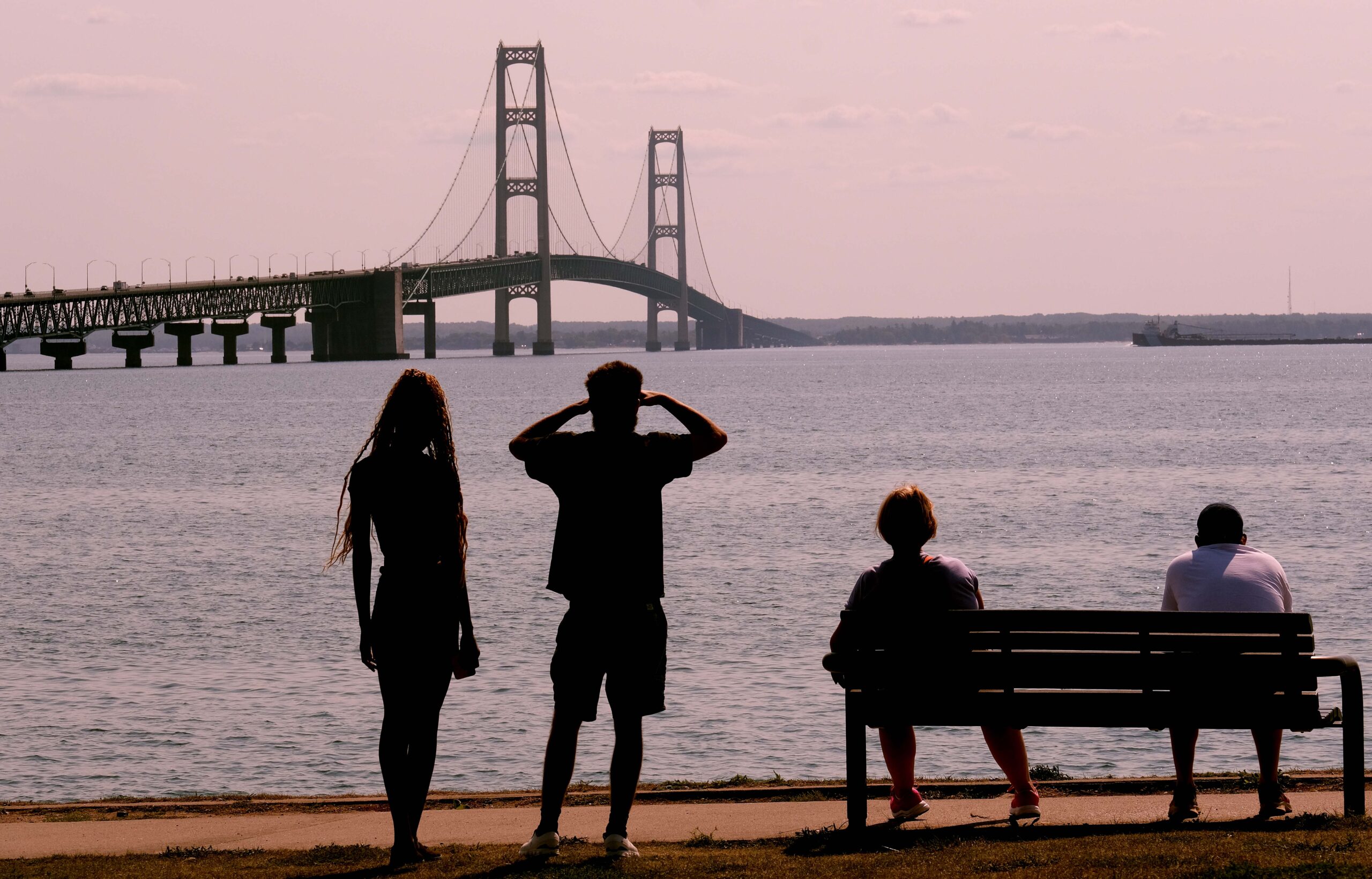
Enbridge’s Line 5 begins its 645-mile run in Superior, Wisconsin, at the company’s manifold and runs through northern Wisconsin, parts of the Bad River Band of Lake Superior Chippewa reservation, east through Michigan’s Upper Peninsula and under the Straits of Mackinac, before terminating in Sarnia, Ontario.
The line carries up to 540,000 barrels per day of light crude oil and synthetic crude, as well as natural gas liquids such as propane. About four miles of the line rest underwater on the lake bottom of the Straits of Mackinac, which connect Lake Michigan and Lake Huron.
In 2018 and 2019, the pipeline was struck by ship anchors in the straits’ busy shipping lanes. Although no oil was spilled during these accidents, opponents note that Line 5 has leaked in other areas, releasing over 1 million gallons of oil in various spots in the past 50 years.

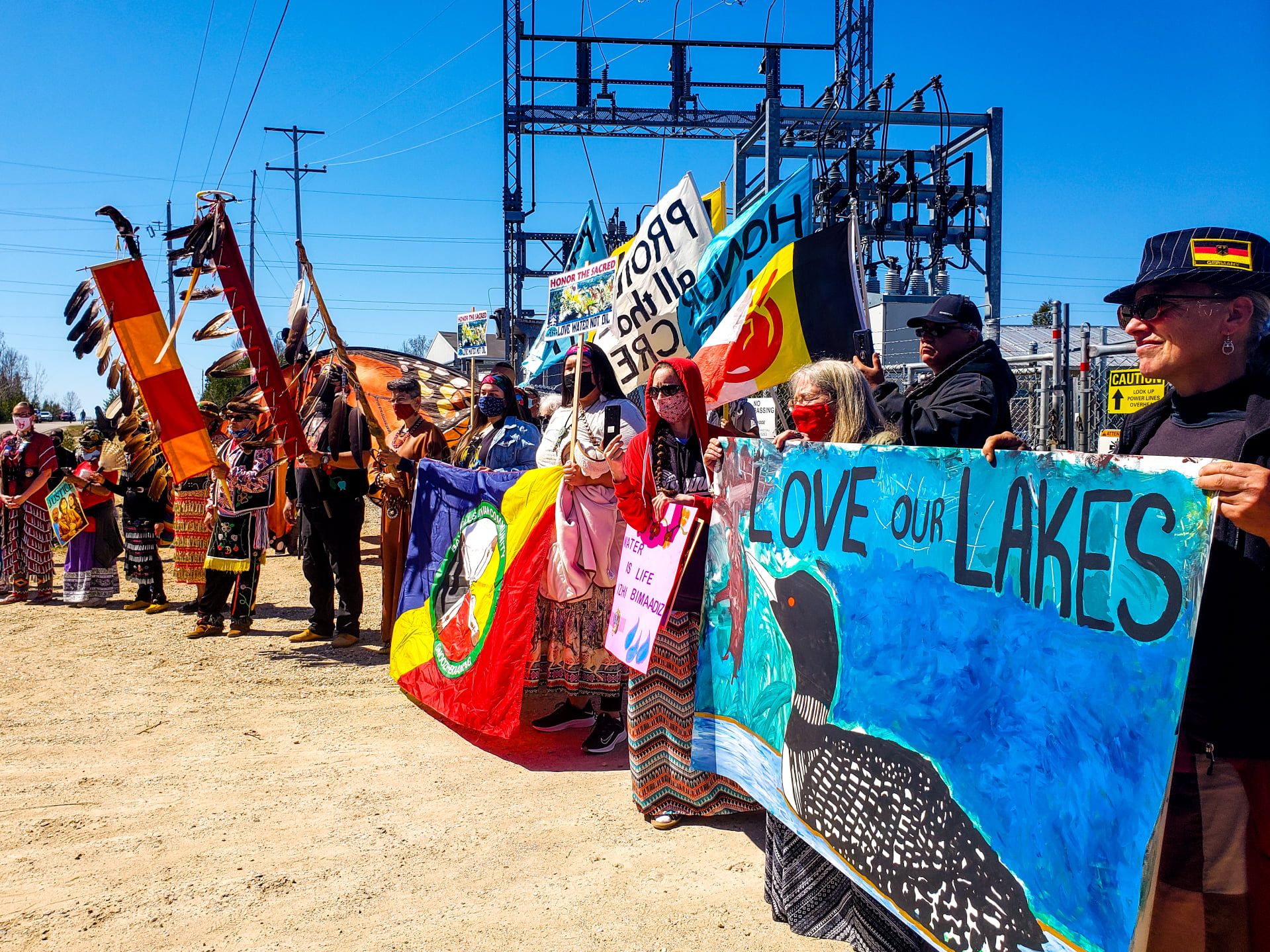
According to tribes and other critics of the project, a spill in the straits would have catastrophic effects on the environment, water, fish and wildlife, and would endanger tribal members’ abilities to practice their subsistence ways of life protected under the Treaty of 1836.
In 2010, Enbridge’s Line 6B ruptured, spilling 3.3 million gallons of tar sands oil into the Kalamazoo River.
The president’s order states that the U.S. Army Corps of Engineers should take “prompt and appropriate action” concerning the use of emergency Army Corps permits.
“The United States’ ability to remain at the forefront of technological innovation depends on a reliable supply of energy and the integrity of our nation’s electrical grid,” according to the executive order.
“There is no national energy emergency,” Debbie Chizewer, an Earthjustice attorney representing the Bay Mills tribe, told ICT. “This is really a fossil fuel subsidy in disguise. The project doesn’t add to American energy capacity because oil is already flowing through the pipeline.”
Looking ahead
Chizewer and Gravelle both noted that most of the product flowing though Line 5 originates and terminates in Canada.
Enbridge’s Line 3, which originates in Hardisty, Ontario, carries petroleum products traveling east through Minnesota before terminating in the company’s manifold in Superior, Wisconsin. Line 5 then carries the products through Wisconsin, Michigan and back to Canada in Sarnia.
Line 5 also supplies some propane to U.S. locations along its route through Michigan’s Upper Peninsula.
Under the Biden administration, the Army Corps was preparing a draft Environmental Impact Statement after receiving more than 17,000 public comments on the tunnel project. An internal memo circulated in early January before Trump took office directed the agency to assess the risk of oil spills before approving the tunnel project, and to consider other alternatives in its review. The letter was written by former Assistant Secretary of the Army (Civil Works) Jaime Pinkham.
Gravelle noted that PInkham’s memo has not been rescinded.
“So what we have now are two conflicting federal mandates,” Gravelle said.
Tribes will, however, continue to participate as consulting parties for the project under the National Historic Preservation Act, according to David Gover of the Pawnee and Choctaw tribes. He is an attorney with the Native American Rights Fund, which is representing the tribes.
“The emergency order essentially eliminates the tribes’ opportunity to have a full consultation on the project,” he said.
Enbridge still needs permits from Michigan’s Department of Environment and Great Lakes and Energy before going forward with the project, however, and still must go through Democratic Gov. Gretchen Whitmer’s office. Whitmer has long been an opponent to the project, previously ordering the state’s Department of Natural Resources to revoke the permit allowing Enbridge to operate the pipeline under the Straits of Mackinac.
According to Michigan Advance, attorneys for Whitmer and Michigan’s Department of Natural Resources are currently looking to dismiss legal challenges from Enbridge.
“Uniquely, we have every single tribal nation in the state of Michigan standing up and saying the tunnel is a bad idea; it was a bad idea when it was first built in 1953 and it continues to be a bad idea now,” Gravelle said.
“How can we allow an oil and gas pipeline to run through the largest freshwater body resource in North America where 40 million people rely on it for drinking water on a daily basis?” she asked.
“It just doesn’t make any sense.”

Our stories are worth telling. Our stories are worth sharing. Our stories are worth your support. Contribute today to help ICT carry out its critical mission. Sign up for ICT’s free newsletter. ICT, formerly Indian Country Today, is a nonprofit news organization that covers the Indigenous world with a daily digital platform and news broadcast with international viewership

