
Jourdan Bennett-Begaye
ICT
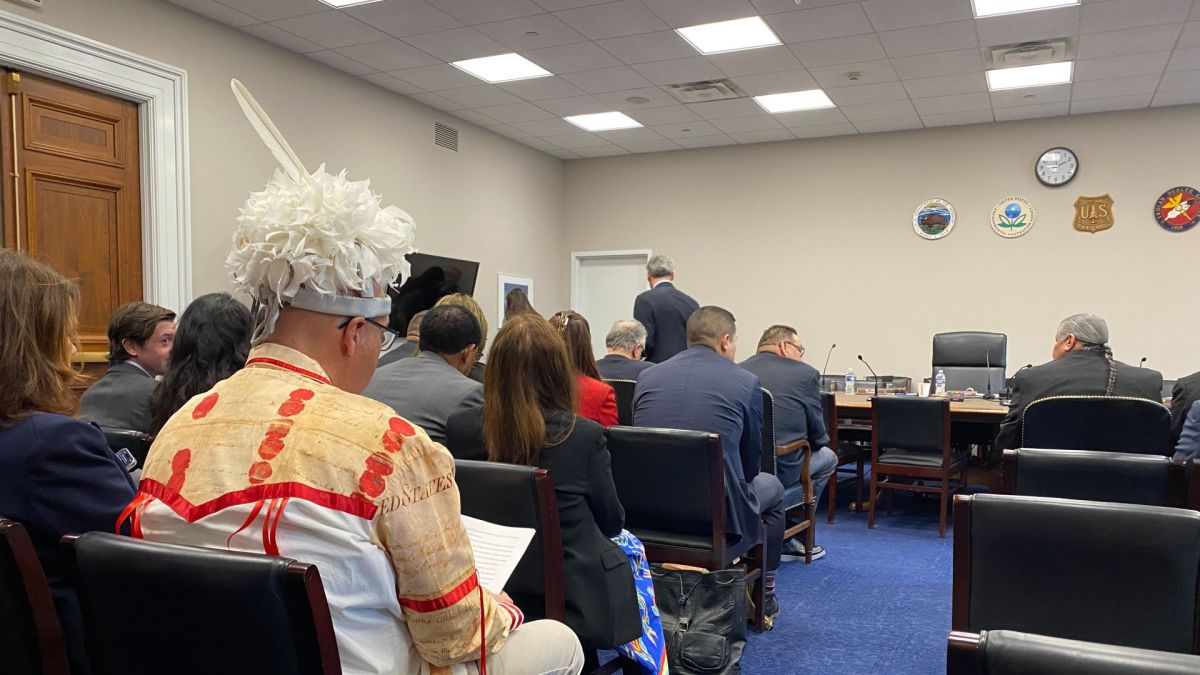
WASHINGTON — Nearly 100 tribal leaders or representatives are testifying in appropriations hearings for three consecutive days to share their worries over federal funding for tribal programs and to air their concerns of the Trump administration’s policies in the last few weeks.
The three hearings are to help inform congressional members of the needs and priorities of tribal nations for the 2025 and 2026 fiscal years, U.S. Rep. Chellie Pingree of Maine said Tuesday, Feb. 25, the first day of the hearings.
The subcommittee heard from about 40 tribal leaders on Tuesday, who identified Medicaid funding, health and mental health programs and public safety as key issues that rely on federal funds.
“While we respect Congress’s efforts to balance the federal budget, the [Indian Health Services] budget is too small to impact the national debt,” Harlan Baker, chairman of the Chippewa Cree Tribe of the Rocky Boy Reservation in Montana, told subcommittee members Tuesday.
“Cuts do not save significant money, but cause real harm to tribal communities,” he said.
The number of tribal leaders stepping up to testify to the House Appropriations Subcommittee on Interior, Environment, and Related Agencies nearly doubled over last year, when the subcommittee heard testimony from 68 tribes.
This year’s testimonies came from tribes across Indian Country and ranged in size, geography and whether they have tribal lands.
The hearings started as U.S. House Republicans worked to win passage of a GOP budget blueprint, a step toward delivering what President Donald Trump has called a “big, beautiful bill” with $4.5 trillion in tax breaks and $2 trillion in spending cuts. The bill would cut spending across federal programs and services, including Medicaid and SNAP benefits.
The bill was narrowly approved Tuesday 217-215, with a single Republican and all Democrats opposed. The bill now moves to the U.S.
The next steps are long and cumbersome before anything can become law — weeks of committee hearings to draft the details and send the House version to the Senate, where Republicans passed their own scaled-back version. And more big votes are ahead, including an unrelated deal to prevent a government shutdown when federal funding expires March 14.
Many tribal leaders focused on future funding and ensuring that tribes do not fall under the Trump administration’s definition of diversity, equity and inclusion. There was less testimony on the changing federal government under the new administration that has led to layoffs and a funding freeze across the nation for tribes.
This wasn’t a surprise to Pingree, who is the ranking Democrat on the subcommittee.
“They’re both such pressing needs in that a lot of the funding that was blocked in the beginning has been reinstated, and much of the funding going into the future we’re still uncertain about,” Pingree told ICT Tuesday. “I feel like people are at this moment of uncertainty, but the things that they’re experiencing with, say, law enforcement and the lack of funding is ongoing and a big need, so I’m not surprised that that ends up taking a lot of the time that people have to talk to us.”
Oklahoma Rep. Tom Cole, Chickasaw, who chairs the House appropriations committee, also sits on the subcommittee and was present during the morning session of the hearings on the first day.
“I have been – and remain – committed to ensuring the federal government upholds its trust responsibility to Native Americans to provide basic services and resources throughout Indian Country,” Cole said to the room after he arrived. “I have been in contact with the agencies and the White House to ensure our responsibilities to the tribes are fully understood across all facets of the federal government.”
Cole, a Republican, is the first Native American to chair the appropriations committee. Republican Rep. Mike Simpson from Idaho is chairman of the subcommittee.
The hearings began less than two weeks after a round of thousands of layoffs of probationary federal workers began to hit Indian Country. IHS almost laid off 950 employees before Secretary of Health Robert F. Kennedy Jr. verbally rescinded the layoffs. The Bureau of Indian Education lost nearly 85 employees.
The layoffs followed a freeze in federal grants and loans that has tied up tribal access to some funding.
Medicaid
A key concern noted by tribes is Medicaid funding.
ICT reported in November that Medicaid would be targeted for presidential advisor Elon Musk’s spending cuts. About two-thirds of Americans have some connection to Medicaid programs, and Medicaid pays for one out of every 4 patients at IHS, or more than one million patients.
Donna Thompson, vice chair of the Shoshone-Bannock Tribes in Fort Hall, Idaho, said that cuts to Medicaid will have “serious negative consequences for the Indian health system.”
Approximately 50 percent of the tribal citizens on the Fort Hall Reservation are enrolled in Medicaid, she said.
The tribe’s health center, the Not-Tsoo Gah-nee Indian Health Center, is a direct-service facility serving more than 20,000 American Indian and Alaska Natives patients, according to IHS.
The health center also “relies heavily on Medicaid funding to continue to provide health services,” Thompson said.
Harlan Baker, chairman of the Chippewa Cree Tribe of the Rocky Boy Reservation in Montana, also emphasized that protecting Medicaid must continue.
“For tribal facilities, 30 to 60 percent of funding comes from Medicaid,” Baker said in his testimony. “Capping Medicaid would not significantly reduce spending, but it would devastate facilities like ours, forcing reduction in patient care. In previous budget discussions, Congress exempted IHS and tribal programs from Medicaid caps.”
Energy development
Oil and gas production and energy projects were also key concerns for tribal leaders.
Mike Natchees, a councilman from the Ute Indian Tribe in Utah, testified Tuesday morning in the Rayburn House office building.
Natchees talked about the Ute Indian Tribe’s need for funding in energy development. In a written statement submitted to the subcommittee, he said that more than 91 percent of his tribe’s government revenues come from energy development which go to services for citizens and business partners.
The tribe “has been producing domestic oil and gas since the 1940s and we now produce almost 80 percent of the oil and gas coming out of the State of Utah,” he wrote.
The councilman pointed out that while the tribe has waited for more than 20 years to manage its own energy development and the statutory process to get it done, the tribe is held back by the federal layoffs that have happened recently.
“Just this past week, we lost seven of the eight people who help us secure those federal approvals at the agency level,” Natchees said in the hearing. “We need those employees back immediately. Our tribal energy production cannot afford to become an unintended consequence of national budget cuts and employee terminations.”
He asked that the federal employees at the Bureau of Indian Affairs, the Bureau Land Management, and other related federal agencies “stay in place and are fully funded” to help his tribe.
Public safety
Law enforcement and public safety also drew concerns from leaders.
In Santa Clara Pueblo, James Naranjo said that their tribal police officers stay for about two years and then leave to work at non-tribal police departments because the salary and benefits are better.
Naranjo, governor of the pueblo, said the turnover hurts the pueblo because they can’t match the salary and benefits with the current funding from the Bureau of Indian Affairs. Naranjo spoke from experience, as he was in law enforcement for 20 years but never worked for tribal police because of the low salary and benefits.
He asked for a “minimum of $320 million for BIA Criminal Investigations and Police Services to effectively serve and protect our community, including additional resources for officer equipment, training, and innovation.”
Up in Montana, Gene Small, president of the Northern Cheyenne Tribe, talked about how his community is enduring the lack of law enforcement and detention centers, which BIA and the Office of Justice Services, both under the Department of Interior, must provide.
Small said that crime levels — violent crime, property crime, drug trafficking, gun violence, human trafficking, and murdered and missing Indigenous individuals — “have skyrocketed at least 800 percent over the past half dozen or so years since BIA closed our own reservation jail and the number of officers dropped by half.”
He said that BIA Office of Justice Service officers will show up very late or not at all in response to 911 calls.
When the officers do detail a suspect, they have to call the BIA to ask if there is room in the jail. The jail is an hour away from the reservation.
“If there’s no room in the jail, BIA OJS officers will unarrest the suspect and simply let them go,” Small said.
The hearings are continuing through Thursday and are available online for those who couldn’t attend or listen to the livestream.
- American Indian and Alaska Native Public Witness Day 1, Morning Session
- American Indian and Alaska Native Public Witness Day 1, Afternoon Session
- American Indian and Alaska Native Public Witness Day 2, Morning Session
- American Indian and Alaska Native Public Witness Day 2, Afternoon Session
- American Indian and Alaska Native Public Witness Day 3

Our stories are worth telling. Our stories are worth sharing. Our stories are worth your support. Contribute $5 or $10 today to help ICT carry out its critical mission. Sign up for ICT’s free newsletter.
