Kadin Mills
ICT
WASHINGTON — Indigenous delegates and digital content creators represented Indian Country at last week’s Democratic National Convention in Chicago, where Kamala Harris officially accepted her party’s presidential nomination.
There were more than 100 Indigenous delegates present at the convention, as well as a handful of Indigenous influencers after the Democratic National Committee announced in June it would offer credentials to digital content creators.
The committee ultimately credentialed over 200 creators for the national convention.
That list included 23-year-old Chante‘ Reddest, Rosebud Sioux. Reddest is active on both Instagram and TikTok as @lakotalightning. The creator, who has over one million followers on TikTok, spoke on behalf of the South Dakota delegation during a ceremonial roll call on Aug. 20, the second day of the convention.
@lakotalightning Indian country, this is for you! #fy#nativetiktok#indigenous#culture#government#dnc#southdakota#representationmatters♬ Electric Pow Wow Drum – The Halluci Nation
“More opportunities, more good paying jobs, better access to healthcare and a quality education,” he said during his address. “That is the future we deserve, and it is the future we will win on Nov. 5 when we elect Kamala Harris.”
Reddest says the experience was overwhelming, but he hopes he inspired other young Native people to be present in spaces like the Democratic National Convention. “I was just looking to be there for our people, for our young people,” he said. “I thought about the rez kids, the people that aren’t here today, that aren’t here to see that there is hope for the future.”
For Native people who attended the convention, it was about representation on a national level.
“It’s very, very important that our people are represented in these types of spaces,” said 48-year-old Montana delegate Lance Fourstar, a citizen of the Assiniboine Nation. “Without that presence, we’ll be ignored and will continue to exist in silos of isolation on our little reservations that are pocketed throughout the United States.”
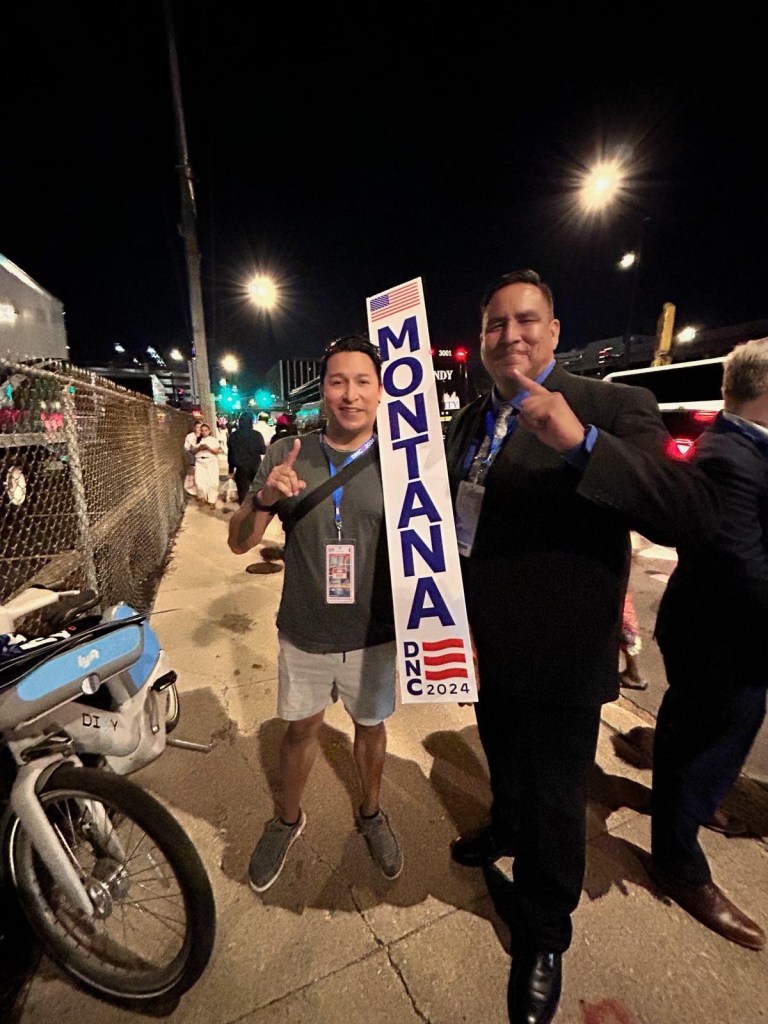
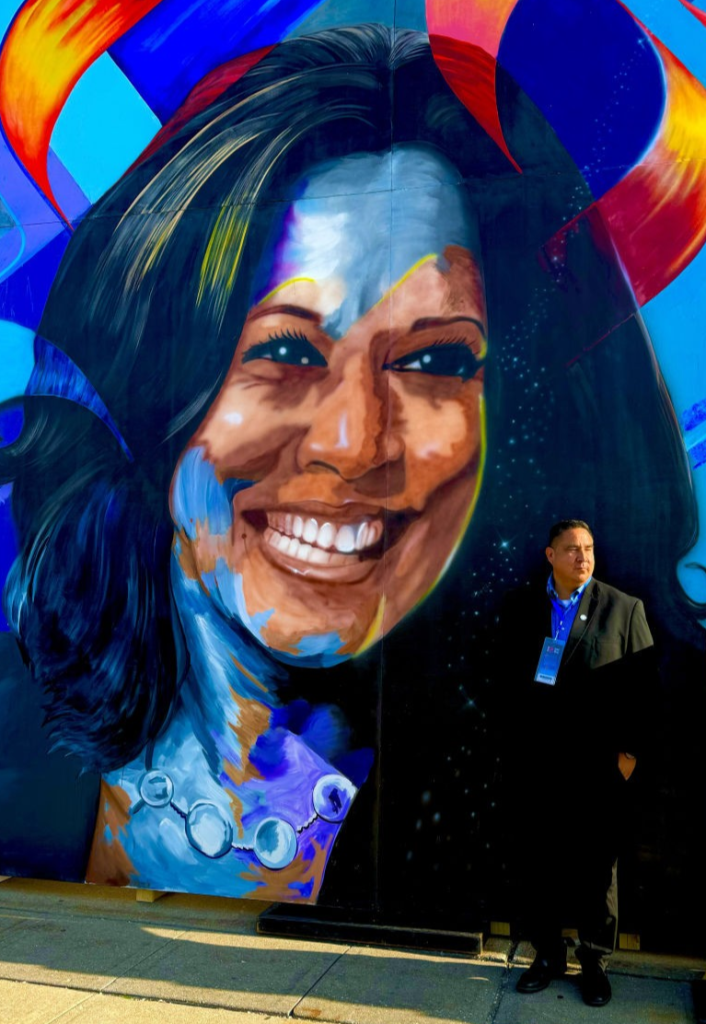
While he was not credentialed as a content creator, Fourstar and many other delegates made sure to document their experiences on Facebook.
Fourstar ran for a seat in the state’s House of Representatives but lost in the primary election. Still, he says he has a responsibility to his family and community to represent their issues on a national stage. With the election of more Indigenous peoples and fearless allies, he says “we’re slowly and surely gaining a lot of ground, and we need to keep this momentum up.”
Related stories:
— Indigenous leaders show up in force at Democratic National Convention
— Past, present Indigenous elected leaders endorse Kamala Harris
There were other Indigenous creators who were present at the convention who focused on bringing attention to specific issues. Ashbey Beasley, also 48, is a Hopi mom, digital content creator and a lobbyist. On Instagram, she is known as @campbeasleywood and she has about 25,000 followers.
One way Beasley engages with political topics is by spoofing conservative creators like John McEntee, former Trump aide and senior fellow at the Heritage Foundation.
“I try to make politics funny and entertaining,” she said. “I want people to watch them and feel like it’s a little bit lighter — almost like a break into political discussions.”
While she has an online platform, Beasley was invited to the Democratic National Convention as an activist, not as a content creator. Still, she recorded and posted interviews with other advocates and politicians throughout the convention and at the rally hosted by Vice President Harris and Governor Tim Walz in Milwaukee, Wisconsin, on Aug. 20.
Beasley became more engaged with politics after she and her son survived a mass shooting at an Independence Day parade in Highland Park, Illinois, a suburb about 20 miles north of Chicago, in 2022. Since then, she has rallied behind movements to prevent gun violence, and she’s even lobbied Congress.
“I’ve met with over 300 lawmakers and the White House Office of Gun Violence Prevention,” she said. “And I’ve also worked with my state legislature as well.”
She said being present at the Democratic National Convention and seeing other Indigenous peoples was inspiring. “I just came away feeling just so uplifted and just so happy,” Beasley said. “Our votes matter.”
Lily Joy Winder, 21, was also at the convention as a content creator. She is a rising senior at Stanford University. Winder is Diné and Southern Ute. She is also Nahiłii, or of Black heritage.
She started doing advocacy work in high school, making content about Native American mascots. Since then, she has grown her platform on Instagram, @lilyjoywinder, and TikTok, @sheshortnbrown — where she has over 300,000 followers.
@sheshortnbrown Comment if you would like to hear more about this because this is just my quick download on this topic ↕️thankful to be a #WHMpartner along with others who are sharing the truth #indigenous#context#coconuttree#woc#navajo♬ original sound – lily joy
Winder’s videos focus on bringing awareness to the issue of missing and murdered Indigenous people, as well as the climate crisis. She says gender-based violence and environmental justice are linked. A 2019 report from the U.S. Bureau of Justice Statistics found a rise of workers to oil producing regions from 2006 to 2012 led to a 70 percent increase in cases of aggravated assault, and a 30 percent increase in other violence like homicide and rape. At the same time, these numbers decreased in surrounding areas not impacted by fossil fuel industries.
“Native women are culture bearers in many communities,” she said. “If we want to (stop) the environmental crisis, protecting Native people — Native women — is in the best interest of everyone,” she added.
For the last several months, Winder has also brought attention to the Israel-Gaza war by sharing videos about the humanitarian crisis faced by Palestinians. During the convention, she also uplifted the “Uncommitted” movement, a demonstration aimed to express dissatisfaction over the Biden administration’s support for Israel’s ongoing military occupation of Gaza and continued illegal settlement of the West Bank. Members of the movement — which started in Michigan, home to the nation’s densest Arab American populations — vow to vote “Uncommitted,” meaning they will cast their ballot as a vote of no-confidence.
At the convention, the movement campaigned for an arms embargo on Israel.
Winder said the “Uncommitted” movement was disrespected and belittled by “both the DNC and too many of its attendees.” One key issue is the Democratic National Convention would not allow a Palestinian American to speak, despite family members of Israeli American hostages in Gaza being invited to speak, as reported by the Associated Press.
Critics on social media accosted Winder saying she was complicit in U.S. support for Israel by attending the convention. She noted a glaring lack of young Native people represented at the convention, and she defended her decision to attend.
“I’m an imperfect person doing what I can to help Indian Country,” Winder said. “I made the best decision that I could in the moment, and I was able to talk to people about Indian issues that people don’t hear about.”

ICT is owned by IndiJ Public Media, a nonprofit news organization. Will you support our work? All of our content is free. There are no subscriptions or costs. And we have hired more Native journalists in the past year than any news organization ─ and with your help we will continue to grow and create career paths for our people. Support ICT for as little as $10. Sign up for ICT’s free newsletter.