
Charles Fox
Special to ICT
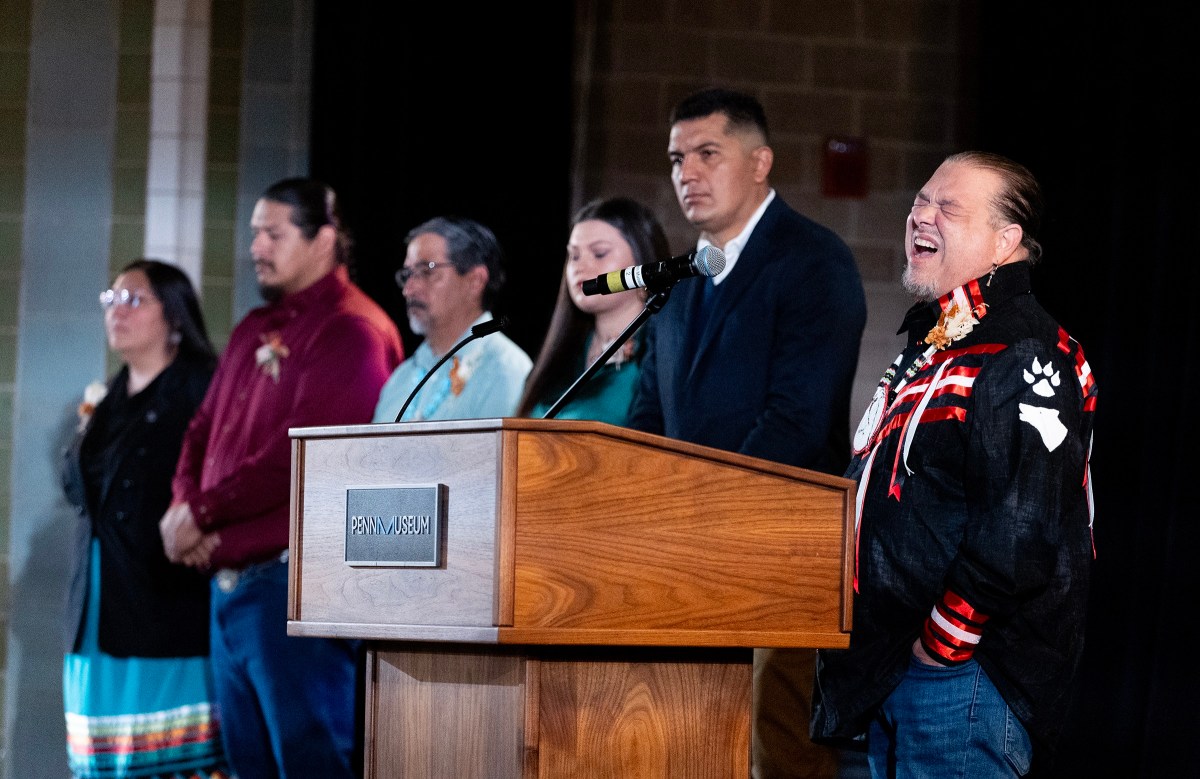
PHILADELPHIA — Jeremy Johnson delivered a short but gracious speech to the hundreds of people gathered at the Penn Museum’s Harrison Auditorium, but he felt a void, a need to collectively honor and bless the reason they were there.
The honor song that followed — in an Indigenous language rarely heard in Philadelphia — called out in the Lenape language to the spirit that had once enveloped the mid-Atlantic homelands and the past generations that preceded him.
It was an impromptu decision, a song that flowed from his heart and matched the emotions of the day, a reclamation of the land, filled with pride and defiance. But it also signaled there was something different about the museum exhibit they were about to unveil.
For not only were Native Americans part of the opening celebration at the Penn Museum, but Johnson and seven other Native consulting curators contributed beyond the auditorium walls to shape an exhibit depicting Native people in the present day.
“I had a sense of humility because the reason I was standing there was because of the resilience and strength of my grandmas and grandpas, and to be even able to sing that song was because of what they had done,” Johnson, the cultural education director for the Delaware Tribe of Indians, also known as Lenape, told ICT later.
“It was meant to honor what was going on there [at the museum] and the people there,” he said, “but it was really a recognition of those who came before me, who have set this path up and allowed us to keep continuing these ways.”
He was joined by other Native speakers, including three other consulting curators and contributing artists, as well as Tewa Dancers from the North, in November to initiate a weekend of activities for the opening of the Penn Museum’s new exhibit, “Native North America Gallery: Rooted in Resilience, Resisting Erasure.”
Given that Native Americans and museums have always had an uneasy relationship, it was unusual not only for the celebratory atmosphere but also for the Native participation.
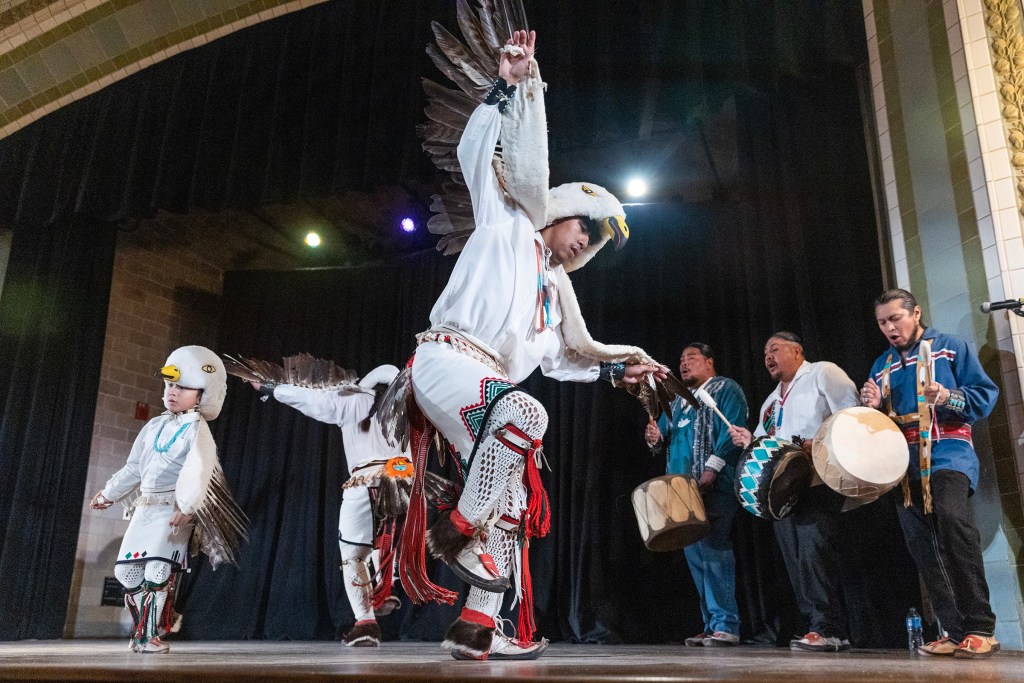
But this exhibit is different. The new gallery is planned to be up for the next 10 years and follows the success of the museum’s previous exhibition, “Native American Voices: The People Here and Now.”
The museum and its curators hope the gallery will broaden the historical narrative that is presented in Philadelphia during the semiquincentennial celebration of the United States, and serve as a model for other museums struggling to incorporate Native voices in their corridors.
“We hope that some folks will come up here to the Penn Museum to check out the exhibit, maybe it will help put some context into what they’re celebrating as far as the 250th goes,” said Dr. Joseph Aguilar, a tribal historic preservation office board member for the San Ildefonso Pueblo and one of the consulting curators.
“Maybe it will give them some perspective like, ‘Hey, there’s this other history that also needs to be celebrated and acknowledged.’”
Ushering in the future
Native Americans rarely have gotten a say in what manner they were depicted in museums, especially in a state they were forced to leave in the 18th century. Museums often portray Indigenous people as primitive, defeated curiosities of the past rather than as a present-day populace with a rich cultural tradition.
The past actions of museums have been clouded by the unauthorized expropriation and display of sacred objects and human remains.
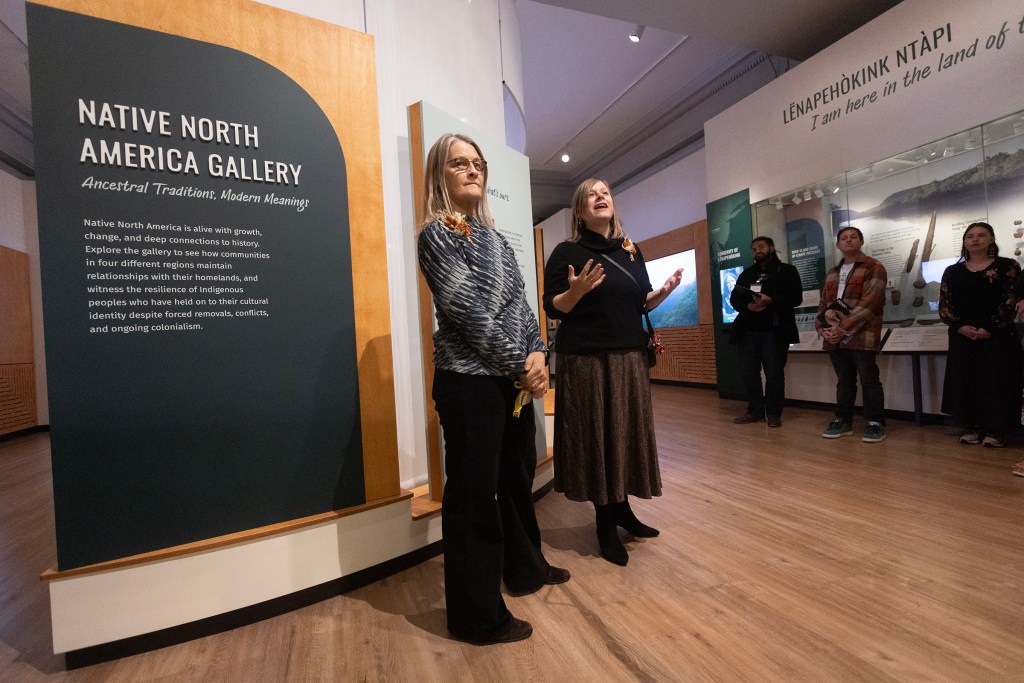
The Penn Museum at the University of Pennsylvania has tried to distance itself from the past practices of museums with the new exhibit, which opened Nov. 22, 2025. It coincides with the upcoming 250th birthday of the United States in July as all Philadelphia museums and cultural institutions are gearing up for the expected influx of visitors for this year’s celebration.
The museum, a Philadelphia archaeology and anthropology institution founded in 1887, has been ahead of other museums with its recent practices. While other museums have pulled exhibits and closed galleries to comply with a change in regulations under the federal Native American Graves Protection and Repatriation Act, known as NAGPRA, the Penn Museum has taken a different approach.
For the current exhibit, the museum tapped the eight Native consulting curators from different tribes to create a gallery that emphasizes the Native people and cultures that have thrived across the United States despite a historic agenda to erase their culture and language.
In addition to Johnson and Aguilar, the other consulting curators are RaeLyn Butler, secretary of culture and humanities, Muscogee (Creek) Nation; Beau Carroll, lead archaeologist, Tribal Historic Preservation Office, Eastern Band of Cherokee Indians; Christopher Lewis, cultural specialist, Zuni Pueblo; Mary Weahkee, archaeologist, Santa Clara Pueblo; Dr. Nadia Sethi Alutiiq, art historian and museum consultant, Homer, Alaska; Darlene See, cultural heritage director, Huna Indian Association, Tribal House Management Kaach.adi Clan Tlingit.
The curators were able to shape the exhibit by helping determine its focus, what display items were appropriate, and ensure that Native people were depicted in the present day.
The exhibit hopes to “tell the past while ushering in the future,” Jill DiSanto, the museum’s public relations director, told ICT..
It marked a first for Johnson.
“Most of the work with museums in the past has been extractive of our cultural knowledge, or at worst, simply exploitative of our knowledge and our items,” Johnson said. “This is the first we collaborated on … to really get our story out there. Not just the historical presence, the pre-contact that is usually focused on in exhibits, but to really use the items here to tell the story of the people and to show that we are a living, thriving community still to this day.”
RaeLynn Butler, another of the Indigenous consulting curators and secretary of culture and humanities for Muscogee (Creek) Nation, agrees.

“There’s been too much emphasis on objects and not enough on the culture and people,” Butler told ICT. “The difference here is to bring the ancient up to modern times. We want people to know there are 574 tribes in the United States…and that we are still here today. I think that’s always the message. and I think that this exhibit is a perfect example of including tribal nations in the telling of the history of these items and personal belongings.”
She noted in an earlier press conference, “We’re living, grieving, strong cultures, and that’s what is so exciting about these exhibits, to see people’s faces and to hear their voices and the language. That helps people when they walk away to understand these are living communities of people and that’s an important message.”
NAGPRA changes
The Native American Graves Protection and Repatriation Act was passed by Congress in 1990 to establish protocols for the return of human remains and other objects to their specific tribes.
In January 2024, the federal regulations were strengthened with new rules requiring museums and government agencies to obtain permission from Native American tribes and Native Hawaiian organizations before displaying sacred and funerary objects.
“Among the updates we are implementing are critical steps to strengthen the authority and role of Indigenous communities in the repatriation process,” then-Secretary of the Interior Deb Haaland, Laguna Pueblo, said at the time. “Finalizing these changes is an important part of laying the groundwork for the healing of our people.”
The changes left some museums scrambling to comply. The Field Museum in Chicago and Peabody Museum of Archaeology and Ethnology at Harvard University were forced to remove objects or cover displays, while the American Museum of Natural History in New York City closed its Eastern Woodlands and Great Plains Halls.
The Penn Museum had anticipated the new NAGPRA regulations, however, and had been acting accordingly before planning the new exhibit, officials said.
“I think many of those displays were really old and outdated, so they may have included items such as funerary objects or sensitive items that today tribes would not agree or want to have on display,” said Dr. Lucy Fowler Williams, the Penn Museum’s co-curator of the Native North American Gallery and associate curator-in-charge. “We were already tuned into what is sensitive for tribes and what would be appropriate to show… It’s not to say we’ve got it all perfect or anything, but we’ve just been working in this mode for a long time.”

The Native co-curators worked with the Penn Museum to decide which items were appropriate for display and which were not for public viewing. An empty case at the start of the gallery symbolically represents those items in the museum’s collection that were deemed to have been obtained inappropriately or were considered inappropriate for display. Many of those items have been repatriated back to their tribes.
“The inclusion of an empty display case is a deliberate intervention — not an act of censorship,” Aguilar said in a museum press release.
“It serves as a thoughtful prompt for visitors to reflect on the fraught relationship between museums and Indigenous communities,” he said. “In its absence, the object becomes an act of Indigenous sovereignty.”
Williams said the collaboration built positive relationships between the museum and tribes.
“I think that what is so important about the NAGPRA law is, they [ tribes] do have a great and a vested interest in the materials that we house,” Williams said. “And they have the right now to reclaim some of those items through repatriation. But this also sets up building positive relationships and moving forward together, to work together to find common ground and work together on projects that we both know are important to help regain those histories that the museum is interested in, and the communities are even more interested in.
“It’s taken us a long time to figure out that you can do it better together.”
‘More than fluff’
The gallery, which features approximately 260 historic and contemporary items, is arranged to represent the four corners of the country: the Delaware (Lenape) in the Northeast, the Eastern Band of Cherokee and Muscogee (Creek) in the Southeast, the Pueblo in the Southwest, and the Tlingit and Alutiiq people of Alaska in the Northwest.
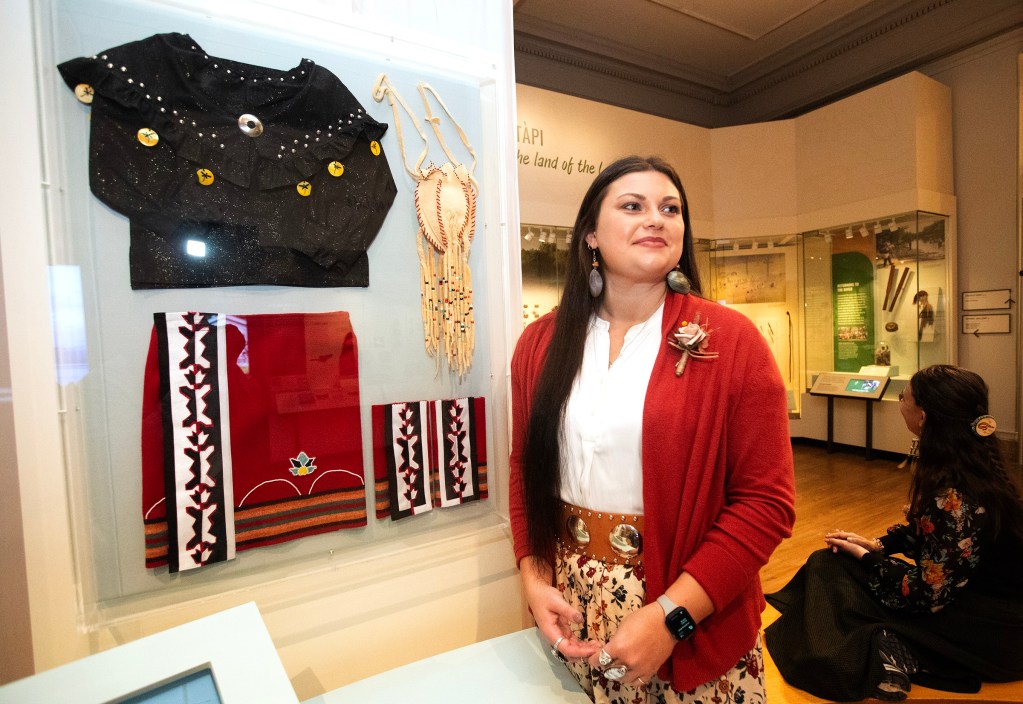
The exhibit includes a floral beadwork collar from the Lenape; a Tlingit Naaxein (Chilkay blanket) ceremonial robe; a contemporary glass sculpture, “Emerging from Raven,” by Tlingit artist Preston Singletary; a San Juan Pueblo robe created by Ramoncita Sandoval in 2001; Cherokee stickball equipment and rag dolls, and a pot ring and ring basket woven from yucca grass by Native consulting curator Christopher Lewis, a cultural specialist with the Zuni Pueblo. Lewis studied ancient baskets, textiles, wood, and feather work in the Penn Museum and other museums to create modern items using ancient techniques.
The words of Delaware artist Holly Wilson that accompany her sculpture, “I’m More than Fluff,” summarize the objective of the exhibit.
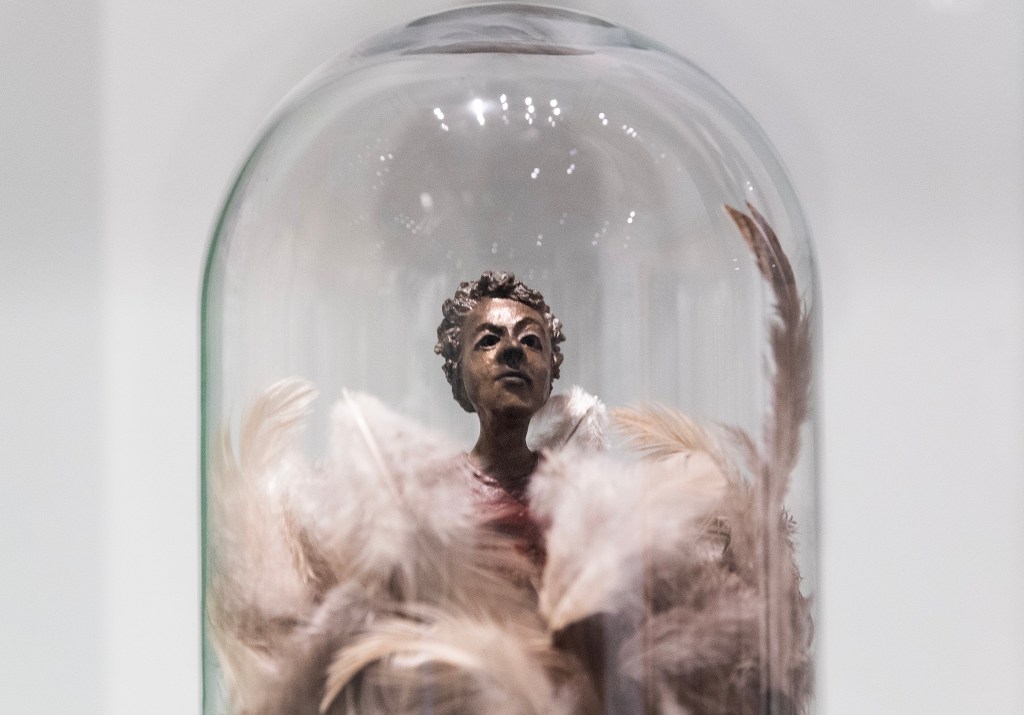
“I am more than the view that my people are frozen in time, lost to a romanticized ideal of who Native Americans were, we are more, and we are still here,” according to an informational sign posted at the exhibit. “I am not this fluff: I am here: I am loud and larger than life.”
Focusing on the stories of the people first, Wilson told ICT, “tells a different story and looks at things in a different way.”
“So much of the time it’s the history of the objects and there’s nothing connecting them to the people,” she said. “So, it’s been very emotional and powerful.”
In addition to historic items and works commissioned by contemporary artists, the gallery also features interactive stations focusing on language, stories and artistic techniques, with displays about traditions, cultural items, and the hardships caused by European contact.
Oklahoma road trip
In July, four members of the Penn Museum staff, including Williams and Penn Anthropology professor Dr. Megan Kassabaum, co-curator of the exhibit, traveled to Oklahoma to spend three days with members of the Delaware Tribe.
They brought with them four items: a floral Lenape beaded collar, a woman’s traditional red blouse, a dance staff, and an ancestral stone atlatl weight, which is a decorative stone used as a counterweight on a spear.
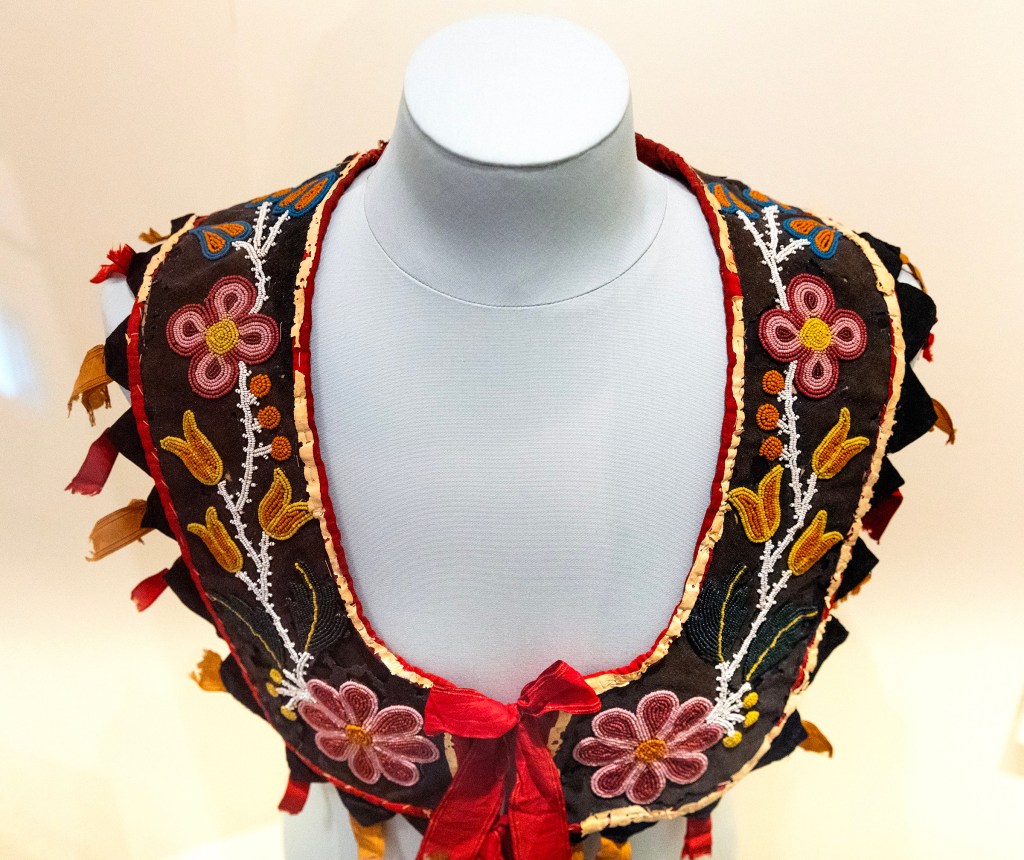
“We made two presentations to the tribal community members, during which time they were all invited to look closely, study, and handle the items made by their ancestors,” Williams said. “From my perspective, it was incredibly moving and important for them to see these items and to see us making the effort to go there to meet them. We hope to do more of this kind of work to try to create opportunities that strengthen the communities and the next generation, and to continue to build meaningful relationships with tribes when possible.”
Johnson, the Delaware Tribe’s cultural education director, said the items connected the past and present.
“People got to experience it and touch it and examine it, so it really went against a lot of the curatorial practices,” Johnson said. “In the two hours that we were able to spend with this beaded collar, we learned more in that time than anyone else has learned with it being behind glass for the last 100 years.”
Johnson continued, “These items have a life, and they aren’t meant to just be stuck in time. They’re really meant to be cared for and utilized within our culture and traditions and community. And we’re trying to change the way people view these things. Sometimes, it actually goes in direct opposition to museum conservation principles and in the ways that they should be cared for. Oftentimes, things need to be handled in order to take care of them, to preserve them.”
“They’re not artifacts. They’re living items that have a life and have eons of knowledge contained within them.”
Moving forward together
There is a hope that the manner in which the Penn Museum gallery was created will be a guiding model in the future for other institutions.
“Places like the Penn Museum, they’re moving forward together in a good way.. there’s a healing that has to go on in the relationships and we’re starting that process and hopefully continue that process,” said Johnson.
“It’s a good feeling to try and heal from the harms that have been done to our Native communities by the whole museum culture and the way they operate,” he said. “ It felt good to be able to contribute in a positive way in which we were able to express ourselves in the ways that we wanted, and also to be able to consult and collaborate on the items that were used and which shouldn’t be used…There’s a sense we’re getting our voice, but there’s still a lot of work to do.”
Williams said Native involvement has been key to the success.
“I have always worked in this mode [of collaboration] and I think it’s so much better,” Williams said. “It only makes sense to me. They [Native people] speak from the place, and from the history and the knowledge and from the heart with such an authenticity that they can bring to the items and to the histories.”
Streets of Philadelphia
Unlike the other Indigenous consulting curators, a trip to Philadelphia for Johnson involved returning to Lenapehokink, the Lenape homeland, which includes eastern Pennsylvania, New Jersey, the lower Hudson Valley of New York and New York Bay, and eastern Delaware, and the conflicting emotions that it provoked.
There was the gratification of shaping and influencing an exhibit, but it was tempered by the negative history of the past and feeling isolated in what was the traditional homeland and the subsequent diaspora of his people.
William Penn’s friendship, for example, with Chief Tamanend (also spelled Tammany) and the Lenape people is often romanticized in words and in the paintings of Benjamin West and Edward Hicks, both depicting the 1683 Treaty between them in the Lenape village of Shackamaxon.
Penn’s so-called Holy Experiment soon unraveled for Indigenous people, however. After Penn’s death, his sons and other officials devised a land-grab scheme known as the Walking Purchase in 1737 to dispossess the Lenape of their homelands in eastern Pennsylvania.
During the 18th and 19th centuries, the Lenape were removed to Ohio, Indiana, Missouri, Kansas, Arkansas, Texas, and eventually Oklahoma. Fifteen treaties were signed with the United States and fifteen were broken. Despite living in their homelands for 16,000 years, Pennsylvania remains the only state in Lenapehokink that never recognized its Indigenous peoples. Even the Lenape name was replaced by the commonly used European name of Delaware.
“It is complicated because the Lenape people were the first Indigenous nation to sign a treaty with the United States in 1778, (the Treaty of Fort Pitt which promised them the potential of becoming a 14th state), and it’s the first treaty broken six months later,” said Johnson. “And so, we fought on the side of the early United States, and we later fought against the United States because of these broken promises.”
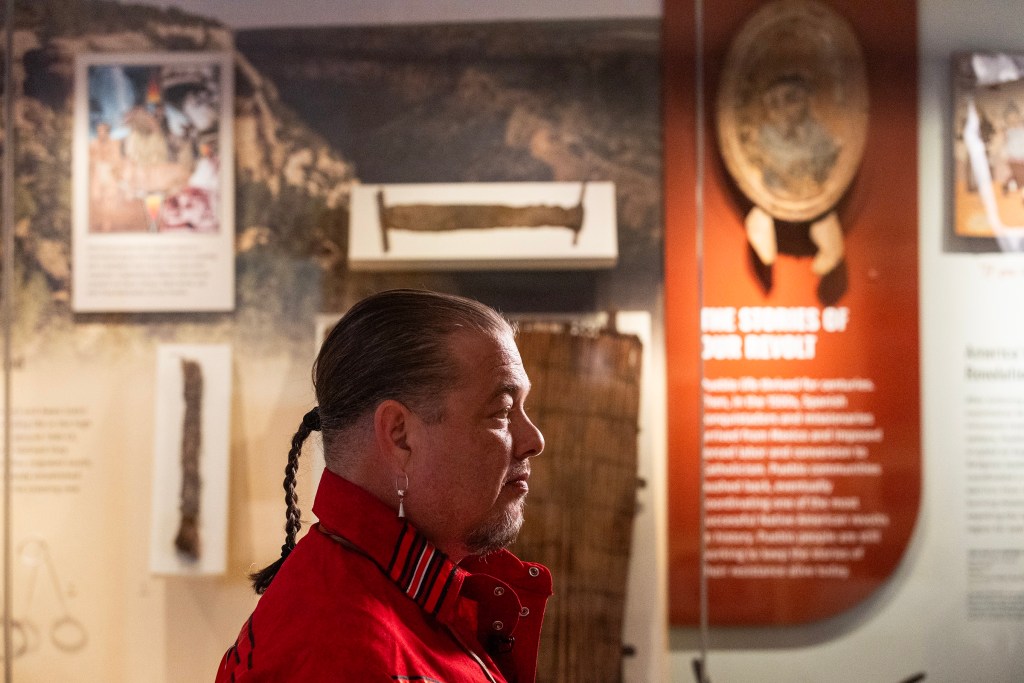
Walking the streets of Philadelphia, a city with a limited Native population, is awkward for Johnson. The congested infrastructure and the degraded natural environment of the urban landscape obstruct any connection with the Lenape homeland from centuries ago.
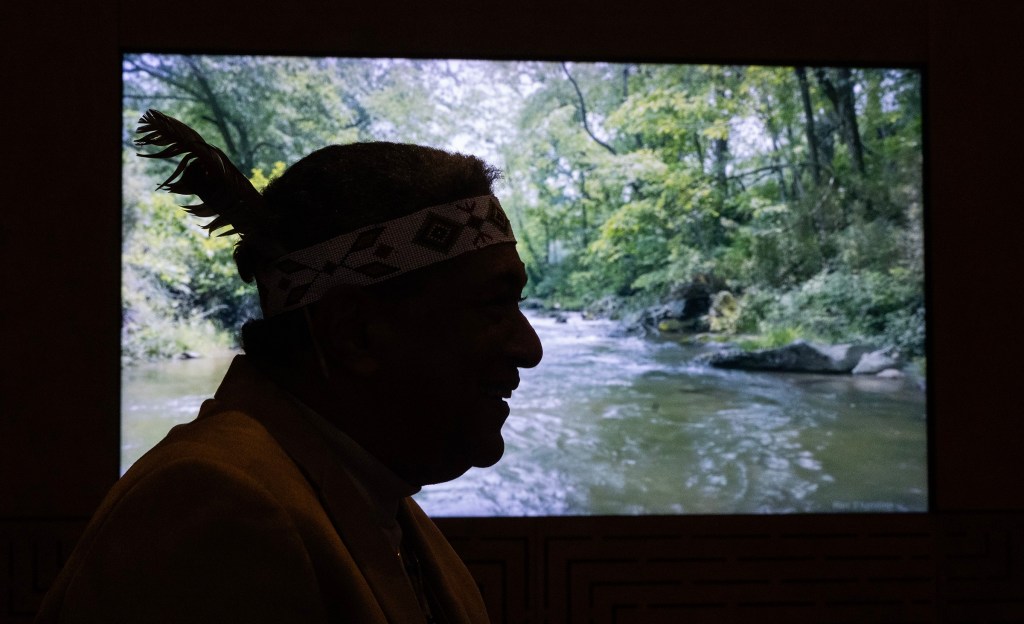
Despite their development, only waterways, such as the Delaware and Schuylkill Rivers, offer some feeling of tranquility. After centuries of dispossession and a relocation to an area without large rivers in Oklahoma, there is the opportunity for these “water people” to reconnect to the tributaries of their homeland.
Otherwise, there is little Lenape representation. Only a small statue of Penn commemorates the 1683 treaty site in Penn Treaty Park along the Delaware River. A few blocks south, sandwiched between a bus stop turnaround and an entrance ramp to Interstate 95, a 20-foot statue of Chief Tamanend hovers as the highway traffic speeds by below. A proposal to relocate it for the semiquincentennial to a new area that was deemed a more positive location was opposed by tribal leaders, including Johnson, who saw it as another form of forced removal. The move was shelved.
The statue plaque states Tamanend was considered “the patron saint of America by colonists prior to American independence,” but the celebration of Tammany Day on May 1 disappeared with colonial times.
Despite the efforts of the Penn Museum gallery to usher the Native culture into the present, their absence in the city once again relegates them into a civilization of the past.
“I love going and visiting Philadelphia… but it’s really hard to find a true connection,” said Johnson, who feels the attachments are the strongest in the natural state and solitude along northern sections of the Delaware River far from Philadelphia.
“There’s not a whole lot of representation of Lenape that’s in our homelands that highlights our voices, our ideas, how we think, and what we do, and what we feel is present to share with people,” he said.
The absence, however, has made the Penn Museum exhibit and the method with which it was created even more meaningful for him.
“To be able to exhibit in this way in Pennsylvania and our homelands that had not been historically kind to us in many ways is empowering,” Johnson said. “To have that opportunity to reclaim some of the spaces in our homeland and to have our tribal citizens involved in that process, to give them voice in a place where we were forcibly removed from, I’m incredibly proud of that. We were not only able to empower our tribal citizens to tell their own stories, but also to reconnect with the lands of their grandmas and grandpas.”
“I think [the museum gallery] really built more pride in being able to say, ‘I’m Lenape,’ and to be able to acknowledge, yes, my ancestors went through massive hardships and challenges, but to be able to say, “I’m Lenape and still have these ways’ …
“It makes me eager to say, ‘Hey, we survived this, we’re still around, we’re actually thriving now,’ and that should be something that we’re proud of.”

