ICT is working to shape the future of journalism and stay connected with readers like you. A crucial part of that effort is understanding our audience. Share your perspective in a brief survey for a chance to win prizes.
Felix Clary
ICT + Tulsa World
TULSA, Okla. – The Cherokee Nation has taken a multifaceted approach to revitalizing its language, everything from video games, to TikTok videos, social media posts and immersion schools for Cherokee language learning.
After nearly losing its language during the Oklahoma Boarding School Era, the tribe has relied on federal funding and its own efforts to bring the language back.
In a recent ICT and Tulsa Word interview, Cherokee Principal Chief Chuck Hoskin Jr. said “part of this effort will be to send a message to the United States that we are committing ourselves to putting our own resources in, but we are not going to let the United States off the hook. … The destruction of our language took place over a couple of centuries, and it was well funded by the United States, and we need to recognize that as a country.”
When Cherokee children were placed in boarding schools from the late 1800s into the 1900s, they were not allowed to speak their Native language and were forced to learn English. Hoskin said the language was “beaten out of them.”
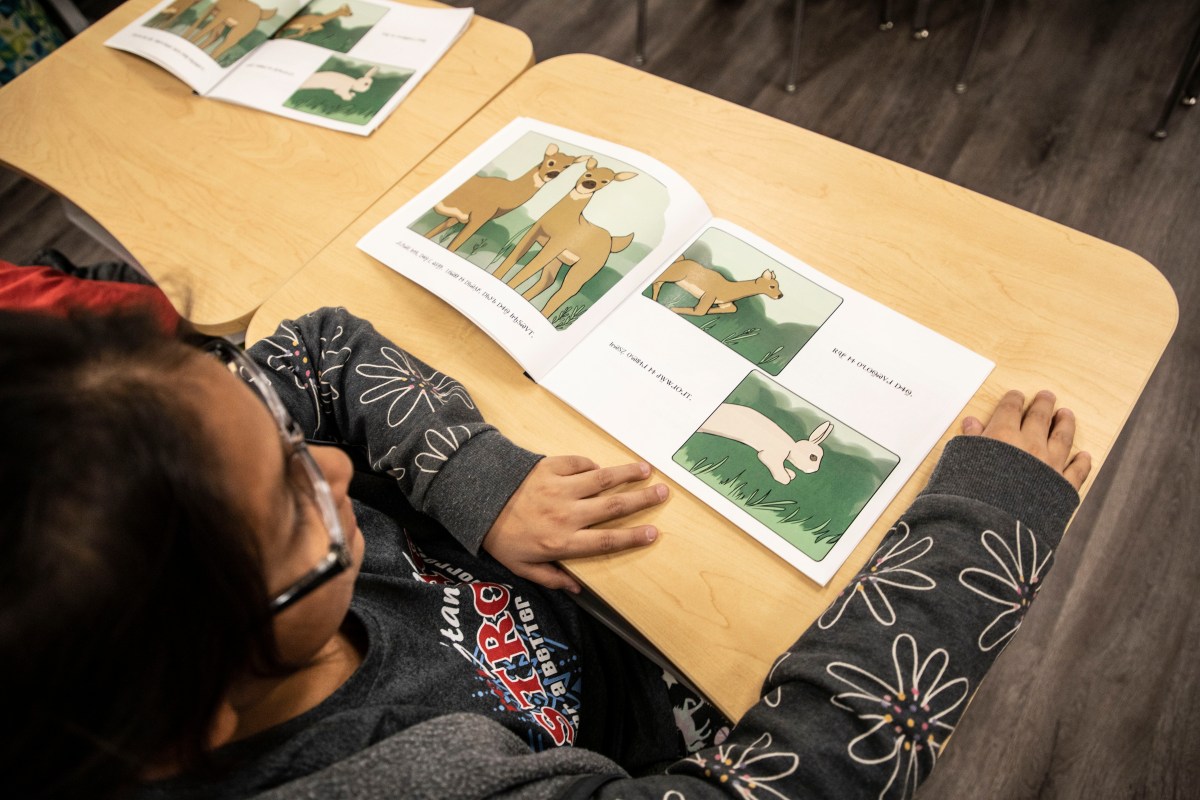
Howard Paden, executive director of the Cherokee Nation Language Department, said they have students in the Cherokee Language Immersion School as young as 6 weeks old. The school began in 2001, putting infants through adults into a primarily Cherokee-speaking environment.
The young students are often given Cherokee names, which they learn from childhood.
This is a juxtaposition to the time Cherokee children were given English names in boarding schools. The Cherokee Nation reclaims that experience, indigenizing it to deconstruct the country’s assimilation efforts.
“During COVID when everyone was at home, we tried thinking of how to keep people engaged and keep the language alive, so we turned to social media. We started posting ‘Word of the Day’ on Facebook in 2021. We now have an Instagram and a TikTok account. We are also on YouTube,” said KenLea Keys, Cherokee Nation social media strategist.
The Cherokee Nation TikTok account has over 189,000 followers, with each video receiving thousands of likes and views. Keys said they try to follow TikTok trends when crafting their videos.
“We have one video that went pretty viral where we did the ‘Mean Girls’ trend since the new movie was coming out. We said, ‘On Wednesdays, we wear pink,’ in Cherokee,” Keys said.
“We are seeing the language become normalized and getting that recognition. I think our most viral TikTok was teaching how to say, ‘Watch for turtles,’ in Cherokee. We also had a viral video of how to say, ‘Protect Them’ as part of an MMIW Campaign.”
Teachers from the Cherokee Language Master Apprentice Program and fluent elders are featured in their videos. The language has its own syllabary that can be downloaded to any iPhone or Android through the application CWY on the Google Play Store and Apple Store. The Cherokee language is also available to learn on the Mango app.
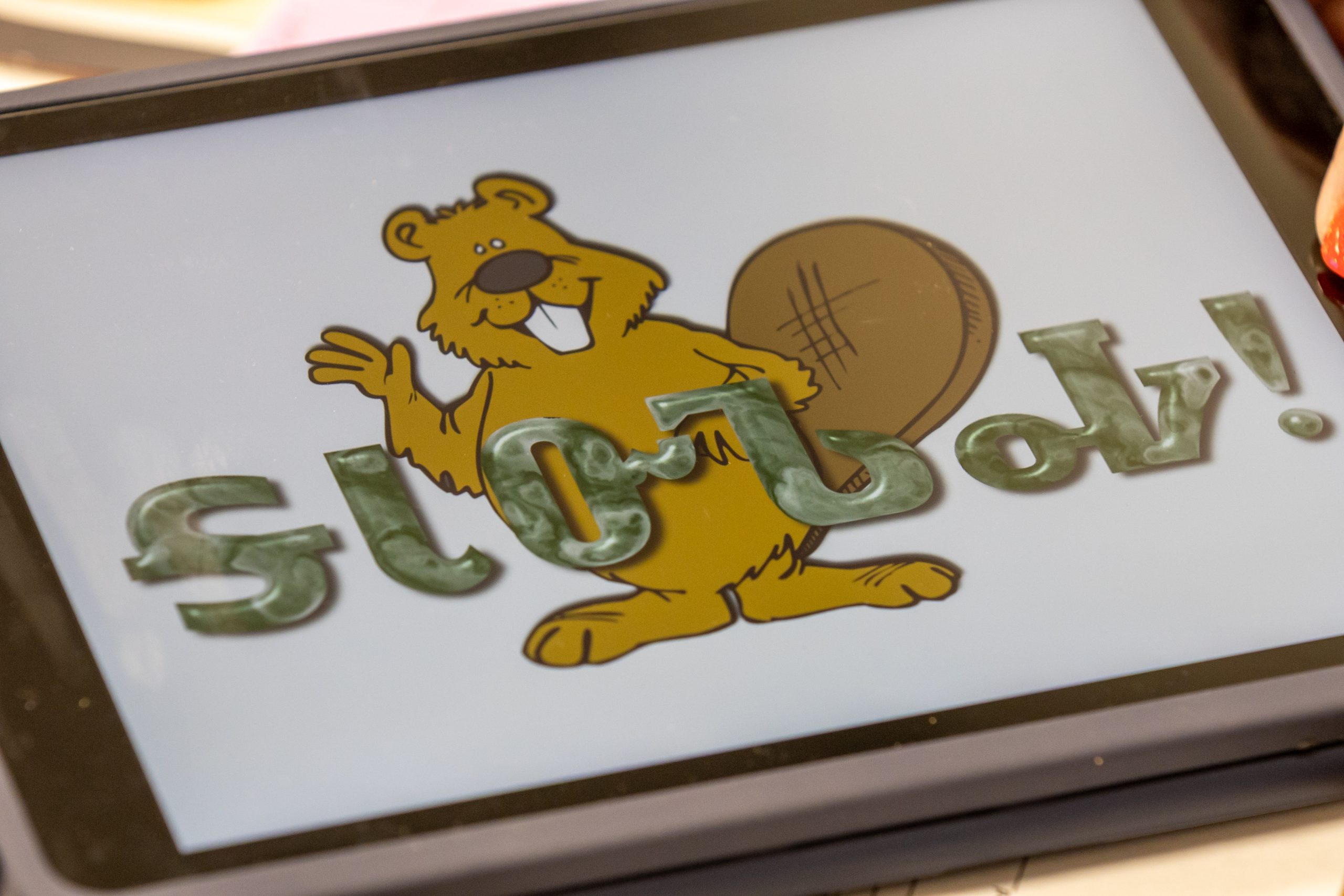
They also created the video game “Adalonuhesgi,” or “trickster,” that is about a trickster rabbit character who tries to steal Cherokee elders, and the goal of the game is to save the elders and the language.
“This way we are reaching users beyond Oklahoma. We have viewers from all over the world on social media who can learn the language,” Keys said.
Hoskin emphasized the need to create normalcy for learning and speaking the Cherokee language.
“We’re putting some objective analysis on ourselves to make sure what we’re doing is effective. In the immersion school in particular, we want kids coming out learning the language for their lifetime and having an education that fulfills them for a lifetime,” Hoskin said.
The biggest local effort at language teaching is the Cherokee Language Immersion School in Tahlequah. The initial teachers are the 2,000 fluent Cherokee speakers still alive. The next generation is made up of second-language speakers, adults who have completed the two-year language program and are certified to teach.
There are campus locations in Tahlequah and Greasy, and the Cherokee Nation has plans to build a location in Kenwood, which will be on 1,400 acres of land.
They also have a Sequoyah High School Language Immersion After-School Program for students to receive more intensive language instruction.
Teachers are offered a training scholarship through the program. When they complete their first academic year, students sign a contract committing their teaching services after graduation to the immersion school.
Spending every day with a group of Cherokee teachers and learners is a “spiritual awakening” said immersion program student Bradley Jones in an ICT and Tulsa World interview.
Jones is a high school Native American history teacher and coach of four sports at Sequoyah Indian High School. His Cherokee name is Yona, and he grew up “around the Cherokee language, but never really appreciated it properly until the learning program.”
“We start every day with a morning song in Cherokee, and basically we are singing, ‘We are going to speak Cherokee this day, learn Cherokee this day,’ and we’re asking for a blessing to allow that to happen. And then we say a Cherokee prayer every morning before we meet and congregate,” said Jones.
He also said there are no tests or grades in the program, as they try to avoid a Western style of teaching.
“We are assessed by interviews. They even encourage us not to take notes. They say the language will come to you. At first, it was really hard to understand what they meant by that, but now, when you keep your ears alert, you hear Cherokee everywhere you go, whether it’s listening to it, reading it or just listening to old interviews,” he said.
Jones spoke about the language reflecting the culture and the culture reflecting the language. “When people say the culture is in the language, that is 100 percent true. You learn more about yourself and about your ancestors, why they did things the way they did.”
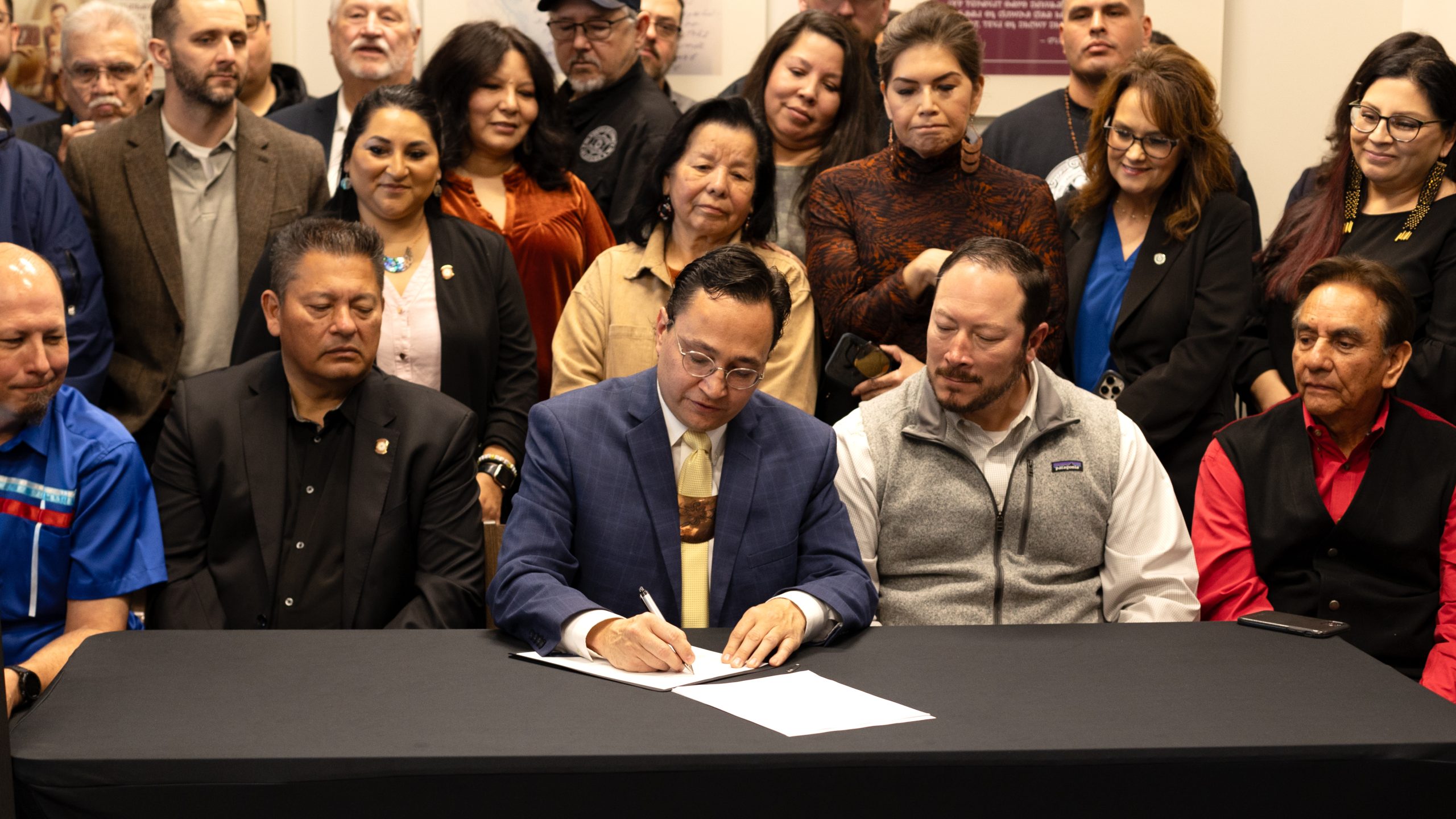
At a January 24 signing ceremony held at the Cherokee Language Immersion School in Tahlequah, Hoskin signed a piece of legislation that reauthorizes earlier legislation that supports continuing Cherokee language programs indefinitely. The Durbin Feeling Language Preservation Act was passed in 2019 to assist in the language initiatives of the Cherokee Nation.
It was named after the late Durbin Feeling, a Cherokee linguist who wrote the Cherokee-English dictionary in 1975. Feeling’s wife attended the ceremonial signing of the act reauthorization held January 24 at the Durbin Feeling Language Center in Tahlequah.
“What this reauthorization does is it takes the very successful pilot effort under the Durbin Feeling Act and makes it permanent. It stabilizes the operation funds, Hoskin said. “I mean we’re at a high watermark now of about $18 million in annual operating funds. This legislation says we should not drop below that, and it puts pressure on me to increase that over time.”
Hoskin said the law is like a stamp of approval from the government for the immersion schools, “which are expanding our translation department, our use of technology, creative arts and speaker services, which improves fluent speakers’ quality of life. It not only puts the stamp of approval, but it centers our focus as a government.’
Over $30 million dollars are going into the new immersion middle school in Kenwood.
“We have the little kids, the K-6, here at this immersion school, and this is a beautiful campus. We have a baby language development in the community of Greasy. Just a short distance from here, we will have the $30 million dollar middle school,” Hoskin said.
The legislation states that by 2027, the Cherokee Nation will have the Kenwood campus available.
Said Hoskin: “What we want is in a generation or two is to make the language more a part of Cherokee peoples’ lives, no matter where they live. … We need to have a day when the Cherokee Nation will have a chief, unlike me, who can speak fluently to his or her people.”

Our stories are worth telling. Our stories are worth sharing. Our stories are worth your support. Contribute $5 or $10 today to help ICT carry out its critical mission. Sign up for ICT’s free newsletter.