
Every summer, cattails rise from their winter slumber to stand sentry around the nation’s marshlands, waterways and ponds. Tall and distinctive with their cylindrical seedpods (hence, the name “cattail”), they are largely regarded as either a bothersome weed or a sought-after landscaping element—depending on your point of view.
Usually found in tight clusters reaching up to 10 feet in height, cattails are no pushover. As self-pollinating monocots, they are aggressive colonizers of wetlands and marsh areas where they dominate other native plant species. Even so, the cattail is also a natural water purifier that absorbs arsenic, phosphorous and other contaminants, while providing a natural habitat for dozens of species of fish, birds, insects and other wildlife.
But across North America, the humble aquatic perennial has a long and storied history among tribes for its myriad uses. From root to tip, cattails have been used by Native people for at least 12,000 years for practically everything from food, medicine and shelter, to name just a few of their applications.
“We used cattails in a variety of ways, but also as food,” says Timothy Begay, cultural specialist for the Navajo Nation Historic Preservation Department. “It grows around our springs and wet areas and it has a big presence around our four major rivers, including the Rio Grande, the Little Colorado, the Colorado and the San Juan. It has always had a presence in our culture.”
As part of the genus Typha, there are three species of cattail in the United States. They are the broadleaf cattail (T. latifolia) and southern cattail (T. domengensis), both of which are Native to North America; and the narrowleaf cattail (T. angustifolia), which is thought to have been brought over from Europe.
As a food source, the cattail is high in fiber, calcium, B-6, magnesium, potassium and manganese. Its roots and stems can be peeled and eaten raw or boiled. They can also be ground into flour (one acre of cattails can produce up to 6,500 pounds of flour). The leaves can be eaten in salads; even the pollen can be collected and added to bread or used as a thickener. The flower spikes can be boiled or roasted and eaten like corn.
For medicinal purposes, cattails were nature’s first aid kit. Cattail pollen is a hemostatic that helps control bleeding and has antiseptic and diuretic properties. Its mashed roots can be used as toothpaste or as a poultice for wounds, insect bites and infections. And it can be used in a drink to relieve diarrhea.
Additionally, the jelly-like substance that grows between its leaves can also be used as an antiseptic and a pain reliever. Because of its medicinal potency, women are warned against using it during pregnancy.
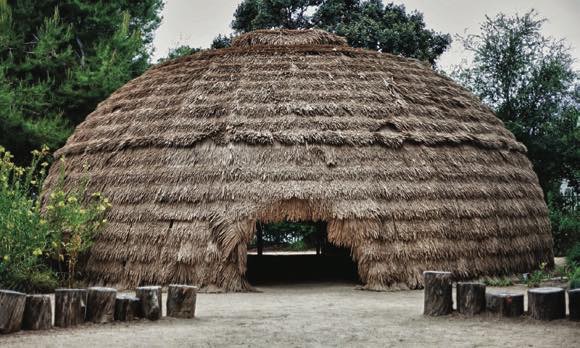
Cattails are a significant part of cultural patrimony in tribal cultures from coast to coast. The plant stalk and its fibers were made into shelter, boats, mats, clothing, shoes, baskets, ropes and nets for fishing, while the “fluff ” was employed as insulation, bedding and diapers, as well as padding for footwear and cradleboards.
Though the widespread use of cattails has diminished in the modern era, many tribes still recognize their importance. “People here still go out and collect leaves and pollen for offerings,” says Begay. “The cattail is so significant that we use it in all of our major ceremonies to this day.”
