A report in Quaternary Science Reviews in August of 2012, entitled “Early Retreat of the Alaska Peninsula Glacier Complex and the Implications for Coastal Migrations of First Americans” suggested that the deglaciation around the Aleutian Islands may have occurred between 1,500 and 2,000 years earlier than previous believed. It has also concluded that the maximum thickness of the ice sheet in the Sanak Island region during the last glacial maximum was 70 meters, or about half that previously projected–and that deglaciation could have happened more rapidly than earlier models predicted. As Sergio Prostak wrote in Sci-News.com:
The study is important because it suggests that the possible coastal migration of people from Asia into North America and South America–popularly known as “First Americans” studies—could have begun as much as two millennia earlier than the generally accepted date of ice retreat in this area, which was 15,000 years before present.
The lead author of the report, Nicole Misarti of Oregon State University, added that “Glaciers would have retreated sufficiently so as to not hinder the movement of humans along the southern edge of the Bering land bridge as early as almost 17,000 years ago,” and that they found “a full contingent of pollen that indicated dry tundra vegetation by 16,300 years ago. That would have been a viable landscape for people to survive on, or move through. It wasn’t just bare ice and rock.”
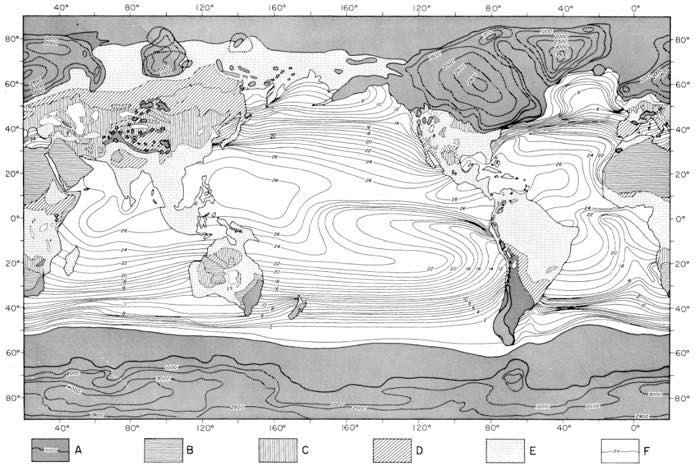
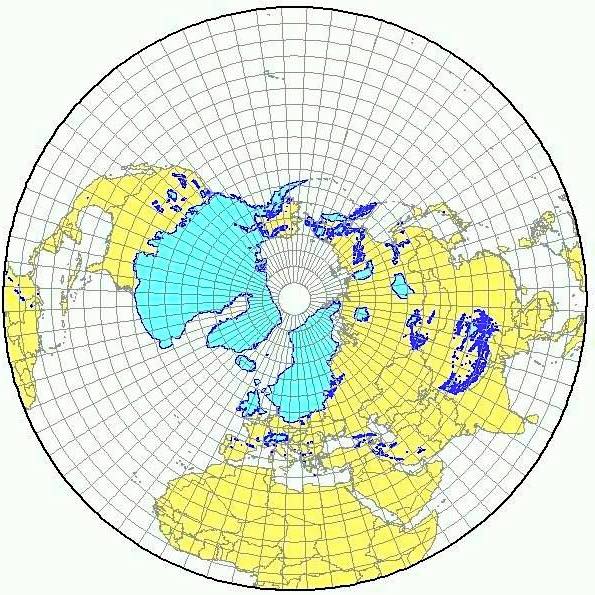
The new dates make the Coastal Migration Theory more plausible by giving Paleoindians possibly 1,500 years to travel 8,000 miles to the early Monte Verde site, as opposed to only 200 years, as had been previously presumed. But making things more complex, recent studies from Russia indicate that the eastern side of Beringia may have been covered with ice-sheets, dispelling the notion that this area was ice-free. Large ice-sheets, up to 3,000 feet in thickness, also covered parts of the Arctic Ocean. Exactly when these ice-sheets existed and their extent is not certain.
The most recent glacial period (which is the one which has a bearing on our discussion) has a bewildering number of differing names for different areas, although Late Wisconsinan is often used for the North American glaciation. The “Last Glacial Maximum (LGM)” is the period when the ice sheets reached their greatest extent, approximately 26,000-19,000 years ago.
For the Bering Strait Theory as it currently stands, exactly when the ice-sheets retreated enough to allow passage, by land or by sea, is essential. Right now the question is, “was travel even possible.” Whether travel was likely or easier than any other route, given the hostile environment, is another discussion. The Standstill theory supposes that Paleoindians lived in Beringia during the height of the Last Glacial Maximum, surrounded by massive ice sheets.
The first map of the ice caps of North America to be drawn with reasonable accuracy was by the influential geologist and founder of the Journal of Geology, Thomas Crowder Chamberlin, in 1894, although the area of Alaska was left incomplete.

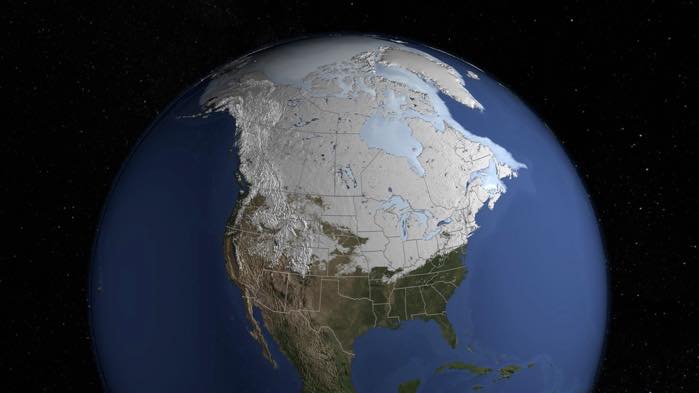
Throughout the 20th century, greater advances in research and technology began to make it clear that the ice cap’s expansion and retreat was not synchronized, but varied depending on the location. Radiocarbon dating has helped to provide a more exact extent of the glaciation and also the dates for ice advances and retreats. By collecting samples of pollen, wood, or plants, the radiocarbon dates given can determine approximately when an area was devoid of any plant life, and thus completely covered with ice, or when it became ice-free.
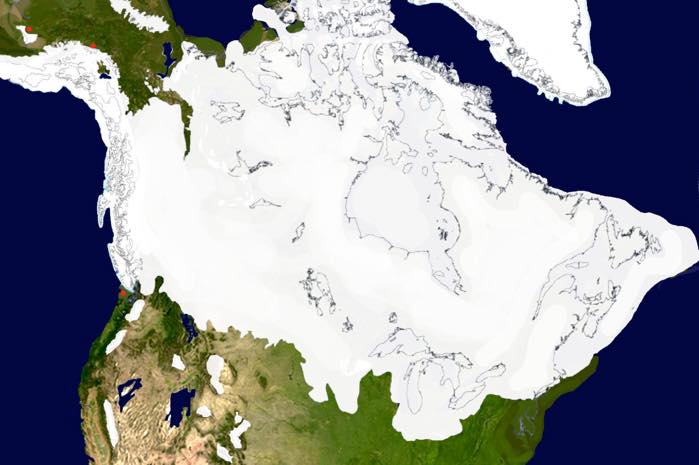
The Canadian geologist, Arthur S. Dyke, has collected radiocarbon data from a vast array of sources and compiled them into a database, using it to create one of the most comprehensive maps of North American glaciation. Although new studies continue to expand and change our knowledge of the extent of the ice sheets, Dyke’s maps are still in standard use today. The following maps are based on his 2004 paper, “An Outline of North American Deglaciation with Emphasis on Central and Northern Canada.” The ice sheets are pictured in white, and red dots are radiocarbon data.
There is little doubt that during the LGM, passage to the Americas through Beringia was virtually impossible. Approximately 18,000 years ago, the ice began to retreat, but at what point it retreated sufficiently to allow passage is still unclear.

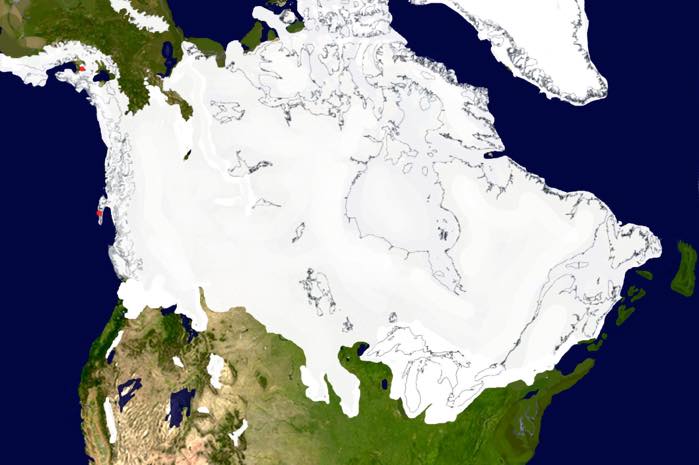

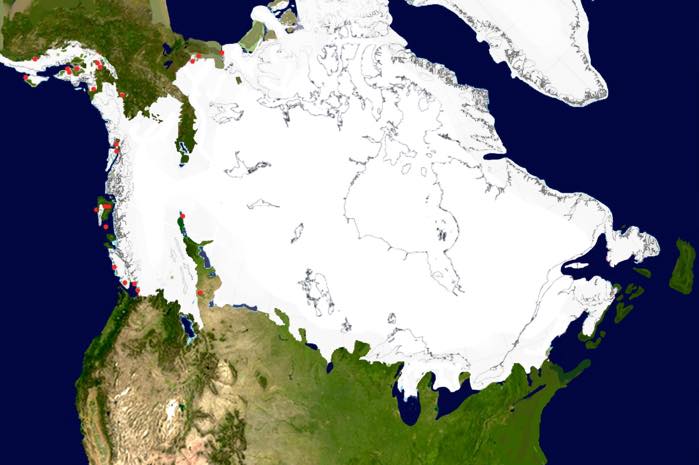
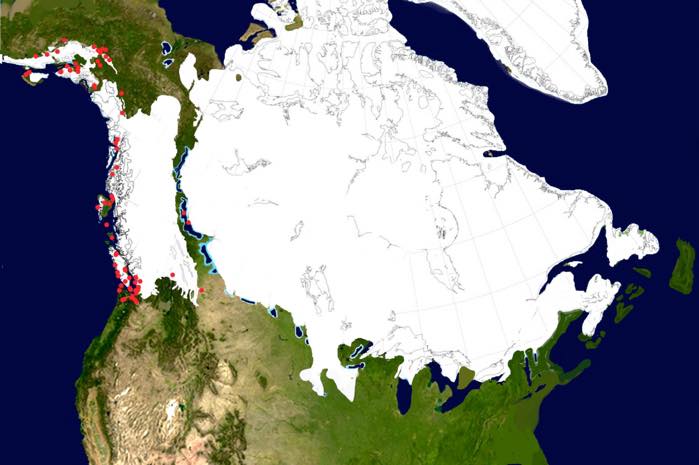
The maps do not take into account the extent of sea ice along the coasts during the period between the LGM and the end of the Wisconsinan. The extent and timing of sea ice in that region and period is currently not clear. The CLIMAP project estimated that 18,000 years ago, the seas around Bering were 4° C cooler that they are today and the seas around the Japanese coast and the Kamchatka Peninsula up to 10° C cooler than today.