Sandra Hale Schulman
ICT
The latest: Bronze statues honor native animals and materials, luxe skincare wins award, Trail of Tears songbook
ART: Artist takes on New York critters and philosophy
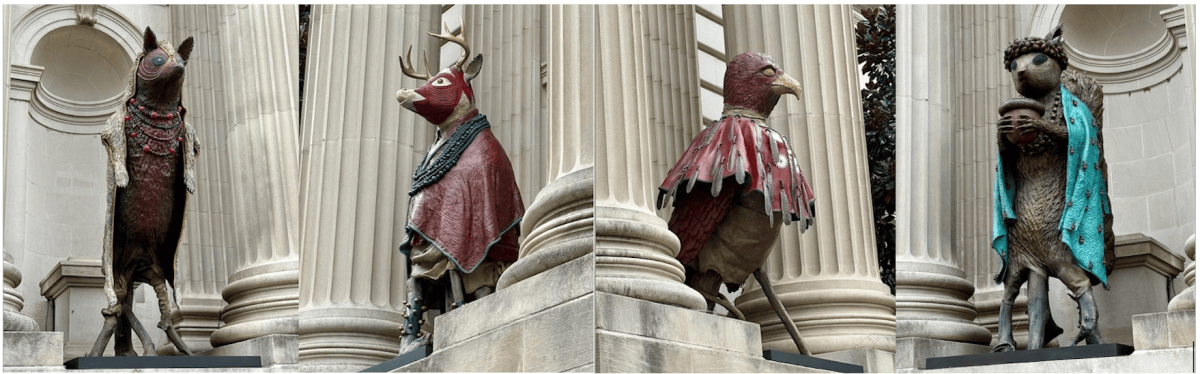
Fantastical creatures native to New York City grace the entrance to the Metropolitan Museum of Art in a new installation by Jeffrey Gibson, Choctaw. The four new sculptures on the Fifth Avenue facade of a deer, a coyote, a squirrel and a hawk are collectively titled “The Animal That Therefore I Am” after a published book by the French philosopher Jacques Derrida. These sculptures are poignant messengers. Derrida was known as the founder of deconstructionism, a complex and divisive brand of philosophy that examined languages.
Standing 10-feet tall on two legs, paws, claws and hooves, they began life as sculptures carved from driftwood found in the Hudson River then mixed with clay, rawhide, beads and feathers, digitally scanned, cast in bronze, and hand colored with a time-consuming patina process.

They have long teaching names. The deer wears a deep red poncho, a necklace of blueberries and is titled “they teach us to be sensitive and to trust our instincts issi/awi/deer.” “Issi” is Choctaw for deer, from Gibson’s father’s side, and “awi” is Cherokee for deer, from his mother’s side.
Next is the coyote, wearing a coyote-skin cloak, an ode to this trickster, titled “they are witty and transform themselves in order to guide us nashoba holba/wayaha/coyote.”
The squirrel holds a big stash acorn, a crown of nuts, and wears a turquoise cloak adorned with more acorns. It is called “they plan and prepare for the future, fvni / sa lo li / squirrel”.
The hawk is called “they carry messages between light and dark spaces bia̱kak/dawodv/hawk” while enveloped in a dark red cape with bronze feathers dangling from it.
Gibson says the regalia is a comment on how animals have been forced to adapt their lives to survive with humans in their environment. He says the regalia “is imbued with the ability to transform oneself — while you’re wearing it, you are a different being.”
The installation remains on view through June 2026.
BEAUTY: Native brand earns national magazine award

Acorn news from art in NY to skincare in CA!
N8iV Beauty, the acorn oil-based skincare line from founder Ruth Ann Thorn, has won a 2025 Best of Beauty Award by prestigious fashion publication Allure magazine out of a field of tens of thousands of products.
They won for the Móyla (Moon) Polish Exfoliate, making N8iV Beauty the first Native American brand to receive this recognition. Allure editors will gather to honor the winners during a special ceremony on Saturday, October 18, at Chelsea Industrial in New York City.
Allure said: “Founded by a California-based entrepreneur, Ruth-Ann Thorn, with roots in the Payómkawichum (Luiseño people), N8iV Beauty’s formulas are inspired by plant-based remedies handed down from her ancestors over thousands of years. Both a chemical and physical exfoliant, the Móyla ‘Moon’ Polish Exfoliant gently sloughs away dead skin cells on the surface and boosts cell turnover below it using botanical extracts (sweetgrass, spirulina, white willow bark, and comfrey, to name a few) and a very low level of fine line-smoothing retinyl palmitate. Soothing ingredients, including niacinamide, chlorella, calendula, aloe, and chamomile, ensure your skin isn’t stripped dry in the process.”
“I love that this formula offers just the right amount of exfoliation yet isn’t the least bit harsh. Every time I use it, my skin is left soft with a healthy-looking glow — like it’s just been freshly scrubbed,” said Alison Ward Frank, senior vice president of global talent for Allure.
“We are deeply honored to receive this award from Allure Magazine,” shares Ruth-Ann Thorn. “This recognition reflects our commitment to restoring beauty routines through the rich tapestry of our culture.”
Products are available online, at select fairs throughout the year and at the only Native boutique in San Diego, Native Star, which also carries indigenous fashion, jewelry, foods and wine.
FILM: Cherokee history told through lost hymns
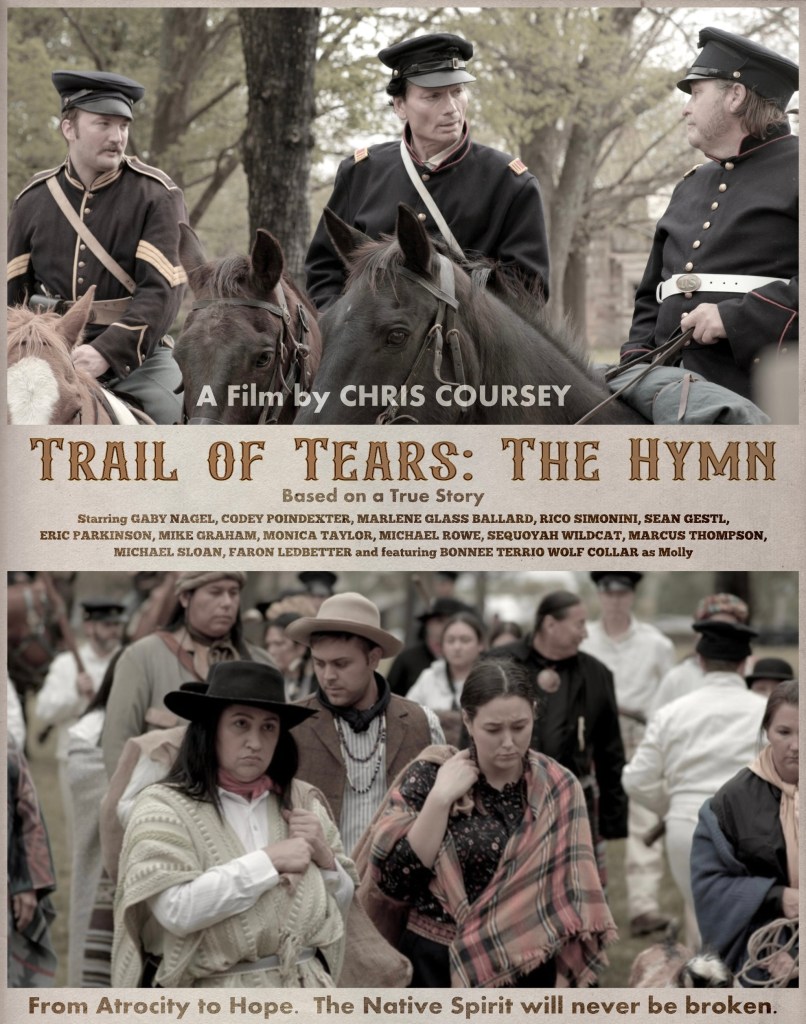
“Trail of Tears: The Hymn,” a new short film, will be released as the lead title to filmmaker Chris Coursey’s feature anthology, “Native Fables,” which features four additional Native-themed short films. The Trail of Tears segment will be exhibited theatrically at Laemmle Theatres in Los Angeles, starting September 26, as a qualifying theatrical run for the Best Short Film (Live Action) category of the Oscars.
“The forced marches on the ‘Trail of Tears’ is a dark chapter in American history,” Coursey told ICT. “Thousands died on the 1,100-mile march from North Carolina to the Indian Territory, and those that made it have few items from their past. This film tells the story of David Brown, who transcribed a song his grandmother frequently shared with him. The book containing the lyrics in Cherokee was lost along the Trail of Tears. Our film tells his story, including the discovery of the book and the hymn’s adaptation into a choral song for our Cherokee choir.”
The lyrics were adapted by Marlene Glass Ballard (a first-language Cherokee speaker), and the Cherokee choir was directed by Oklahoma music legend and Cherokee Nation member Monica Taylor. Some of the principal photography occurred along the actual Trail of Tears. Other locations included a home in Tahlequah, Oklahoma, Trail of Tears scenes at the Illinois River and a finale at the Celebration Grounds for the United Keetowah Bank of Cherokee Indians.
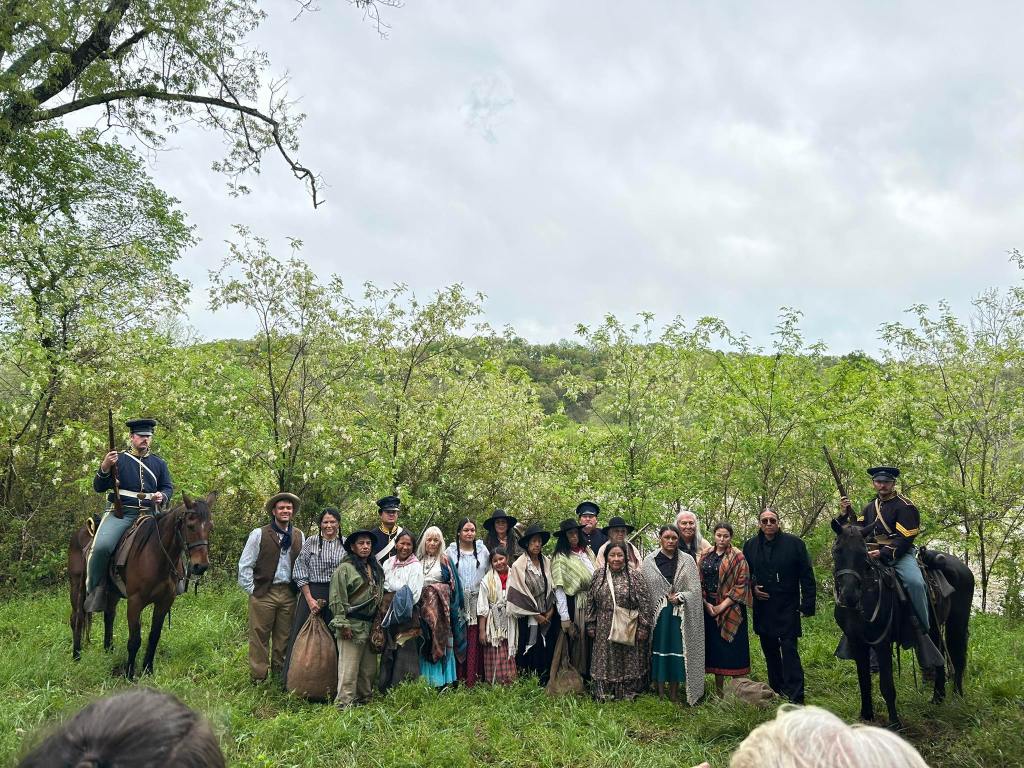
The forced marching scenes included over 40 Native performers as villagers and 12 uniformed Army officers and soldiers. Scenes were shot along the actual Trail of Tears, including the overnight camping locations.
“We are very pleased with how the movie turned out, and hope that our marketing efforts will let it be seen by a large audience,” says Coursey. “The history of our Native peoples should not be brushed aside for political expediency. We are telling a story of hope that emerged from tragedy. We owe it to those who lost their lives on the Trail of Tears to not let their stories be forgotten.”
The actual manuscript is now on display at the Cherokee National Research Center and was the inspiration for Coursey to tell the story of this journey.