
Sandra Hale Schulman
ICT
The latest: Native style shines in San Diego, bison knowledge in song, Boston showcases Indigenous art
STYLE: Native Star is a stellar new experience
A powerhouse visionary showcasing Native arts and style, Ruth Ann Thorn, Luiseno, rose from hard-won experience as a teenage drug runner to become a beacon for Indigenous resilience.
She hosts a TV series, “This is Indian Country,” currently streaming on the new FNX media app. She has owned seven art galleries called Exclusive Collections. Her acorn oil-based skin care line grown on tribal land, N8iV Beauty, is a unique, high-end brand recently showcased at the Coachella Music festival, the first Native-owned line to be represented there.
Now Thorn has become the first Native to own property and open a retail store in the historic Gaslamp District of San Diego, an area that once posted signs that read “Indians Wanted: $25 a head. Dead or alive.”

The boutique store, Native Star, housed in the jewel 1882 Yuma Building that Thorn owns has stained glass and painted architectural detail, was purchased with the help from the Soboba tribe bank. With the rise in Native fashion and interest in the arts and culture, she has opened a store that carries some of everything.
At the May 30 grand opening, there was a proclamation from the mayor, drum groups, live blues music from Tracey Lee Nelson, a frybread lounge, and hundreds of dressed up Natives.
“You do these things and you don’t know what’s going to happen, but I just think everything came together so beautifully,” Thorn told ICT. “What I really enjoyed was the community. Seeing tribal members and Native people come in that felt a sense of pride.”

Thorn carries several Native designers that only sell online now. Retail is a big next step, and Thorn has been helping to educate on the importance, as well as the financial aspect. She hopes that lines of coffee, wine, wild rice, contemporary designs from Sky Eagle Collections, K Lookinghorse, Patricia Michaels, and Thunder Voice Hat Co. will open customers’ eyes to the wealth of products available.
“I feel like we’re at the very beginning of something that’s going to be even more and more incredible as time goes on. I can see this opening up in other major cities in New York and LA. It’s not just about business, it’s about representation, that’s the key. I’m doing something that’s for our community, that’s just intrinsic in who we are as Native people and once you start getting in touch with your culture you feel an obligation to push things forward.”
MUSIC: New song taps into Tatanka culture
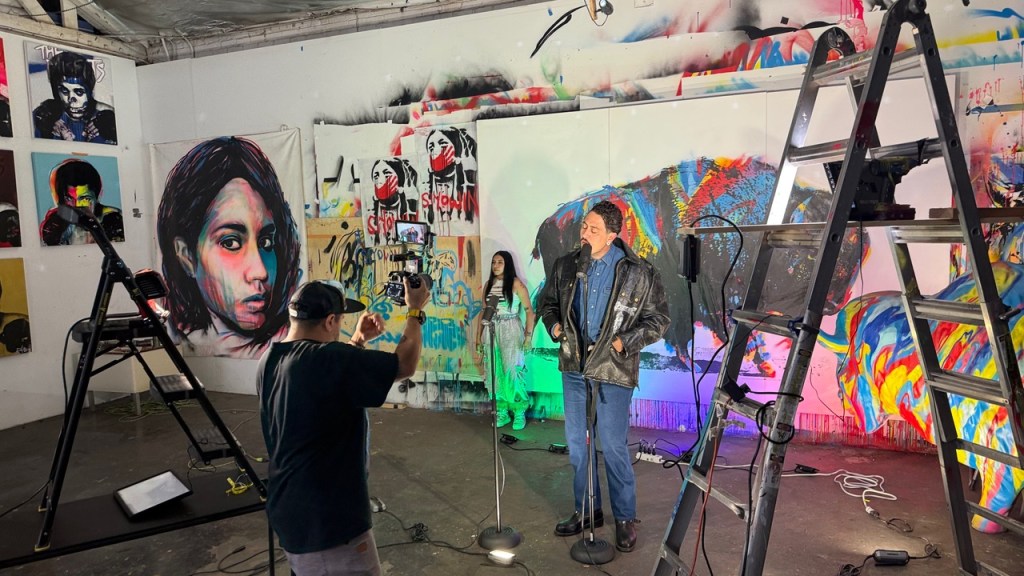
Pat Vegas and Stella Standing Bear have released a new song, “The Buffalo Know,” after meeting in New York. Produced by Tippie, a Comanche producer from Los Angeles, the haunting melody stampedes from lilting to thundering with a rap edge.
“Stella and I met in New York as the only Native American artists representing on a major platform On the Radar,” Vegas says. “From that moment, our connection was real. Creating The Buffalo Know together was powerful – Stella truly captured the spirit of the moment with grace and heart.”
Standing Bear says, “It was an absolute honor to collaborate with PJ Vegas – kin of the legendary Redbone, known for the iconic ‘Come and Get Your Love.’ We made history together as the first Native American artists to represent our people on a major platform. From the moment we met in New York, making that connection – we knew we had to collaborate. Together, we’re stronger.”
“’The Buffalo Know’ is a tribute to the resilience of our people. My verse was inspired by the strength it takes to endure what we’ve been through – generations of hardship, displacement and pain – and yet, we’re still here, still standing. I was taught that when a storm comes, the buffalo don’t run away – they walk straight into it. Even more powerful is how they protect the herd. The youngest stay at the center, surrounded by teens, then mothers, and finally, the strongest bulls form the outer circle, facing danger head-on.
“That kind of unity and protection reflects how we are as Indigenous people – we protect the most vulnerable and face the storm together. It also speaks to the ongoing fight to protect our women, girls and Two-Spirit relatives from violence. We move like the buffalo – with purpose, strength and the instinct to protect our people. We face the storm together.
“Colonizers tried to break that strength by targeting our food source – the buffalo. They slaughtered Tatanka in massive numbers, wasting their bodies and trying to erase our connection to the land. But we’ve always honored the buffalo. We used every part in a good way – for food, clothing, tools and ceremony. Though they were nearly driven to extinction, just like our traditions, the buffalo survived. And so did we. The buffalo know.”
A music video is being produced for release on YouTube.
ART: Top artists in an art exchange
Triennial 2025: The Exchange is the inaugural edition of the Boston Public Art Triennial. A citywide exhibition with newly commissioned public artworks placed throughout Boston’s diverse neighborhoods has art from some top Native artists. The Exchange invited artists and experts to work together to create impactful artworks that present compelling narratives about the issues faced as a society from now through October 31, 2025.
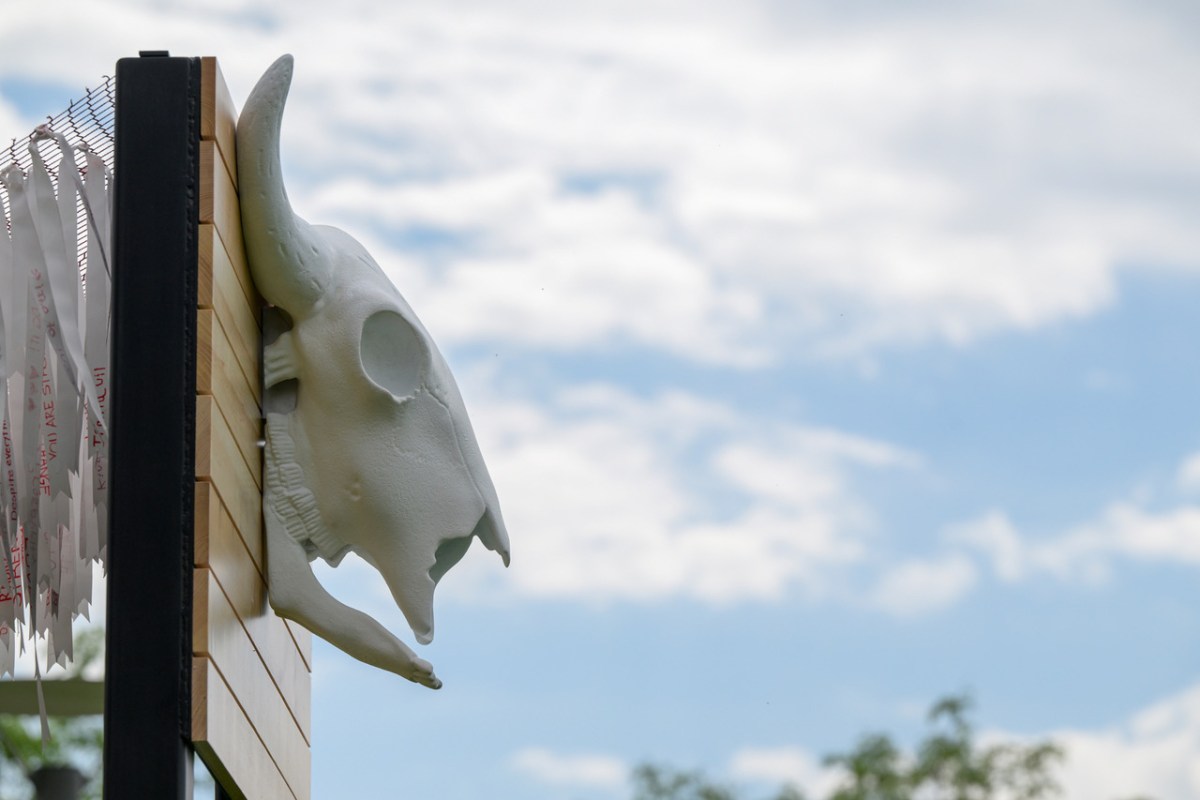
Fresh off his GHOST Ride at Desert X, Cannupa Hanska Luger created “Transmutation,” which extends Luger’s ongoing interventions in public space, where speculative fiction, land-based restoration, and acts of collective empathy meet. Two towering portals hold colossal buffalo skulls, with suspended mesh fabric and thousands of ribbons, each one knotted and inscribed with messages by the hands of community members.
New Red Order is a public secret society facilitated by core contributors Adam Khalil, Zack Khalil, and Jackson Polys. They present a larger-than-life sculpture. Material Monument to Thomas Morton, which humorously highlights the controversial colonial figure and Puritan defector Thomas Morton, leader of the Merrymount Colony, known for staging multi-day celebrations around an 80-foot maypole.
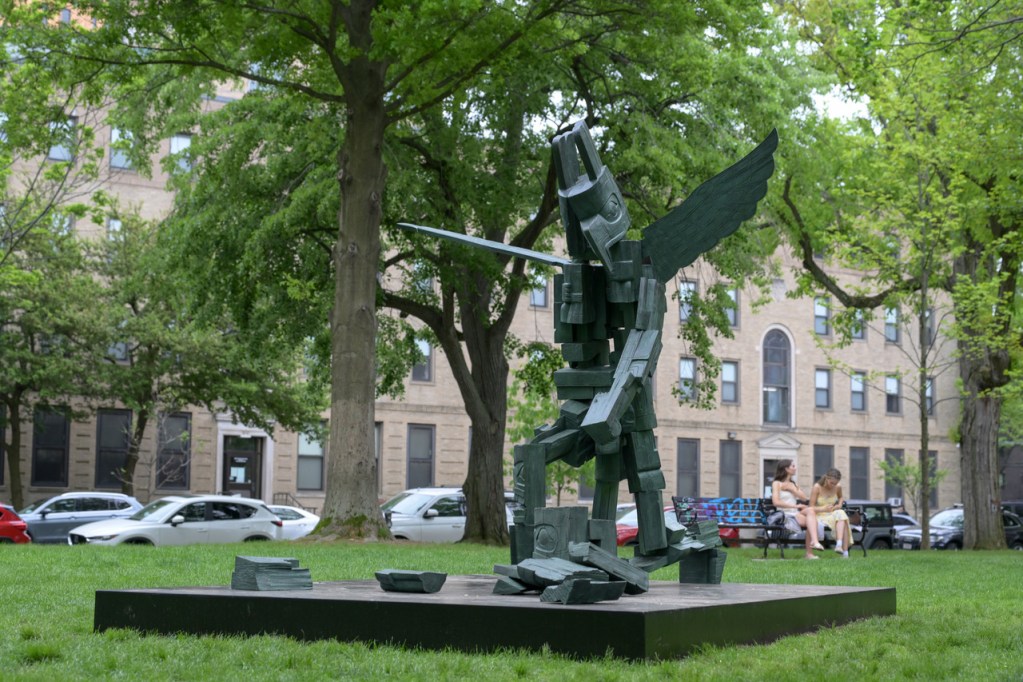
Artist Nicholas Galanin has a new sculpture, “I think it goes like this (pick yourself up),” a monumental bronze cast from chopped-up imitation totems. The bronze logs show a kneeling figure, pulling itself together from a pile. The work reflects damage to Indigenous culture and technology inflicted by colonization.

