
Sandra Hale Schulman
Special to ICT
The latest: Large scale art talking heads, groundbreaking Biennale show moves to LA, Down under magic on film
ART: Mesa art in Manhattan
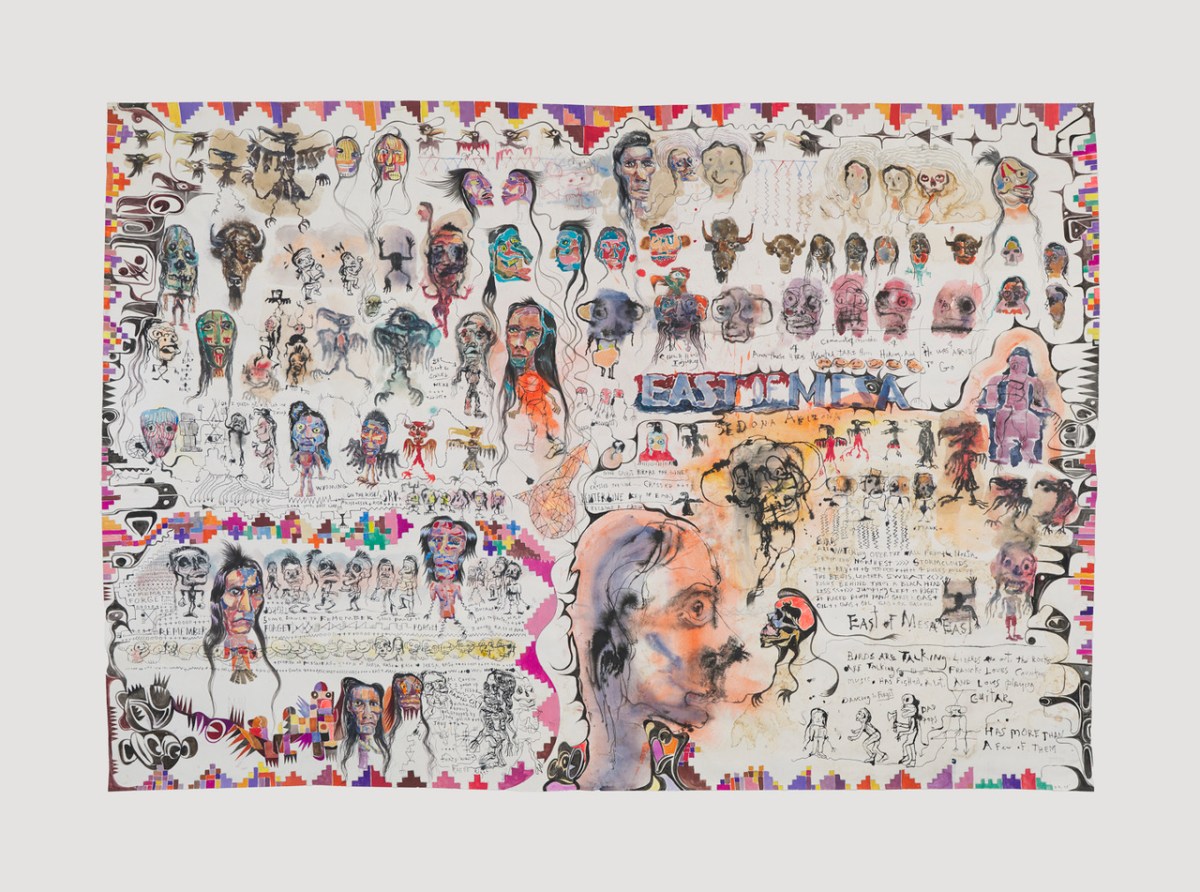
The wildly prolific Brad Kahlhamer has opened his first solo show at the Venus Over Manhattan Gallery in NYC Bowery Nation: Birds Are Talking.
On view from May 13th until mid-June, the show debuts a new body of work created primarily at his winter studio in Mesa, Arizona, with eight large-scale paintings on bedsheets, and a new “Supercatcher” sculpture – a dreamcatcher on steroids. The artworks map a deeply personal cosmology that draws upon Indigenous storytelling, punk aesthetics, Abstract Expressionism, and the raw textures of New York City street culture.
“I wanted to show big-scale work based on the Dakota winter camps from the 1800s,” Kahlhamer told ICT. “Artists were drawing on square yard sections of cloth or hides. They would record movements on it, kind of a calendar. I traveled with the in-progress artwork so some of them were responding to the local lands and the atmosphere.
“Part of the innovation that was new for me was the way the bed sheets take color. One of them got left out in the desert rain but I liked how the color was another iteration of paint that got impressed. There’s really something there and I’ll just react to what that night in the rain left me. I’ve become a historic book collector; I buy these books at secondhand shops and reframe a lot of these pictures in a contemporary way.”
With so many images of faces with floating braids, wolves, birds, and horses, does he plan the paintings out?
“These were done in quite an intense rush, it’s very musical, like a set list,” Kahlhamer says. “They have a lot of stories. I’m not looking at a contemporary photograph or an icon. I’ll name them after I come up with the actual subject matters, which is how I would imagine the winter camp. The tribe would have traveled a bit and then added an event, then picked up, gone on to the next, added another event. It would have the sequential images of a comic book.
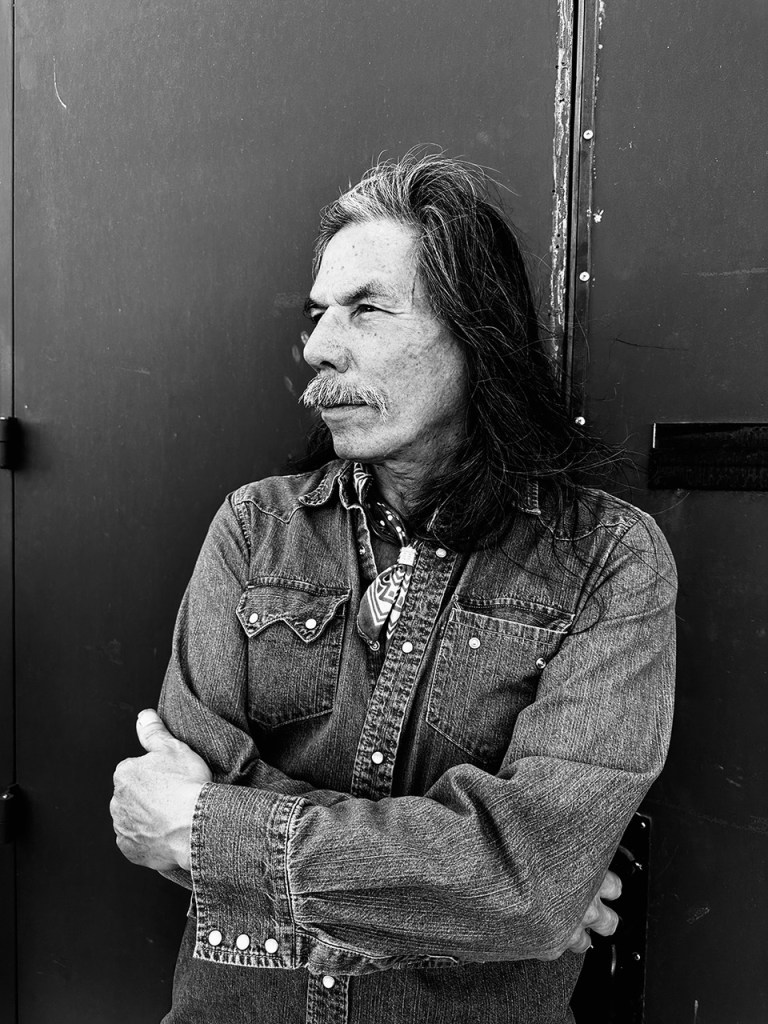
“The title ‘Birds Are Talking’ is excerpted out of a longer stream of consciousness story. I saw the title in a book that had a montage of different winged creatures. It spoke to me, that birds are talking. And the Bowery Nation is the title of a previous show. They are a fictitious tribe because I’ve been living off the Bowery in NYC since the early ’90s. It’s backdating the history of Manhattan to early times, re-colonizing it in a conceptual way. I use Bowery Nation as a book title. And the Birds Are Talking could be volume one.”
As a companion, Kahlhamer will be showing the original Bowery Nation art in Madrid, Spain, in July.
ART: From Italy to California, a new space to place art
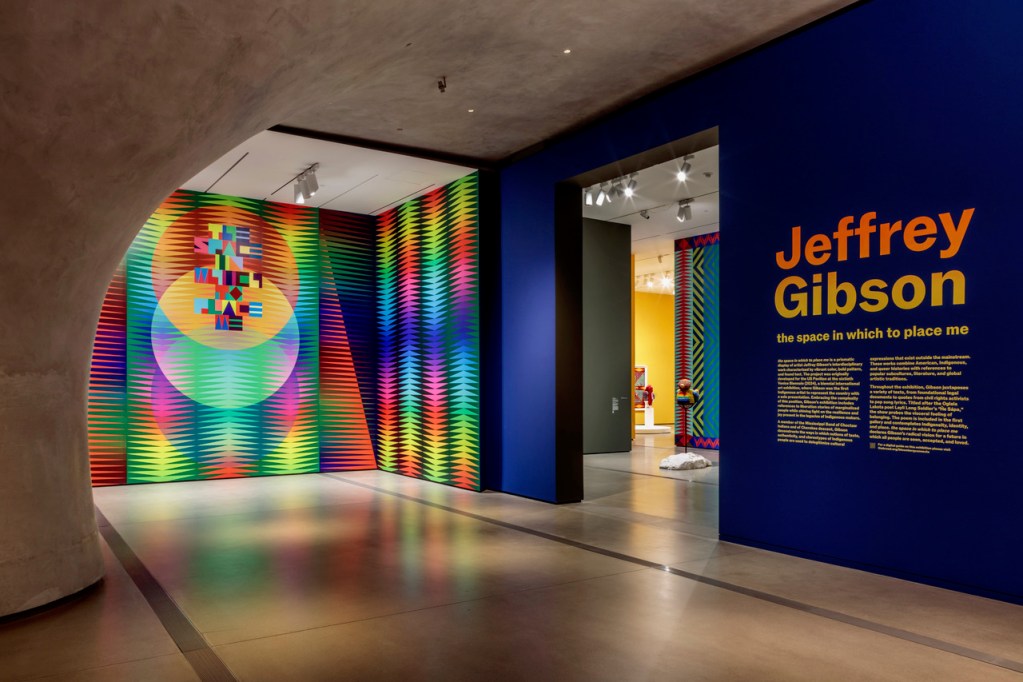
The knockout, groundbreaking exhibit that Cherokee artist Jeffrey Gibson presented at the Venice Biennale last year has moved to The Broad Museum in Los Angeles now through Sept. 28.
“the space in which to place me” is a special exhibition of the artist’s multidimensional work. This is his first single-artist museum exhibition in Southern California. The Broad’s exhibit includes over 30 artworks that highlight Gibson’s distinctive use of geometric design and vibrant neon color alongside references to 19th and 20th century foundational American documents.
Across 10 paintings, seven sculptures, eight flags, three murals, and one video installation, Gibson explores the multiplicity of identity. Museum galleries hold kaleidoscopic environments of Gibson’s painting.

The Broad’s presentation includes two additional artworks first displayed together in Gibson’s 2020 Brooklyn Museum exhibition – a monumental bronze from the museum’s collection by Charles Cary Rumsey titled The Dying Indian (1900s) who wears newly commissioned moccasins by John Little Sun Murie.
“Developing this project for the Venice Biennale made me interrogate my relationship with the United States as an Indigenous person,” said Gibson in a statement. “I wanted to showcase that complexity while celebrating the resilience and joy present in the liberation stories and legacies of Indigenous makers. The show is about turning margin and center inside out, putting topics and people who have been pushed aside in the spotlight. I’m excited for the project to reach audiences in Los Angeles – in a way it’s coming home, from representing the country on an international stage to speaking to histories that are part of our lived experiences here in the U.S.”
“Jeffrey Gibson imbues unabashed radiant color into his paintings, murals, sculpture and video installations, signaling through his art that frank examination of difficult truths can be affirmative expressions of hope, identity and beauty,” said Joanne Heyler, founding director of The Broad.
FILM: Aboriginal magic outback
The Aboriginals of Australia were also subject to boarding schools. In a fascinating new film, “The New Boy,” reminiscent of the spooky mystical films of Peter Weir in the 1970s (“Picnic at Hanging Rock,” “The Last Wave”) a young boy, played by radiant newcomer 11-year-old Aswan Reid, is brought to a remote monastery run by a renegade nun, the always terrific Cate Blanchett, in 1940s Australia. Acclaimed Australian musicians Nick Cave and Warren Ellis bring the score to life with spooky didgeridoo.
The innocence and feral nature of this blond-haired outback boy goes up against a monastery that claims to believe in Jesus and his miracles but is tested when the boy exhibits electric magic miracles of his own.
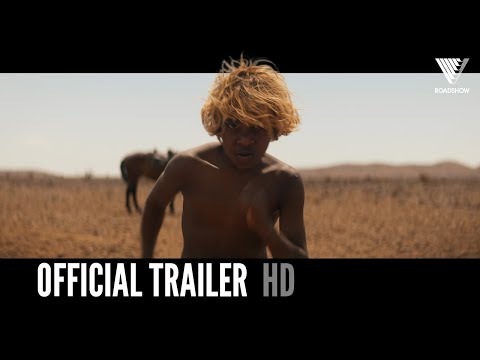
From acclaimed filmmaker Warwick Thornton (“Sweet Country,” “Samson & Delilah”), “The New Boy” becomes a story of spiritual struggle and the cost of survival.
“If it is possible for one faith to exist, then it’s possible for all faiths to exist.” Warwick Thornton says. “For most of the 20th century, it was Australian Government policy to ‘breed out the black.’ This involved separating Indigenous children from their parents and their culture. The church and its missions were integral to much of this policy enactment. This is the background setting of the story of ‘The New Boy.’ Government-appointed Chief Protectors of Aborigines all over Australia were authorized to remove ‘half-caste’ children from their parents, in an effort to breed them white.
”A lot of Dreamtime Aboriginal stories run on the same moral basis as Bible stories – if you do this you’ll get in trouble, so don’t do it. The film is about the extinction of a completely beautiful, sustainable, caring religion by a big bully. A religion that can co-exist with other spiritualities, but Christianity refuses to co-exist with it. It’s a small movement in the film, but it’s as big as the collision of planets in the universe – the death of a star, the birth of a black hole. If you don’t pay attention, you will miss it, which is the sadness of humanity in this day and age.”

