
Sandra Hale Schulman
ICT
Football, track, baseball, running – Jim Thorpe, Sac and Fox Nation, excelled at them all. He overcame punishing odds to become a gold medal-decorated athlete and a film actor, though his later years were tested by racism, poverty and political troubles.
The life and legacy of the legendary Olympian and one of the greatest all-around athletes of all time is explored in a new two-hour documentary, “Jim Thorpe: Lit by Lightning,” executive produced by LeBron James and Maverick Carter. The film airs on Monday, July 7, at 8 p.m. ET/PT on the HISTORY Channel. Directed by “Dark Winds” director Chris Eyre, Cheyenne and Arapaho, the documentary offers a comprehensive exploration into Thorpe’s life through archival footage, interviews and some well-produced recreations.

Thorpe was the United States’ first Native American Olympic gold medalist, having been the sole winner of the pentathlon and decathlon at the 1912 Summer Olympics. He played for both the NFL and MLB and in 2024 was posthumously awarded the Presidential Medal of Freedom by former President Joe Biden, who called him the “greatest athlete of all time.”
He was born on the Sac and Fox Nation reservation in central Oklahoma in 1887. Despite great odds, he was sent to several boarding schools and lost his father and brother before he was a teenager, but eventually found salvation and success in sports.
He played professional sports until he was 41, but this was the start of the Great Depression, and he struggled to earn a living, working odd jobs that were ridiculed in the press. He suffered from alcoholism, was married three times and had eight children, before having heart failure and dying in 1953.
The documentary features narrated excerpts from Thorpe’s unpublished autobiography alongside interviews from scholars and sports commentators.
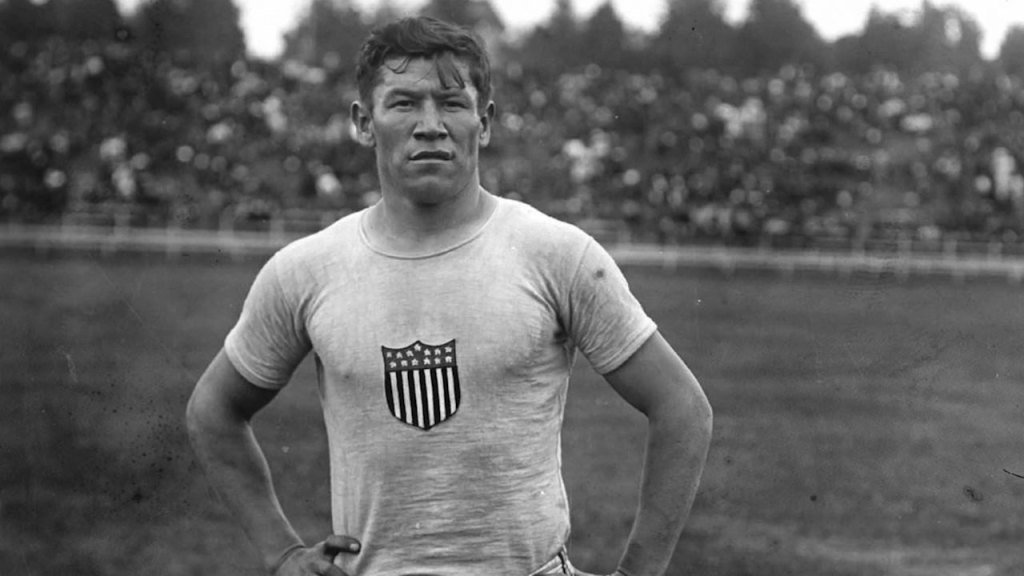
“Like everybody in our community, in Indian country, Jim Thorpe is one of those names that should never be forgotten,” Eyre told ICT. “I was doing the first season of ‘Dark Winds,’ and I remember talking to one of the young Native production assistants and I was putting ‘Little Big Man’ on the marquee in the opening scene, and they said, ‘What movie is that?’ I said, ‘That’s Little Big Man.’ It came out in 1970. I said, ‘Have you seen it?’ And they said, ‘No.’ And I said, ‘Oh my God, you got to see Little Big Man.’”
“Little Big Man” was an early mainstream film starring Dustin Hoffman and several Native actors that depicted the reality of the Battle of the Little Bighorn through the story of a fictional white character who lived through it as an adopted Cheyenne.
“I’m just reminded of the fact that we have to retell these stories over and over to remember Jim Thorpe,” Eyre said. “My grandfather was in World War I, and I just remember growing up and hearing the name Jim Thorpe as the greatest athlete ever. When I was five or six, I remember my non-Native, grade school teacher talking about how Jim Thorpe ran with mismatched shoes from the trash can and won the Olympic gold medal.
“I’d always wanted to make something on Jim Thorpe, and when LeBron James and HISTORY Channel came and talked about this, I said I’m in. We need to appreciate what he was, what he went through, and how he persevered. There’s a lot of exposé, and people see headlines that say, ‘Jim Thorpe’s tragic life,’ or the tragedy of his life after athletics. But really, I’m wanting people to understand why his name holds the value that it does because of the tent poles of his victories and his success that made him the greatest athlete ever and one of the greatest Americans who ever lived. That role modeling is so important to people that I know, we can’t ever forget what Jim Thorpe did.”
Thorpe lived through challenging times that impacted him deeply. There was racism and rules in athletics that affected his every move.
Eyre said, “The times are very interesting because it was before there were any celebrity athletes and it was before money was a driver in athletics. So, you have to look and say, Why did he do this to the perseverance and degree he did? And as a Native person, you recognize he lost his twin brother at nine. He lost both parents by 11. He was taken to boarding school at Haskell. He ran away multiple times. He eventually was taken to Carlisle so he couldn’t run away anymore, and he was left there. He found sports as a way to survive and as a way to turn his passion into something that wasn’t destructive, something that he could do, and he did it, at a level better than anybody else.
“I think that tenacity, that Oklahoma Indian perseverance and hardness comes across in a way that he’s able to manage his life into a success,” Eyre said. “And then despite all that, after athletics, he had many trials and tribulations. But I want people to understand his name and understand why he was known and what his victories were.”

Coming out of the Depression, people made use of themselves so they weren’t regarded as lazy. Thorpe was found to be digging ditches in the 1930s, and they printed a picture of that, and it went worldwide about this great Olympic athlete who had fallen from grace.
“I think to myself, If I was standing next to him, there’s no shame in that game,” Eyre said. “What I think he’s doing is through a different lens and time. He’s making good use of himself at $4 a day, because he could have been doing a lot of other destructive things. But he didn’t have that shame of, I’m digging ditches. He had the perspective of, I’m making myself useful. And that’s what he did over and over and over.”
Few know about Thorpe’s movie career. Eyre shows clips from many of those films in the documentary.
“He was in a hundred movies!” Eyre exclaimed. “He’s in the 1930s movie ‘King Kong.’ So, if anything, he’s adaptable and he’s tenacious. And he was the greatest athlete ever. It just is such a reminder of the role modeling for Native people and all people that you put one foot in front of the other and you keep going.”
Was there anything Eyre learned that surprised him in the course of directing the film?
“I learned the humility of Jim Thorpe, which is he didn’t do it for money, and he didn’t do it for fame. When they made a movie about his life played by Burt Lancaster in 1953, his daughter said the last time that he saw it, in real life he was getting on a public transportation bus and going home to his trailer in the LA area, because he was a humble person. It was before all of the benefits of being a superstar athlete. He had a certain work ethic and a certain humility. I looked deep into his pictures and his life, and I say to myself, He has such admirable qualities and such qualities that remind me of an Indian person. The perseverance is just amazing, the motivation was he found a love for life.”