Kalle Benallie
ICT
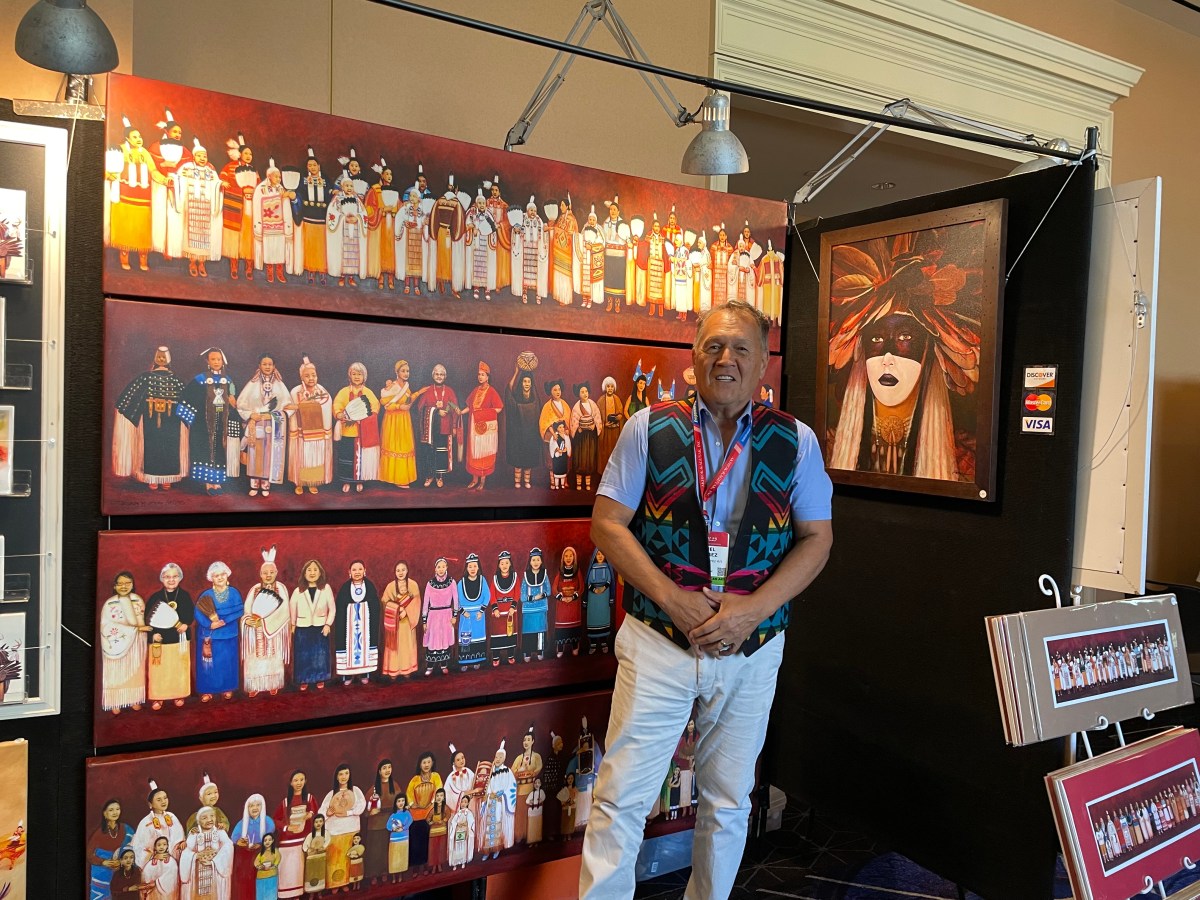
LAS VEGAS — “The World’s Longest Native American Painting” is nearly the size of a basketball court that is made up of 280 Native women from over 250 tribes in the United States. Artist Daniel Ramirez envisions having a life size scale of the painting at the National Mall in Washington D.C. one day.
“So that you can make this big, beautiful circle that people who are in D.C. can go inside there and see all the colors, the women and get a feel for it like that,” he said.
As well as it being animated online where kids can “have this physicality with the ladies and click on her and she’s going to walk forward and tell the story of her tribe,” he said.
Ramirez brought four of the 12 sections to the Reservation Economic Summit for three days in April as part of his display for the Native Art Market. He has been working on it for over a decade when he was a featured artist at the National Museum of the American Indian.
Ramirez, who is Saginaw Swan Creek Black River Chippewa from Michigan, said he researches for about a month and half for each piece. He finds inspiration online, in books and from people. At least 50 to 80 of the women are inspired by real people.
“I kind of just want your silhouette, your regalia, your dress of your nation,” he said.
Then it takes about two months to complete the piece.
Ramirez said his mother and great aunt, who he says was their matriarch, are the primary inspirations for the painting. He said his great aunt and his grandmother rescued his mom from going to boarding school.
As a child he said he was always into art and had that “bug.” It wasn’t until he met his seventh grade teacher — who he considers his first real art teacher — legitimized art for him.
He received his bachelor’s degree and masters degree in art from the University of Michigan.
SUPPORT INDIGENOUS JOURNALISM. CONTRIBUTE TODAY.
Ramirez describes his art style as modern Native American. He wished Native American art would be studied and made into programs at art schools across the country, especially in places like Santa Fe and Albuquerque in New Mexico with notable Native populations.
“Where people would understand the diversity, the value, the range. There’s a whole side of us [that] relates to our tribes and our heritages,” he said. “There should be some awareness of Indigenous art. Just because it’s as valuable as any other art form and we are just underrepresented and under appreciated, and time is going by.”
Ramirez’s designs were printed on tote bags for the RES conference last year and in 2023, as well for a tradeoff to be at the Native Art Market.
He said he foolishly didn’t do RES for a while but thinks of his life as serendipitous. Today, people can understand, recognize and revel in what he’s trying to do with the nearly 90-foot long painting.
He said he does many non-Native art shows where people wouldn’t pay attention at all to the painting.
“It’s so different to be in a place or to do a show where they’re like ‘wow these women are really cool’ and they can kind of relate. So RES is one of those places where that happens,” Ramirez said.
He plans to go to other conferences like the Native American Bar Association and National Indian Gaming Association.
Ramirez is currently in the process of illustrating a children’s book by Tasha Spillet, Inninewak (Cree) and Trinidadian, about a Cree grandmother and her grandson. His first draft is due in August. He said he will be dedicating it to his older brother who recently died.
From that project he said he was able to connect with a literary agent who hopes to make the painting into a children’s book in the next year.
His husband and partner Jerome Dupont for over 30 years helps with the traveling, printing of his work and most of the set up. Ramirez said it gives him more time to paint.
“I just don’t know how anyone could do it alone. You have to have somebody else because there’s so much to do. You gotta present, you gotta talk, then you gotta mail, then you gotta drive, then you gotta take care of the dog…” he said.
He advises other Native artists to have someone help them, to present themselves as an artist and as an Indigenous person. He said it’s hard but it’s very, very gratifying because he enjoys the work that goes into it.
“Researching the women of our tribes, respecting women, understanding women. I’m trying by November to do some writing and do some open thinking about my thoughts about women, the importance of women, matriarchy and in Native culture what women mean, our grandmothers, our stories — how that connects everything together.”
This November all 12 parts of the painting will be displayed as he will be the featured artist at the Vista Center for the Arts in Surprise, Arizona.

Like this story? Support our work with a $5 or $10 contribution today. Contribute to the nonprofit Indian Country Today.