Mark Trahant
ICT
Buckle up. Get your reading glasses. This will take a minute.
Most government budgets are straightforward. Leaders, program managers and citizens discuss and set priorities about what’s important. Then a budget is drafted. And then enacted. Over the next year, progress is measured against that budget (as well as spending, usually a metric of under or over budget lines).
That’s not the federal government’s budget. This is not a literal budget, but a philosophical one. This is a message about what the government considers important, using projected spending to set the standard. It’s important to Indigenous communities because it shows that this administration values and honors the commitments made by the president and the United States (something that is not a given in a federal budget).
This administration lays out a plan for Indigenous communities. Now it’s up to Congress to agree or disagree. Or, more likely, the House Republicans will ignore the the president’s budget altogether.

This is how it’s supposed to work.
The Constitution gives Congress the authority to spend funds: “No Money shall be drawn from the Treasury, but in Consequence of Appropriations made by Law; and a regular Statement and Account of the Receipts and Expenditures of all public Money shall be published from time to time.”
And until the 1920s that was how the process would work. Congress would debate and come up with a plan and then appropriate the money. But that changed in 1921 when Congress enacted The Budget and Accounting Act which required a presidential budget proposal and established a federal agency to keep track of that spending (that’s now the Office of Management and Budget.)
At that point Congress is supposed to pass its budget. That totals a sum that each of the 12 Appropriation subcommittees use to determine the actual spend.
This is where it gets twisted. More often than not Congress can’t legislate a budget, not 12 of them anyway. There are enough votes to say “no” to any spending plan, but not the 218 votes to pass legislation. So instead some of the appropriations gets wrapped up either into a Continuing Resolution (a time-limited spending authorization based on the previous year) or an omnibus spending bill that stuffs several spending bills into a massive spending bill.
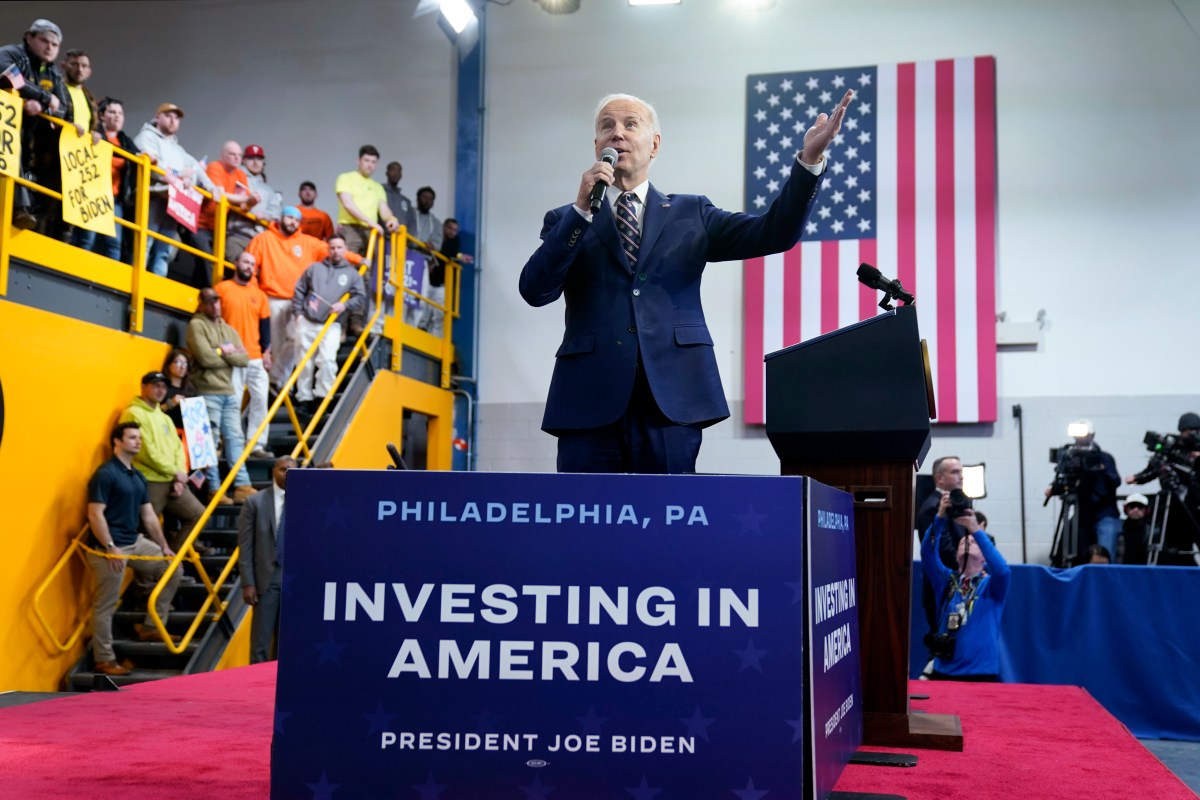
The president’s budget would continue the administration’s record investments in tribal nations and Indigenous communities. The White House says the budget is “informed by direct consultation with Tribal leaders.”
Items include advance appropriations for the Indian Health Service, for a total of $8.1 billion in discretionary funds plus the government would reclassify contract support costs and leases as mandatory for a total of $9.4 billion in discretionary and mandatory resources for IHS in 2024. The budget proposes all IHS resources as mandatory beginning in 2025.
The president would also increase funding for tribal programs at the Department of Interior to $4.7 billion.
And the White House would invest another $4.5 billion into clean energy infrastructure “bringing jobs to rural communities and cities, leaving no one behind.”
Further reading:White House spending priorities for tribal nations
There are other programs that are possible for communities, indeed, communities are eligible for billions more in much-needed investments. The Inflation Reduction Act takes the most aggressive action on climate and clean energy in American history – and it does so by providing funding specifically for tribes to plan for and adapt to climate change, mitigate drought, support fisheries, and shift to clean energy production and use.
No Budget?
On March 24, 2023, the House Appropriations Subcommittee on Interior is scheduled to hear additional testimony on this budget for federal Indian programs. But the next steps might not be up to the committee because it will be the leadership of the House to set priorities.
President Joe Biden has challenged Republicans to come up with a budget proposal. He has told House Speaker Kevin McCarthy that the two should work to find a deal. Take the administration budget and compare it with the House version and go down “line by line.”
Some House members do have a budget. Last year the Republican Study Committee called for dramatic cuts in spending in order to reach a balanced budget in seven years (while also increasing defense spending by three percent.)
The House Freedom Caucus said it will also release its budget plan. It has suggested a rollback of climate spending in the Inflation Reduction Act and sharp budget cuts across the board.
“The plan is to shrink Washington and grow America,” said Rep. Chip Roy, R-Texas, at a Freedom Caucus news conference on March 10. “We can cut the woke weaponized federal bureaucracy that is at odds with the American people.”
Plans include forcing work requirements on Medicaid and other social programs.
The challenge for Republicans is to get to a budget that can win 218 votes in the House and work its way through a Democratic-controlled Senate.
The coming catastrophe
This budget faces an additional challenge: The debt limit. Starting in 1917 Congress enacted a ceiling on how much money the United States could borrow. Most of this debt is in the form of bonds, a paper promise that is sold to an investor with a promise from the U.S. Treasury to pay it back plus interest.
Congress has raised the debt ceiling nearly a hundred times in the 20th century. The debt limit was reached again on Jan. 19, and the Treasury Secretary is shuffling the timing of paying bills, a process called “extraordinary measures” and that includes holding back civil servant and postal retirement funds. Sometime in the summer that process will run out of room, too, and the United States will be in default on its debt.
This is where the news gets worse.
Larry Swedroe, who runs Buckingham Wealth Partners, wrote: “Treating the highly unlikely as impossible is a mistake.” He said the practical implication, even now, is that investors don’t like uncertainty. And not knowing if the United States will pay its bills is about as uncertain as it gets.
If there is a breach, the interest cost of a treasury bond will go up. Even a slight increase, slightly more than a half-a-percentage point will add $165 billion to next year’s budget costs. And the thing is investors, not Congress, determine this amount. It’s a market-based price. This in turn will be less money for other federal programs across the budget.
This is both a fiscal crisis and more important a political one because it represents a systemic failure to govern.
At last week’s House Freedom Caucus press conference, Rep. Scott Perry, R-Pennsylvania, said the debt crisis was created by Democrats. “America will not default on its debts unless President Biden choses to do so. The House Freedom Caucus is offering a responsible solution.”
The caucus’ first steps include ending the student loan relief, rescinding spending on all unobligated COVID-19 funds, end the IRS expansion, and the “recoup of wasteful climate change spending in the so-called Inflation Act.”
The caucus promises to “find” and reverse every “wasteful” Democratic initiative that can serve as a dollar for dollar cut against the debt ceiling.
The math problem
There is no easy way to balance the budget. Part of the problem is demographic. Quick fact: There were 42 workers for every retiree in 1940. Today the ratio is 3-to-1; by 2050 it will be 2-to-1.
Most Republicans are now saying Medicare and Social Security are off the table (after President Biden boxed them into a corner during the State of the Union). That makes balancing the budget impossible without significant tax increases or drastic budget cuts across the board.
So even as Republicans promise to save Social Security and Medicare most are quite willing to sacrifice Medicaid. (Medicare is a general health insurance program for elders while Medicaid is a social insurance program, including health care, for people living on low incomes. The cost of Medicaid is shared by states and is often one of the largest state expenditures.)
Cuts to Medicaid will hurt. The program serves 74 million people. Medicaid is almost as important to the Indian health system as direct appropriations for the Indian Health Service because it pays the agency for covered medical services.
The key difference between Medicaid (and that matter for Medicare) is that if a person is eligible, the money is there. No appropriation is required. The Indian Health Service on the other hand has to come up with a budget, get an appropriation from Congress, and then help patients.
That’s one reason why Medicaid and Medicare have more resources for individual patients (remember many patients eligible for IHS are also served by Medicaid). The Government Accountability Office figures that IHS’s per capita spending is much lower as a result. For example, in 2017, IHS per capita spending was $4,078, as compared to $8,109 for Medicaid, and $13,185 for Medicare.
Medicaid also funds most long term care for the elderly. It is the primary supporter for one out of every three people in nursing home care and nearly two out every three elders receive covered medical care funded through Medicaid.
Medicaid also pays for transportation. Some home health care and dental services. It also pays premiums and cost sharing for Medicare beneficiaries with low incomes.
The point is that it’s not one “entitlement” program driving federal spending. It’s an interrelated network of programs.
The math to fix the federal budget is far more complicated than what can be negotiated over the debt limit barrel.
What are the next steps? A lot depends on how much the next spending plan looks like one from House Republicans or the Biden administration. The difference is stark.
House Budget Committee Chairman Jodey Arrington, R-Texas, said the committee’s work will be crucial to ending “runaway deficit spending and an unsustainable debt trajectory.”
He said: “Job number one, there is no defense. There is no safety net for seniors. Pick your favorite program and policy and it doesn’t exist without resources. And so this committee is critical, and it’s not just about resourcing the government. It’s about stewarding taxpayer dollars. It’s about our view, our values and what we expect from the People’s Government and what the people expect. And I know we have different views on that. And those views will be expressed no doubt in the various topics and debates that we have. But a budget is not just about resourcing, it is priorities, it’s policies, it’s values. And that’s why I think this committee is so important, not to mention that it is our Constitution, constitutional responsibility, the power of the purse.”
Or, on the other hand, Sharon Parrott, president of the Center on Budget and Policy Priorities, a liberal think tank, framed this debate this way: “It lays out an agenda that would move us closer to a nation where everyone — regardless of their background, identities, or where they live — has the resources they need to thrive and share in the nation’s prosperity. The budget makes important investments in a range of areas, including in children, supports for workers, housing affordability, education, and core government functions, among others, and finances these investments by raising taxes on high-income people and profitable corporations that have benefitted the most from the nation’s economy. The President’s budget would broaden opportunity, including among people and communities who have long been underinvested in, such as people with low incomes, people of color, Indigenous communities, and people in rural communities, among others.”
If you have read this far, I’d say unbuckle and relax. Only, given the challenges in the days and weeks ahead, it might be better to be buckled up.

Mark Trahant, Shoshone-Bannock, is editor-at-large for Indian Country Today. Trahant is based in Phoenix. The Indigenous Economics Project is funded with a major grant from the Bay and Paul Foundations.