

Miles Morrisseau
ICT
LONDON, Ontario — It was a good night for a rubaboo.
The calendar said spring had arrived earlier in the week but cold winter winds were blowing off Lake Huron with a warning for freezing rain and possible snow overnight. Inside the venerable Grand Theatre in London, Ontario, however, the fire soon would be lit and the music, dance, song and story of Andrea Menard’s new play, “Rubaboo,” would be served up warm and full of flavor.
“Rubaboo” is a show that only Menard, Métis Nation, could have written and performed. She’s an award-winning actor, singer, songwriter, playwright and performer with dozens of film and television credits, and the show takes full advantage of her many talents, from her powerful vocal skills to the light-footed steps in her Red River jig.

Rubaboo is a Michif word, the Métis language that mixed European and Indigenous language. It describes the stew made up of a variety of leftover vegetables and whatever wild meat was available. It was often made with pemmican, the Métis speciality that combines dried buffalo with fat and blueberries.
What unfolded on stage during a recent performance in March at the Grand Theatre was a living, dancing, singing representation of a rubaboo.
“We had no idea how this would land, because it’s not a typical theater show,” Menard told ICT after the show. “It’s not a typical concert. It’s this mishmash of several things.”
SUPPORT INDIGENOUS JOURNALISM. CONTRIBUTE TODAY.
The show, described as a Métis cabaret, was written by Menard, with music by Menard and Robert Walsh. It was directed by Ottawa-based playwright and director Alanis King and co-produced by the Arts Club Theatre Company, the largest theater company in western Canada.
The show made its world premiere March 7 to start a three-week run at the Grand Theatre. It now goes on the road to western Canada, where it is set for a month-long run through April 30 at the Granville Island Stage in Vancouver. It is also set for performances at the Citadel Theatre in Edmonton, Alberta, from Feb. 10-March 3, 2024.
Discussions are ongoing with a number of other theaters, and Menard said she is hoping to take the show to the center of the Métis Homeland in Winnipeg, Manitoba.
“We’re working on something for our Winnipeg relatives,” she said. “We want to bring it to the homeland. Because it’s so great when there’s Métis people and other Indigenous peoples in the audience.”
Menard said the show has been received “surprisingly well” at the Grand, one of Canada’s oldest theatrical stages.
The Grand Theatre is 122 years old and is built in the Edwardian style with a high cathedral ceiling painted with a Renaissance-inspired fresco and designed for live performances, drama and musicals. Theatre legends John Gielgud, Ethel Barrymore, Sarah Bernhardt and Michael Redgrave performed on the Grand stage.
“I knew what my intention was,” Menard told ICT, “and I think I have achieved it.”
A raucous crowd
Menard is a multi-talented artist who has been in numerous film and television roles, including the lead in the series, “Rabbit Fall,” a supernatural drama that aired on Canadian television. She has also been the voice behind Kohkum and Sarah in APTN’s award-winning animated series, “Wapos Bay.”
She created “Rubaboo” in the tradition of most gifted and experienced Indigenous storytellers — don’t leave the audience down. Some of the songs were old, and some were new.
“I’ve written some of these songs for years,” she told ICT. “I can make you feel an emotion because that’s my gift. I can take you from this emotional state to another. But do I want to leave them in a puddle on the floor hating themselves and hating life? No, I want people to feel hopeful.”
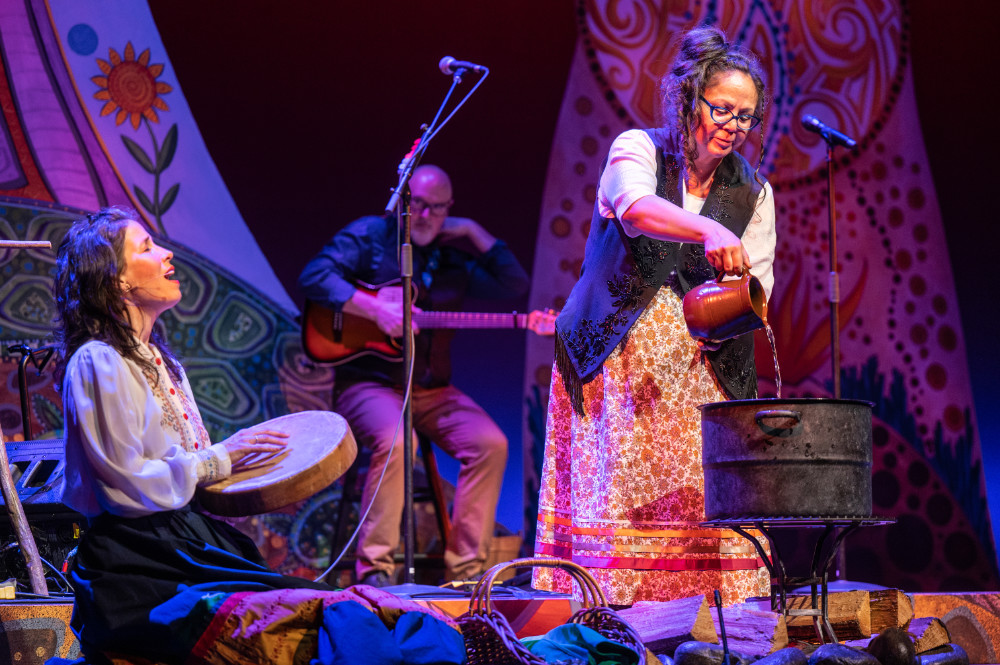
The story is one of colonization and the birth of the Métis Nation and the attacks on the circles that connect family and community and the natural and spiritual worlds. It is this particularly devastating reality in Canadian history that provides the context for one of the evening’s showstoppers, “Where is God in this Place?” It rings out like one of those big Broadway songs meant to bring down the house, because the emotional truth of the words is matched by the vocal performance.
She was initially concerned, however.
“The word reconciliation can make a lot of people frightened to even come through the doors,” she said. “So the ones who walked through the doors, we got ‘em, we got ‘em.”
The audience sings along when encouraged by Menard, who works the stage with the confidence of a preacher at a revival show. Indigenous words and phrases are lifted up, with performers and audience united in song. It is likely that there were more than a few repeat customers in the night’s audience because the sing-along parts of the show got a lot of participation and things got a little raucous when the crowd was encouraged to howl like a pack of wolves.
“We actually got repeat patrons over and over to come back and back and back,” she said. “So for the ones who never made it through the door, I couldn’t do anything about that. I could change the ones who were here. And I think I did it.”
A deeper purpose
Menard shares the stage with an outstanding supporting cast, led by music director Walsh, who worked with Menard in 1998 on her one-person show, “The Velvet Devil,” which was released as a soundtrack and recorded as movie-of-the-week by CBC television.
Walsh provides background vocals and harmonies as well guitar and hand drum. Nathen Aswell is a multi-instrumentalist who played a stringed instrument as well as a hand drum.
Also contributing is Karen Shepherd, Nihiyaw/Cree, a multi-instrumentalist and an accomplished singer-songwriter and composer. In 2008, her group, The Crow Sisters, won a Native American Music Award for best folk album. She didn’t know her biological family but has found a connection to her Indigenous heritage in music.
“I was fostered then adopted and I learned classical violin, by ear, for the first five years until my teacher learned I couldn’t read music,” Shepherd told ICT. “I took Métis fiddle lessons from a few Métis awesome fiddlers.”
Shepherd plays the cajon, a box drum of Peruvian origin with a brush and pounding strokes that add another level of percussion. She shows a master’s dexterity with the fiddle that gets feet stomping and hands clapping, and later, with long, slow bows on the same violin, brings a shift to melancholy.
“I’m also playing two hand drums; one is a Bodhran. But, I’m playing it like an Indigenous hand drum. Not like the way the Irish play it,” Shepherd said.
The collaboration of instruments that range from the familiar to the unknown and the stellar harmonies that support Menard’s powerful voice create a glorious melange of sounds that hit all the right notes.
At the end of the show, Menard meets with a family or two and some youth from Atlohsa Family Healing Services, an Indigenous-led nonprofit that provides community members with help for mental wellness, substance use, homelessness, domestic violence and trauma.
There are smiles and laughter as they pose for selfies and group photos with the star of the night’s delicious serving of “Rubaboo.”
“I don’t want to be on any stages if I’m not furthering the movement of reconciliation,” Menard said. “If people don’t recognize their own part, if I’m not helping people fall in love with Indigenous peoples, then I don’t want to do it.”

Our stories are worth telling. Our stories are worth sharing. Our stories are worth your support. Contribute $5 or $10 today to help ICT carry out its critical mission. Sign up for ICT’s free newsletter.

