

Shondiin Mayo
Special to ICT
Patrick Andrews stood outside his home in Kipnuk, Alaska, securing his boats and supplies while the sky above was calm on the morning of Oct. 11. The air was crisp and clear, the horizon stretching endlessly in every direction. An open country where the wind, the rain, and the sea spoke in familiar tones.
The lifelong hunter and fisherman heard there was a storm on the way. Typhoon Halong, the forecast said. But no one knew how bad it would get. Weathering storms was part of life in his community.
By nightfall, everything changed.
“The wind just kept getting stronger,” Andrews recalled, who is Yupik and a member of the Native village of Kipnuk. “It seemed like every 15 minutes, the water level would be really higher than the last time I looked.”
As midnight passed, the river swelled into the roads, seeping closer to his home. Andrews, his wife, and their three children watched as the calm morning gave way to chaos.
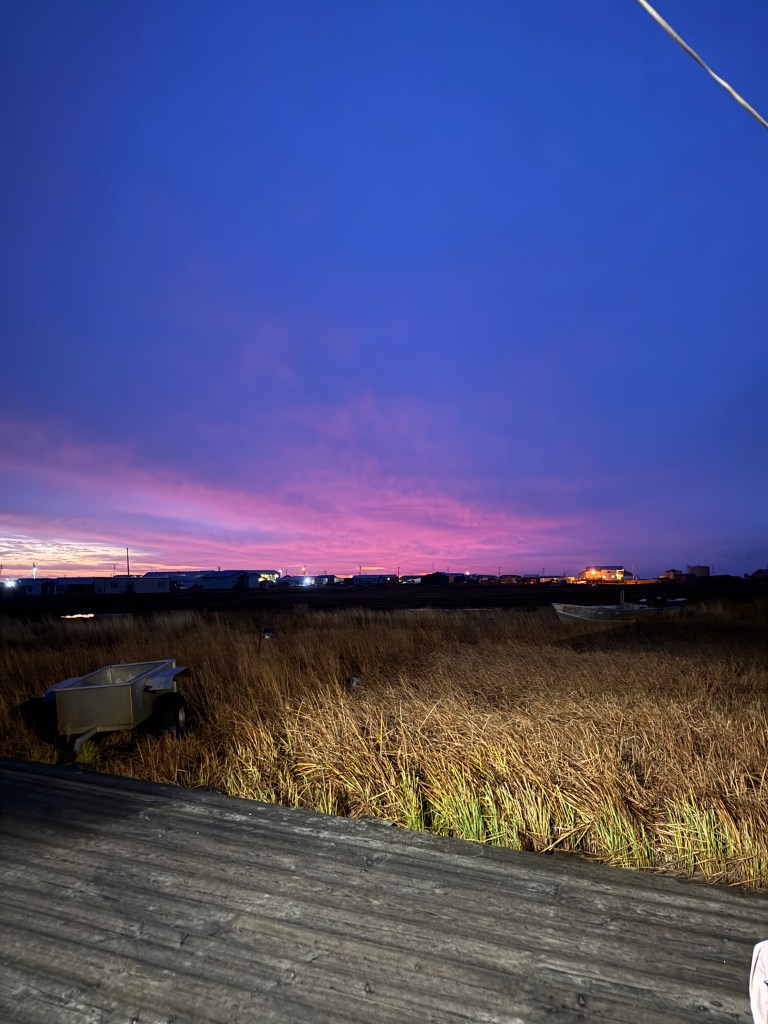
In many western Alaska communities, schools serve as more than classrooms. When strong winds or a winter blizzard rolls in, they often open their doors to families who need a safe and sturdy place to shelter.
“I wasn’t gonna evacuate to the school until I knew I had to,” he said. “Around 2 a.m. I was really concerned, seeing that it was already flooding and the peak was a few hours away, and I decided that I should evacuate to the school.”
He rushed inside his home, yelling for his family to grab what they could: blankets, pillows, a few dry clothes stuffed into trash bags. The wind howled as they scrambled onto their four-wheeler.
“My wife and kids were holding on to each other,” he said.
Along the boardwalks and against strong winds, Andrews and his family drove on four-wheelers in one direction he had planned to take to higher ground. But the water was already too high.
Turning around, Andrews took his family through the storm with another family to the school. Andrews was among the few who made it to the school, while other relatives and families couldn’t get back in time.
Phones began to ring and vibrate once they were sheltered there. It was those who hadn’t evacuated to the school in time.
“We were starting to get phone calls from people asking for help. They were terrified,” he said.
They were caught in the flood and trapped in the homes as the water rose.
“We couldn’t do anything with nothing,” he said. “They were drifting away in their house, and that feeling of helplessness was really stressful.”
By dawn, the village was underwater.
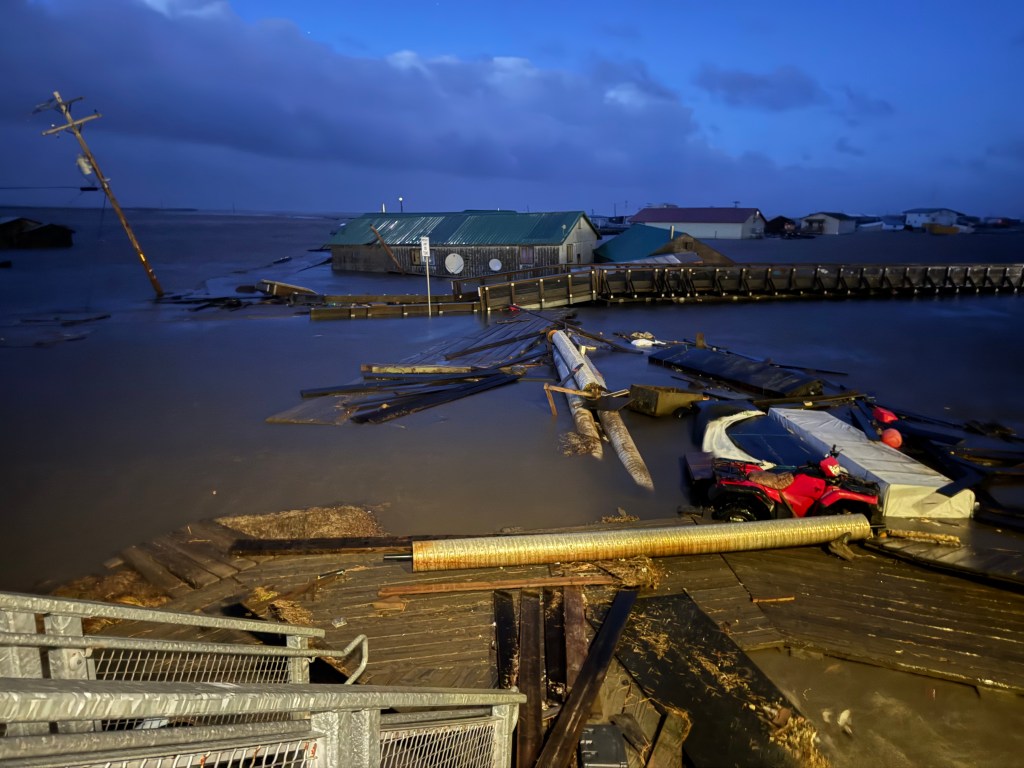
More families poured into the school — more than 700 people in total. The generator hummed weakly, powering a few lights and a small water tank. Outside, houses drifted in the flood.
The scale of Typhoon Halong’s destruction across western Alaska became clearer as state officials released new damage assessments.
In an update published on Oct. 13, the State Emergency Operations Center reported, “49 communities are reporting impacts, and 1,400 residents are sheltering in 12 shelters.” Among the villages affected was Kipnuk, where homes were swept off their foundations and many residents were forced to evacuate.
The numbers underscored how widespread the storm’s effects were, stretching across remote communities where evacuation routes are limited and recovery is expected to take months.
A day later, the Coast Guard and National Guard arrived.
On Oct. 15, evacuation orders were issued. Andrews and his wife returned to their house to gather pieces of their home and memories. “A couple of pictures, and grabbed our Bibles,” he said.
Along with those sentimental items, Andrews also collected some essentials.
“And my shoes, my kids’ shoes that were dry. We were able to get a couple of shoes for my kids, but that was it. We filled her backpack and she had her bag of blankets, pillows,” he said.

Andrews and his family were flown first to Bethel, then to Anchorage, and finally to Fairbanks, where they now stay in an apartment.
Relatives in the interior of Alaska were the reason Andrews and his family decided where to go next.
“My wife told me that her aunt was telling her that we should come to Fairbanks,” he said.
They arrived in Fairbanks on Oct. 17 and learned that an AirBnB host had offered their cabin for about two weeks. “We stayed at the cabin in North Pole for about a week or more until we were able to find an apartment,” he said.
“The day after we got to Fairbanks, we got all these donations, clothes and food, and one donation was a car. A small car. It’s an earlier, older, older car, but it helps us get whatever we need around town,” he said.
For Andrews’ children, adjusting to city life was a cultural shock, but also a relief.
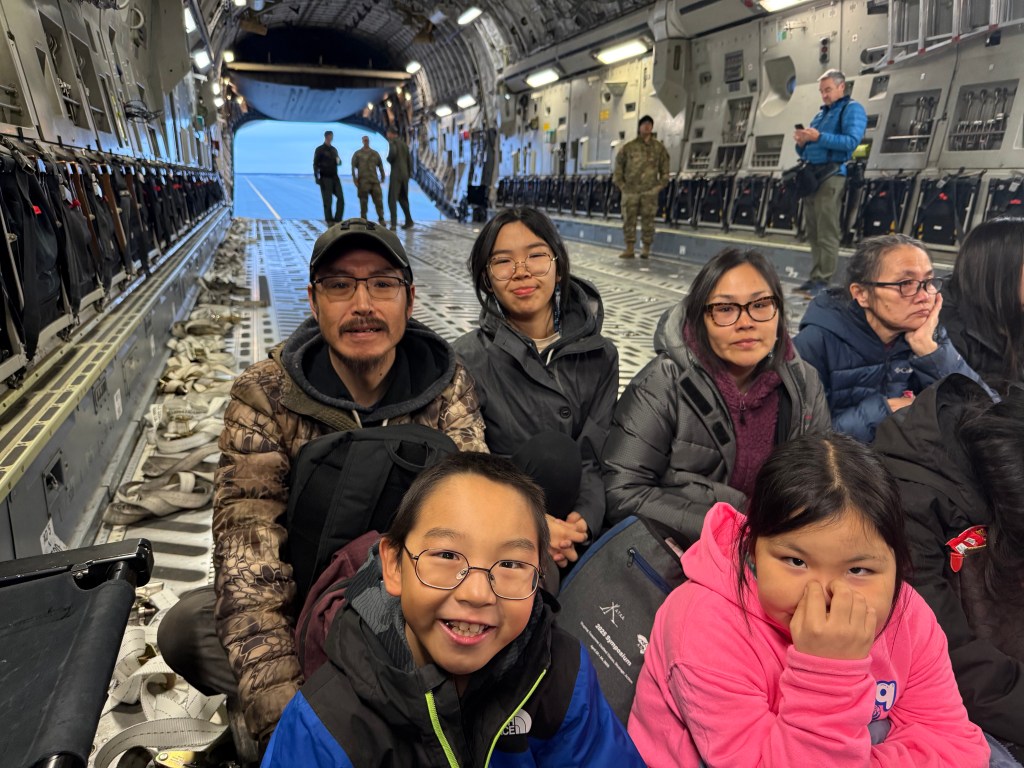
Andrews said all three of his kids had never even crossed a street with a walk signal before. They had never ridden a school bus, and the basic daily routine of getting to and from school was completely new to them. They were used to playing on a playground and going to school, but the need for food was different.
In the city, he said, you have to pay for almost everything you eat, while back home they lived off what they hunted, caught and gathered.
City life brought a lot of differences, but also a lot of conveniences.
“My kids just gone to their first week of school,” he said, smiling. “And they just tell stories of everything they did, and it’s really, really refreshing that they’re enjoying their time in school.”
A community response
Across town, in an office at Denakkanaaga, Sharon McConnell was on the phone. As director of the nonprofit, she and her colleagues had been tracking the evacuees’ arrival in Fairbanks.
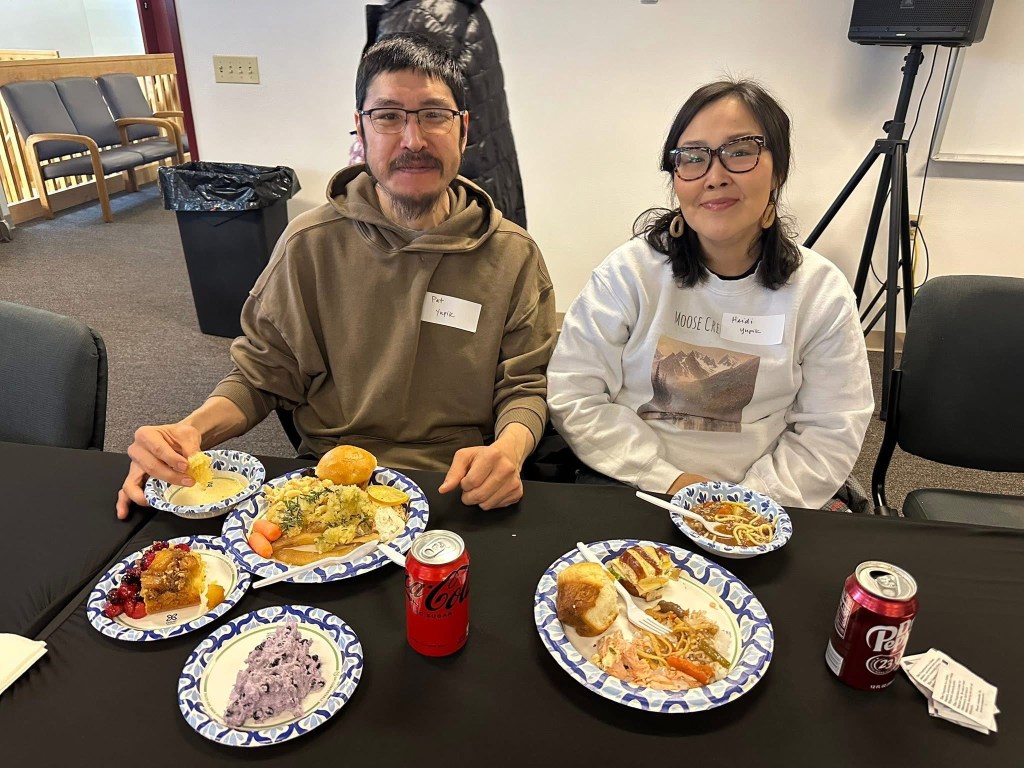
“At that time, we found out that there were about 10 or so, well, there’s 10 adults and about nine children,” she said. “We just thought it would be a nice gesture to get to know them, welcome them, let them know who we are, what’s available in Fairbanks.”
McConnell and a coalition of Native-led organizations — including the Fairbanks Native Association and Doyon, Limited — organized a welcome luncheon. It wasn’t just a meal. It was a gesture of home.
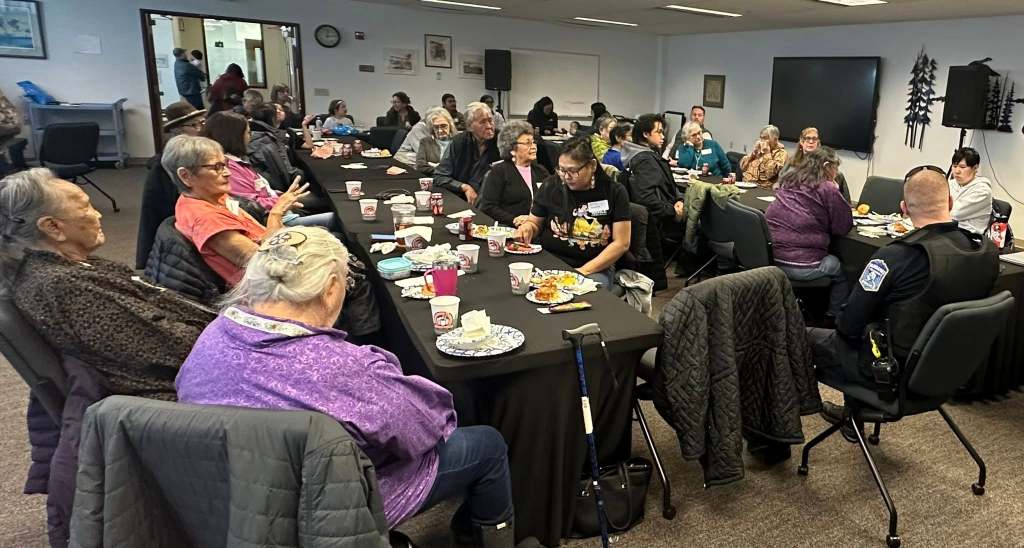
“People brought Native food. Denakkanaaga and [Fairbanks Native Association] put together a menu and we each made different dishes, moose soup, salmon salad with salmon eggs, things like that,” McConnell said, smiling at the memory. “Other folks brought seal oil, dried meat, salmon strips.”
When Andrews and his family arrived, the room was quiet at first. New faces, a new place, the uncertainty of starting over. But as the dishes were passed around and the children laughed, the air began to change.
“By the end of the luncheon,” McConnell said. “People were laughing and teasing each other. You know that we that we do in the Native community,”
Among the guests were community leaders and elders, the Fairbanks Chief of Police, and representatives from Doyon and Fairbanks Native Association. One woman from Southwest Alaska even brought homemade frybread.
“Someone brought seal oil which was wonderful,” McConnell added.
Still, practical needs remained urgent.
“One little child that was at the luncheon needed boots right away,” McConnell said. “Another little toddler, the family needed a car seat for him or her, and [Fairbanks Native Association] was able to provide that immediately while we were at the lunch.”
Beyond material aid, McConnell’s focus — and that of Denakkanaaga — was on connection.
“We’re more of an advocacy organization, not a hands-on direct services,” she explained. “What we’ve offered them, of course, is a place to visit, a place to come to, to meet elders, meet more Native families.”
The strength of connection
For McConnell, the experience reaffirmed the importance of Native-led response efforts.
“No matter where we reside, that really strong Native connection is there, whether it’s in Fairbanks, rural communities, Anchorage,” she said. “We come together, we support each other. Not just our own cultures, but other Native cultures of Alaska, the statewide Native community”
And for Andrews, that connection is what carried his family from chaos to stability. “We lost a lot,” he said. “But we found kindness everywhere we went.”
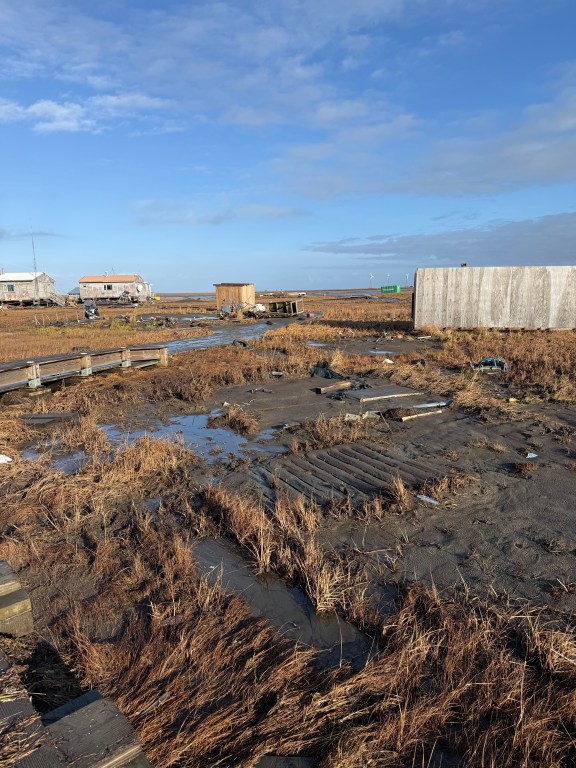
He had spent the fall building a new 10-by-10 shed, finishing the door, the walls and the roof just the night before the flood. “It’s a brand new shed that I made where my wife could process fish and some seal meats,” he said, adding that it was also where they planned to keep their freezers.
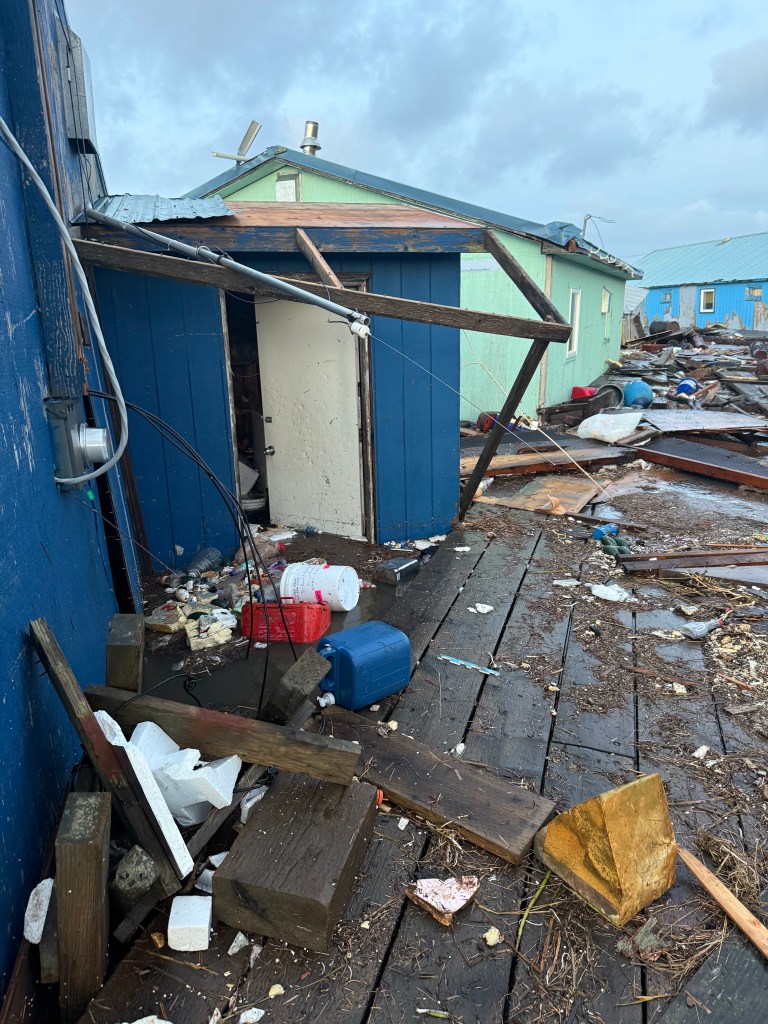
When he returned after the water receded, everything was gone. The house was gone, the shed was gone and so was his homemade wood stove sauna. He listed the rest quietly: three boats, including “a 22 footer with 115 horse Yamaha,” a snowmachine, three utility sleds, an aluminum ATV trailer with the boat trailer, his Honda ATV 500, all of his guns, camping gear, fishing gear, salmon and the fuel tanks he used for traveling.
“Those are all gone,” he said. Even his wife’s 10-foot kayak had washed loose, though he later found it wedged under what was left of the house. “We lost our fish rack,” he said.
Now, in Fairbanks, as his children settle into their new schools and his family finds their footing, Andrews still thinks of home. The open skies and the sound of the wind sweeping across the tundra.
“It’s different here,” he said. “But people have made us feel like we belong.”
The family’s daily rhythm has shifted in ways he still notices.
“Our days are too different now compared to our routine at home,” he said.
Back home, school for all students started around 9 a.m. from kindergarten through 12th grade. In Fairbanks, his middle schooler begins much earlier.
“So we’re starting our days earlier and going to bed earlier now,” he said. He wakes up ahead of dawn, gets everyone out the door and finishes the day on a new schedule. “I’m picking up the kids by myself,” he said, another change in a life that still feels new but is slowly settling into place.
Epilogue
In the weeks after the luncheon, McConnell and her team continued to invite the families to community gatherings like beading circles, craft nights, and elder lunches.
“It’s just the beginning,” she said.
For Andrews, the road ahead remains uncertain, yet hope persists.
The future for western Alaska remains uncertain in the wake of Typhoon Halong.
With “as much as 90 percent of structures” destroyed in villages like Kipnuk, according to the American Red Cross, limited access due to remote locations, and ongoing threats from thawing permafrost and rising seas, many residents face a long and difficult recovery.
“Almost all of the supplies have to come in by barge – plywood to nails to windows – and that isn’t going to happen in winter. You can’t truck it in – there are no roads. Planes can only fly in small amounts – the runways are short and not built for cargo planes,” said the University of Alaska Fairbanks’ International Arctic Research Center.
While some families will likely return, the process may take months or even years, and for others, permanent relocation to higher ground may be the safer option.
“Recovery is a priority for the impacted areas, and recovery operations continue with an emphasis on restoring critical infrastructure and services, including water, power, and communications, and emergency home and boardwalk repairs,” according to the Alaska Division of Homeland Security and Emergency Management.
Officials continue to provide support through shelters, donations, and temporary housing, but the storm has highlighted the broader challenges that climate change and extreme weather pose for Alaska’s remote communities.
“I hope we’ll be able to return home,” he said softly. “While we are in the cities, wherever we are, wherever people ended up after the storm, I just hope that all of us will be alright for as long as it takes.”
