Mary Annette Pember
ICT
ANCHORAGE — The theme of this year’s Alaska Federation of Natives convention, “Standing Strong, Standing United,” was especially prescient as the state’s Indigenous population joined together to help residents affected by Typhoon Halong.
The villages of Kipnuk and Kwigillingok on the Yukon-Kuskokwim Delta in the western part of Alaska were hardest hit, with over 2,000 displaced by the storm and around 1,000 evacuated by the state’s national guard to locations in Bethel and Anchorage.
AFN attendees raised over $1 million in donations and cash during a special blanket dance at the conference.
ICT spoke with a few of the evacuees at the Alaska Airlines Center including Daryl John of Kipnuk.
“Everything is gone. I mean everything, snow machines, clothes, all of our freezer of food,” he said. All of John’s family was safely evacuated.
Ray Kiunuia of Kwigillingok began to weep when expressing gratitude for his family’s safety.
“I want to thank God for saving our people,” Kiunuia said. “But most of our gathered subsistent food is gone; we need some prayers now.”
He and others now wait, crammed chock-a-block on cots in venues such as the Airlines Center in Anchorage and Bethel.
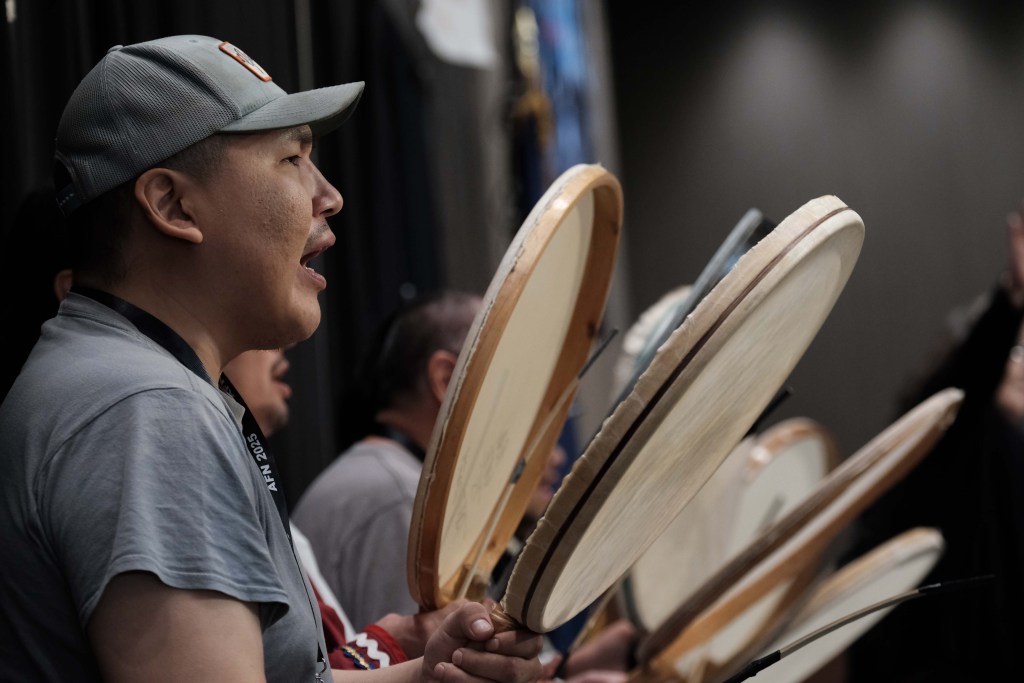
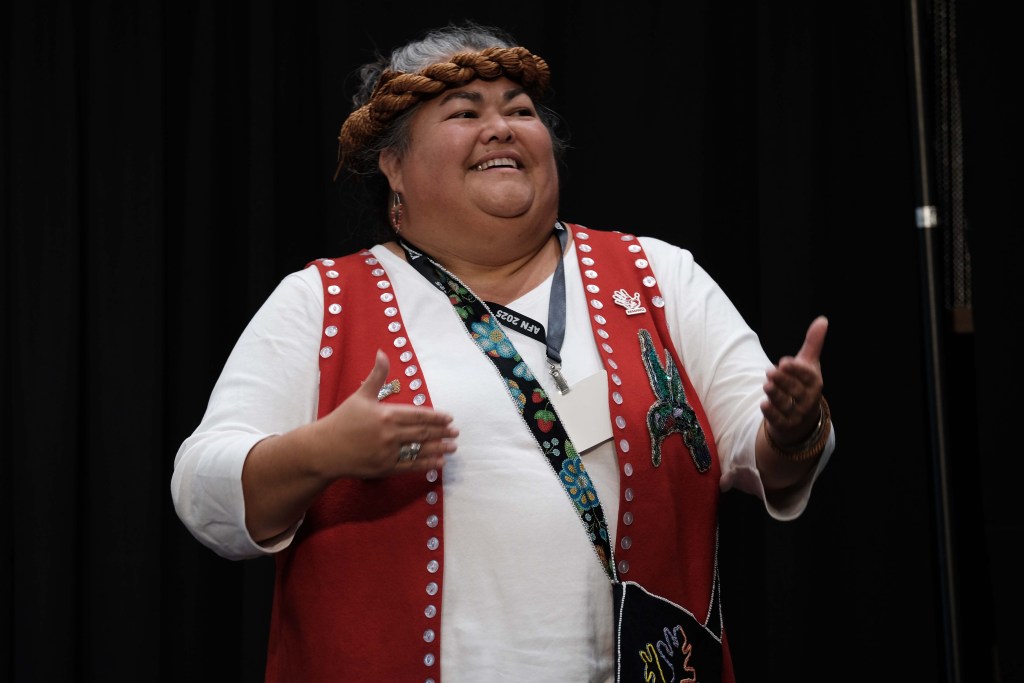
Meanwhile, representatives of state, federal and local organizations spoke about Alaska Native concerns and issues at the convention which is among the largest gathering of Indigenous peoples in the world. The Alaska Federation of Natives is the largest statewide organization representing more than 140,000 Native peoples. More than 6,000 people attended this year’s event.
Protecting Indigenous access to subsistence hunting, fishing and gathering continued to be a major focus. Such access helps feed Alaska Natives on a daily basis.
The state of Alaska wants the U.S. Supreme Court to reconsider a federal court ruling which upheld the state’s two-tiered subsistence fishing system. As explained in The Alaska Beacon, a federal law, the Alaska National Interests Lands Conservation Act, requires that rural Alaskans be given preferential treatment when hunting and fishing are regulated in Alaska.
Simultaneously, the Alaska Constitution forbids that kind of preference. Several Alaska Native groups have joined the lawsuit.
Natasha Singh, president and chief executive officer of the Alaska Tribal Health Consortium gave the keynote address on the first day of the conference. The consortium provides health services to Alaska Natives. Singh Dinyee Hu’tanna of Steven’s Village, a Koyukon Athabaskan community, in the state’s interior.
She lauded the federal passage of the Alaska Tribal Health Compact in 1994 which authorized tribes and tribal health organizations to operate clinics and health related programs.
“Healthy communities don’t happen by accident,” she said in her address. “They’re built on access to basic health care, well-funded schools and the fundamental promise of safety through trusted law enforcement.”
Like Ben Mallott, president of the Alaska Federation of Natives, Singh urged attendees to vote.
“We should only elect leaders who are willing to enact tax policies that align with our vision for healthy communities, otherwise, communities are left behind, and uncertainty hangs over our economy,” Singh said. “We can’t plan for the future, let alone build the kind of communities we deserve.”
She added: “We must unite around bold action shared priorities and come together as a single voice. When we advocate together, our message is louder and our impact is greater. If there’s one thing we can all agree on, it’s that every healthy community needs access to health care, strong education, safety and stability.”
Mallott noted in his speech that only 3 out of 10 members of AFN voted in the last presidential election.
“If we don’t vote, we give the government a reason to ignore us. If we don’t vote we can’t protect subsistence,” he said. “We should each encourage at least 5 cousins to vote.”
Scores of people stood up with their backs turned away from U.S. Sen. Dan Sullivan, Republican, when he addressed the gathering. Turning one’s back away from a speaker is a traditional Tlingit method of expressing disapproval.
Sullivan voted in favor of defunding the Corporation for Public Broadcasting leaving many Alaska radio stations without federal funding. Fourteen small stations, however, received one time grants through a U.S. Department of Interior program. Sullivan also supported a bill cutting $1 trillion in Medicaid.
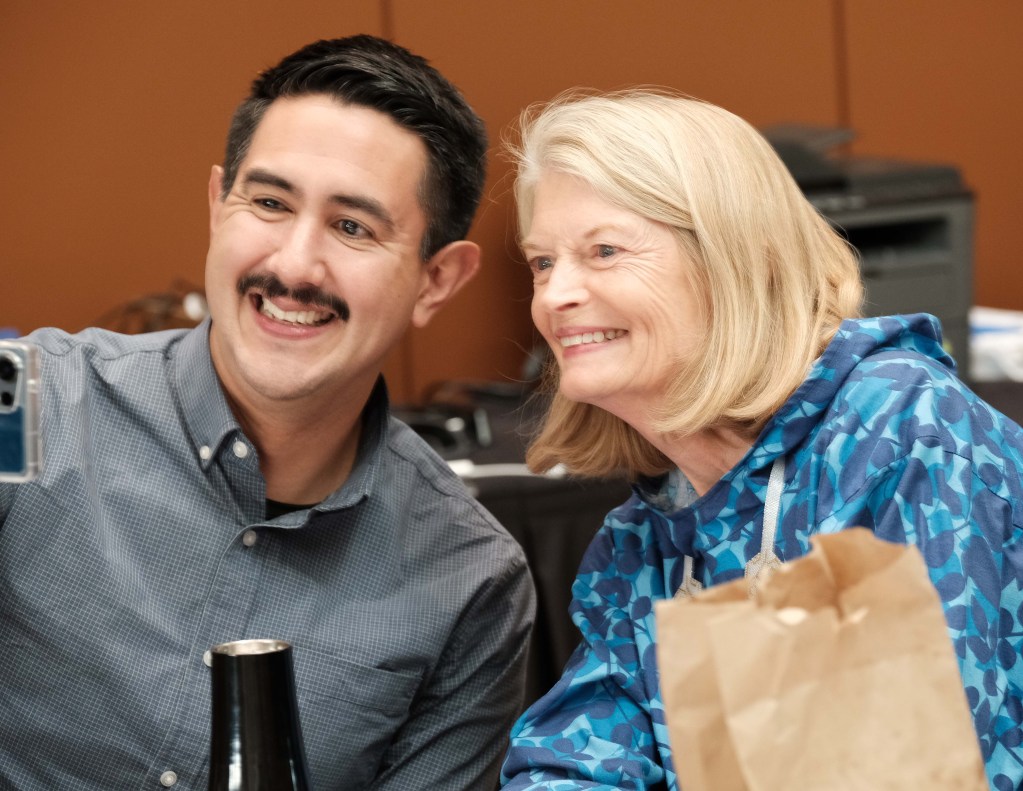
Alaska Sen. Lisa Murkowski, Republican, focused on the tragedy in western Alaskan villages in her speech. She encouraged federal leadership to listen to people on the ground in the state when making funding decisions about natural disaster aid as well as other issues.
“We are seeing this administration peeling back not just the reconciliation bill but also things we put in place in the infrastructure bill, for which grants were awarded,” she said.
Murkowski, however, praised the response from the Federal Emergency Management Agency. “The response from FEMA and everybody else has been fabulous,” she said.
Regarding explaining the impact of cuts to radio service to fellow senators she said, “I tried to explain to people who live in nice safe homes what it means to have warnings of ice conditions up-river on the Kuskokwim during breakup. How important it is for people of Selawik to know if they’re still on a boiled water notice.”
Chuck Hoskin Jr., principal chief of the Cherokee Nation, attended the convention with other Indigenous delegations, such as Japan.
“We’re here to do a couple of things. One is to thank AFN for the support they provided for our push to get a delegate in the Congress,” he said. “So I came here to thank them and also to share what we’re dealing with, the challenges and opportunities back home.”
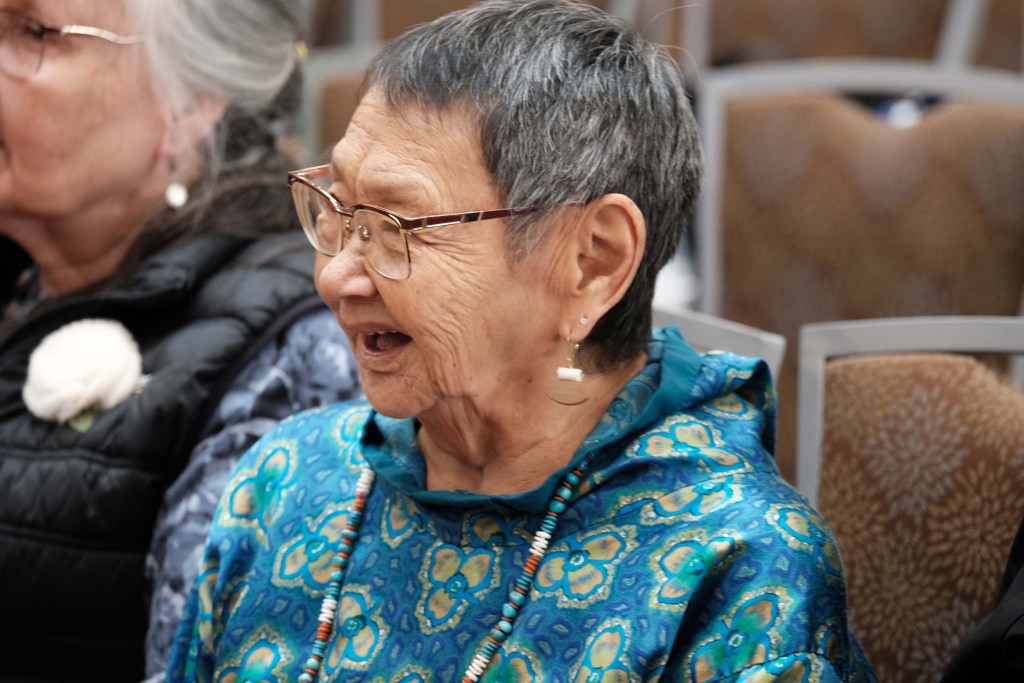
Nearly every presenter at AFN commented on the resilience of Alaska Natives.
“What’s truly powerful about a lot of Native people is our unshakable resilience. We know how to endure and rise with strength. We know how to adapt, and we know how to stand together,” Singh said.
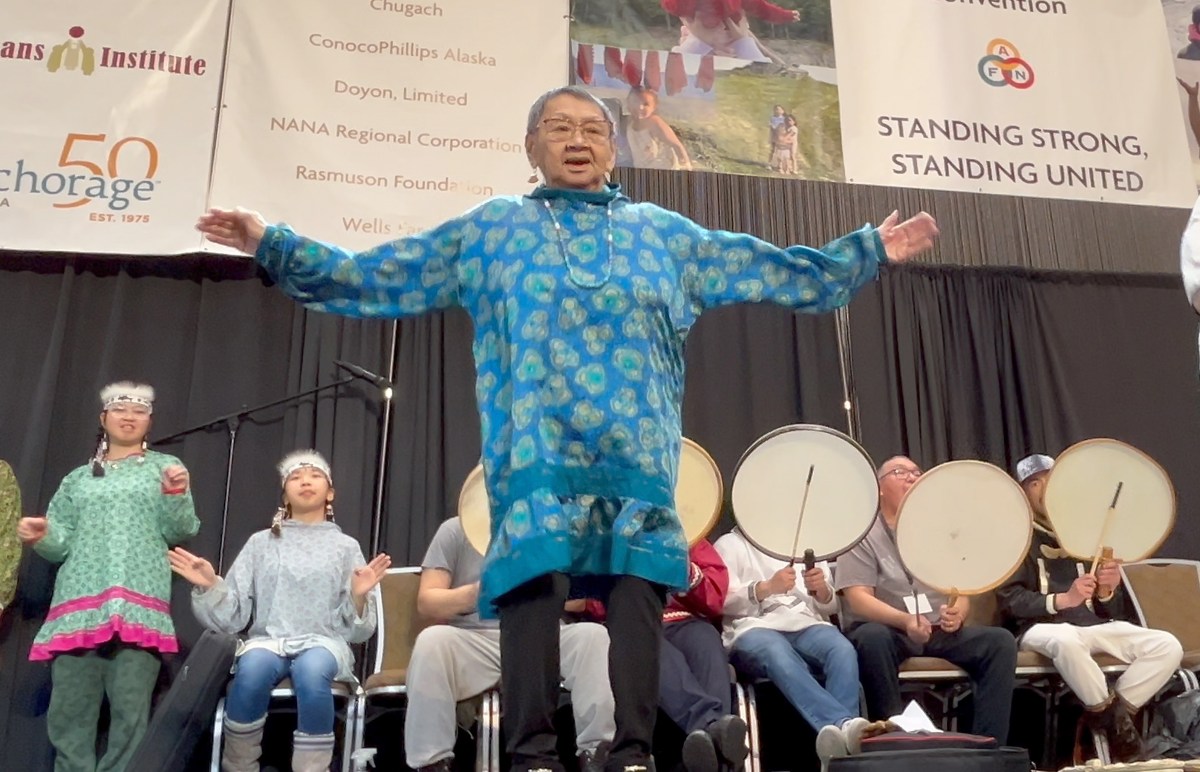
And of course, there was dance. A lot of dance, conducted with great enthusiasm and joy.
Murkowski commented on the healing, unifying power of dance for Alaskan Natives during her speech.
“I asked a 16-year-old boy about what will help (Typhoon) evacuees going forward and he said, ‘We can give them their traditional foods. We can come together where they can celebrate through dance, to be together in a big city like this.’”
The official AFN dance program began with the Oughsatkut Dancers of Gambell School. Their dance was so contagious that 75-year-old Shirley Iknokinok of Gambell leapt onto the stage to join them.
“I just love to dance,” she told ICT.
This story has been updated to include a quote from Murkowski on FEMA.