
Miles Morrisseau
ICT
It was a hard year for Indigenous peoples in Canada.
The largest mass killing ever on a First Nation, the identification of more unmarked children’s graves at former Indian residential schools and the ongoing genocide of Indigenous women.
The visit by Pope Francis in July divided Indigenous peoples, splitting those who felt vindicated by the Papal apology and those who felt betrayed. One Indigenous woman known as Si Pih Ko expressed that anger, standing up to the Pontiff and singing a protest song in her Cree language.
SUPPORT INDIGENOUS JOURNALISM. CONTRIBUTE TODAY.
Soon after that high-profile visit, the eyes of the world turned once again to Indigenous Canada as the largest mass stabbing in the history of the country happened on the James Smith Cree Nation in northern Saskatchewan.
The ongoing genocide of Indigenous women was proven yet again when the Winnipeg Police Service announced that a serial killer had been charged with first-degree murder in the deaths of four Indigenous women. The killer’s online postings expressed a hateful rhetoric.
But Indigenous peoples in Canada also found a way to celebrate another day. It was the Golden Girls of women’s hockey, the artists and storytellers, that lifted people up and carried them forward. Icons in music and film were not only celebrated but continue to make and perform vital work. It was people achieving against all odds and still standing with prayers in their hearts and songs in the air.
Here are some of the top stories from Indigenous Canada in 2022.

Indigenous women golden at the Winter Olympics
It was deja vu all over again at the Winter Olympics in Beijing in February, with the Canadian women’s hockey team in the gold-medal finals in what has become one of the premiere events in the Winter Olympics – the clash between Team Canada and Team USA for women’s hockey supremacy.
Read more:
—Winter Olympics feature three Indigenous women
—Indigenous women stand out in gold-medal hockey game
And when it mattered most, three Indigenous women players were on the ice — Abby Roque, Ojibway from Wahnapitae First Nation, who grew up in Sault Ste. Marie, Michigan, for the Americans; and Jocelyne Larocque and Jamie Lee Rattray, both of the Métis Nation, for the Canadians.
The final score was 3-2, just as it was four years ago in PyeongChang, South Korea. But this time Team Canada came out on top, taking home the gold medal while the Americans settled for silver.
Ground–penetrating radar reveals more unmarked graves
The Kapawe’no First Nation on Treaty 8 territory 235 miles northwest of Edmonton, Alberta, released findings in February of unmarked graves around the Grouard Mission. The mission was part of the infamous Indian residential system that operated in partnership with churches and the Canadian government.
The survey used ground-penetrating radar and specialized drones to identify 169 anomalies that are often associated with graves. The areas searched were based on testimonies of survivors and engagement with community members in an effort to help identify First Nation, Métis and Inuit children who never made it home from the residential school.
“The grief of finding our stolen children has opened fresh wounds as we remember the horror and devastation our people felt when our children were forcibly removed from their families and communities to institutions known as residential schools,” said Kapawe’no First Nation Chief Sydney Halcrow in a statement.
‘We can now begin our collective healing and honour the lives of these children so they can finally rest in peace,” Halcrow said. “We honour all Elders and Survivors who have bravely shared their truth with us – truths that were not believed or acknowledged for many, many years. We are forever grateful for their forced sacrifice and unparalleled courage.”
Two weeks earlier, the Keeseekoose First Nation in Saskatchewan announced that its survey of former residential school grounds had revealed 54 unmarked graves. More than 200 unmarked graves were revealed in May 2021 at the Kamloops Indian Residential School, and others sites from Williams Lakes, British Columbia, to Sandy Bay, Manitoba, have revealed evidence of unmarked graves. The Sakgeeng First Nation announced the discovery of 190 anomalies requiring further study.
Susan Aglukark shines at Junos
Indigenous artists were seen and heard in May at this year’s Juno Awards, a weeklong celebration of Canadian music culminating in a televised awards ceremony.
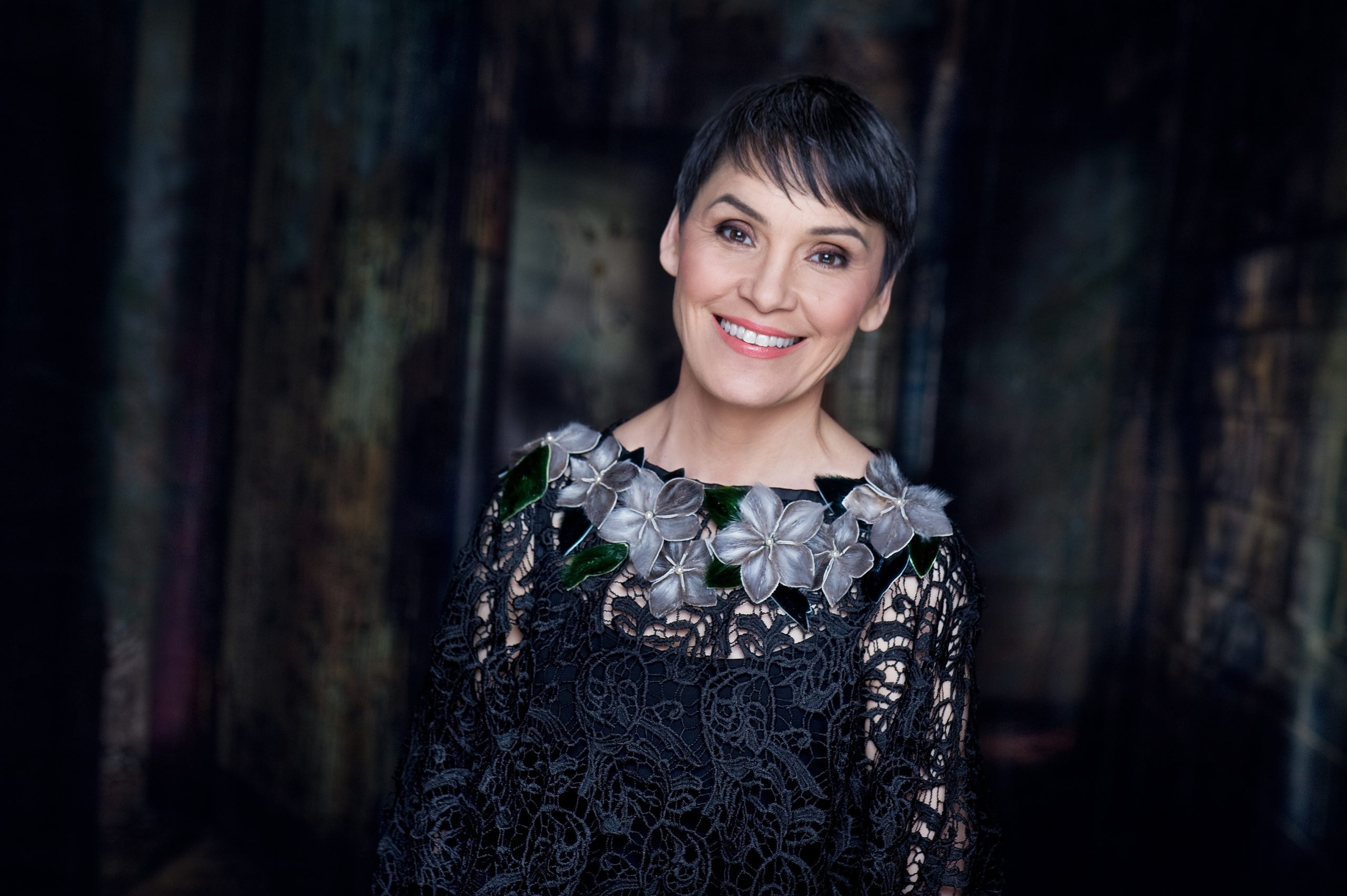
For the first time, Indigenous music was broken into two categories – contemporary and traditional – and the Humanitarian Award was bestowed upon Inuit musical icon Susan Aglukark, known as the Arctic Rose after her award-winning 1995 debut album.
Aglukark is the most decorated Inuit musician/singer/songwriter in Canada, having won four Junos in 11 nominations.She accepted the Humanitarian Award from Canada’s Governor General Mary Simon, Dene, who is the representative of the British Monarchy for Canada.
Read more:
—Canada’s ‘Arctic Rose’ continues her epic journey
—Indigenous artists shine in Juno awards
DJ Shub, Mohawk from the Six Nations of the Grand River, won in the Contemporary Indigenous music category for his album, “War Club,” and Fawn Wood, Plains Cree/Salish, took home the statue for Traditional Album of the Year for “Kakike.”
An apology at last
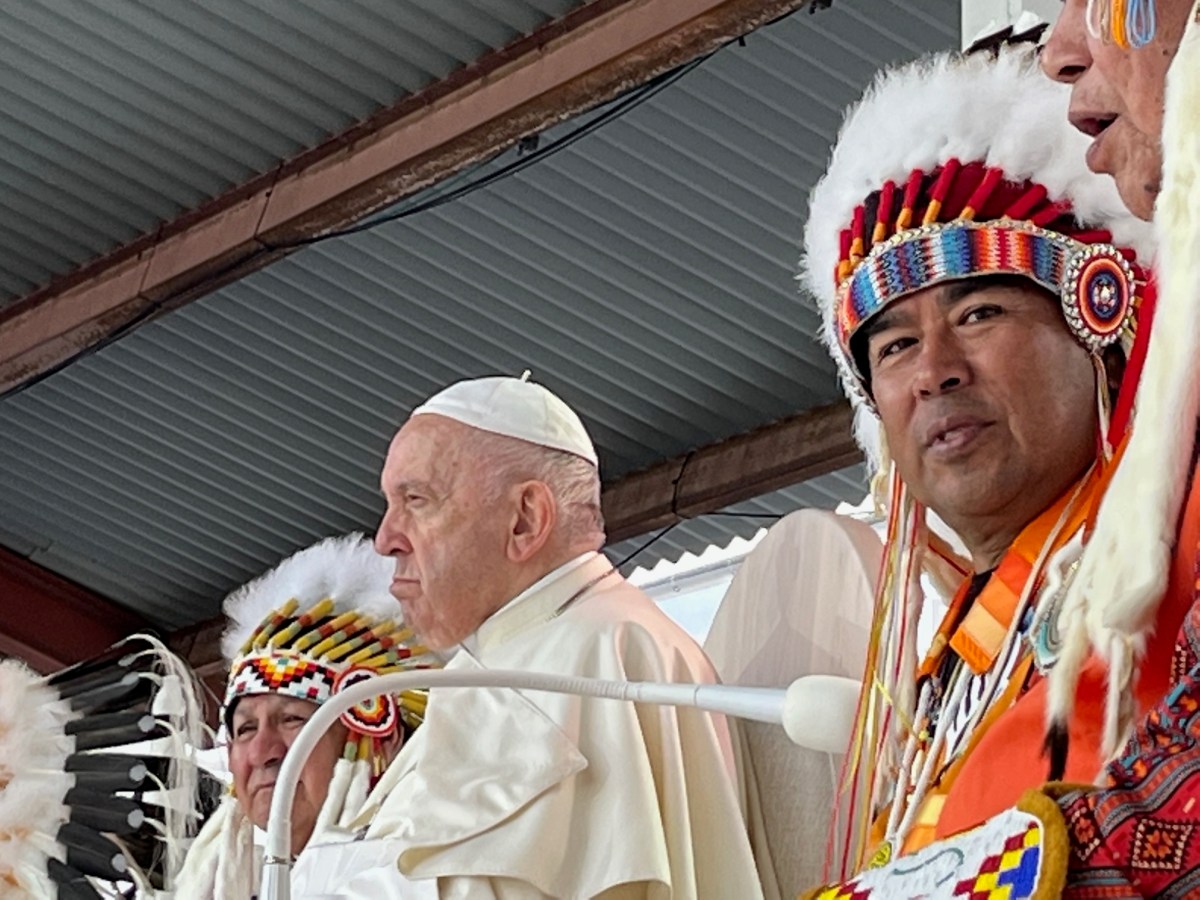
The eyes of the world turned again to Canada in July to watch Pope Francis apologize to Indigenous peoples for the “deplorable evil” of the Indian residential schools. The system of removing children from their homes at the age of seven was a law strictly enforced by the Canadian government.
“I am deeply sorry,” the Pope said, from the grounds of the former Ermineskin Indian Residential School, which operated from 1916 to 1975 as one of the largest government-funded schools run by the Catholic Church.
Read more:
—Apology at last in Canada
—’It’s going to take a long time’
—Singer at peace after protest song
The six-day visit that the Pope called a “penitential pilgrimage” began with a visit to the site of the school on Maskwacis First Nation in Alberta, where he greeted thousands of people, many of whom were former residential school survivors hoping to hear an apology.
He then conducted mass for thousands in Edmonton, Canada, before going on to Lac Ste. Anne and Quebec City. He ended the trip with with another apology at Iqaluit before returning to Rome on July 29.
A number of tributes were offered to the Pope, including the presentation of a ceremonial headdress by residential school survivor Wilton Littlechild that caused online outrage. Littlechild said the event was important for many residential school survivors.
”This has been a journey for many Indigenous peoples who wanted to see this day happen. In tears, sometimes in anger, who said to me, ‘I just want to hear three words from the Pope in front of me, ‘I am sorry,’ for what happened to me as a child.’”
Assembly of First Nations National Chief RoseAnne Archibald was disappointed the Pope did not renounce the doctrine of discovery, and questioned whether he had apologized on behalf of the entire Catholic Church.
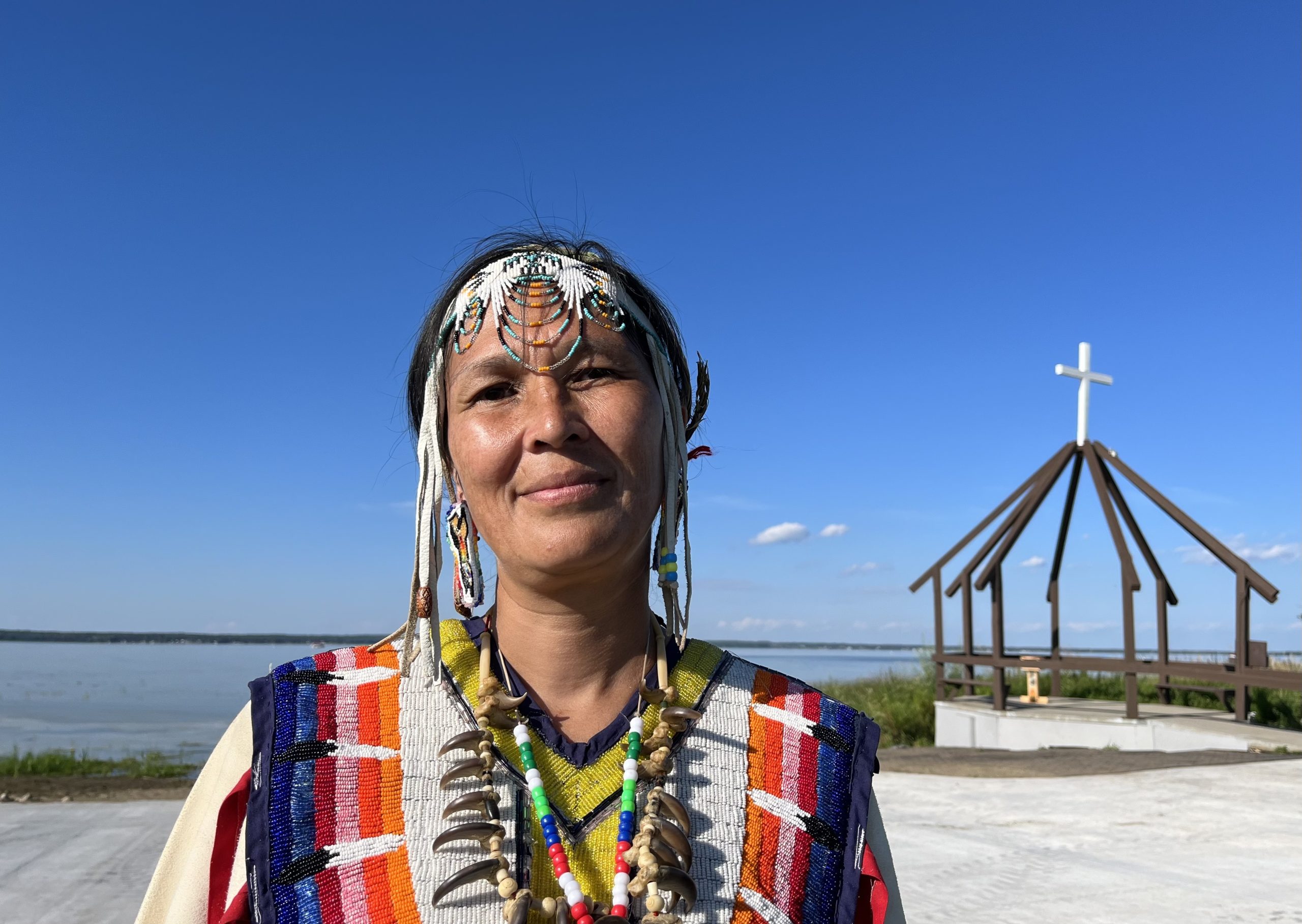
One of the most symbolic and stunning moments of the day came when a Cree woman, Si Pih Ko, in a white buckskin dress, a beaded crown and a bear-claw necklace sang a protest song to the Pope, with her fist raised and tears streaming down her face. The song, mistaken as the national anthem, “O Canada,” was instead a Cree song, “Our Village,” that speaks “for the love of the children.”
The image of her song erupted on social media, and Si Pih Ko followed the Pope to Lac Ste. Anne where thousands of Indigenous Catholics have gathered for nearly a century to honor the grandmother of Jesus Christ. The site had long held spiritual significance to the Cree and Dakota of the region. By then, Si Pih Ko said, she was at peace.
Buffy Sainte-Marie honored at Toronto film festival
Legendary Indigenous musician Buffy Sainte-Marie opened the 47th Toronto International Film Festival in September with a showing of “Buffy Sainte-Marie: Carry It On,” a documentary about her life and career.
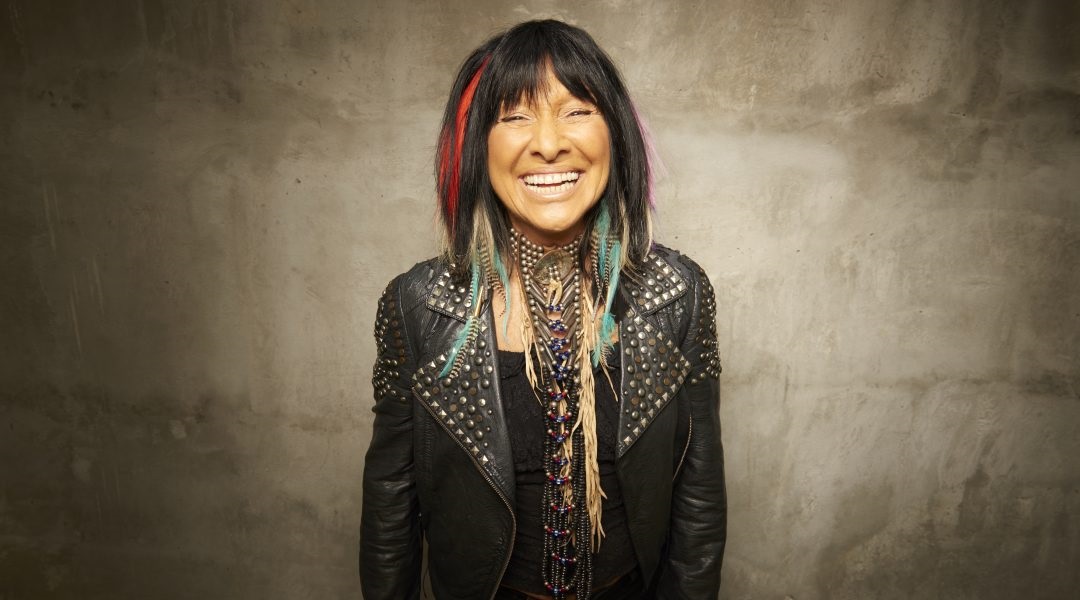
Sainte-Marie, Cree, told a packed theater at the Bell Lightbox that she always wanted to lift up with her music even after facing hard truths.”I really believe that music can really hurt you,” she said. “But it can also really be healing and medicinal.”
Sainte-Marie also received the Jeff Skoll Award in Impact Media presented to artists who are leaders in connecting cinema and social impact.
Sainte-Marie was not the only Indigenous person honored at the Toronto film festival, where a number of high-profile films premiered.
Among those featured was Anishinaabe filmmaker Darlene Naponse’s latest directorial effort, “Stellar,” a follow-up to the 2018 rock-star-goes-home-to-the-rez drama, “Falls Around Her,” starring the legendary Tantoo Cardinal, Cree and Métis, of “Dances with Wolves.”
Read more:
—Festival honors Buffy Sainte-Marie
—Buffy Sainte-Marie kicks off festival with ‘Carry It On’
“Stellar” featured Elle-Maija Tailfeathers, Blackfoot and Sámi, of “Night Raiders,” and Braeden Clarke, Cree, and included in the supporting cast Billy Merasty, Cree, of “It: Chapter Two,” and Tina Keeper, Cree, of “North of 60.”
In the film, “Rosie,” writer/director/actress Gail Maurice, Métis — who is seen on screen in “Bones of Crows” — stepped behind the camera as writer and director to tell the story of an orphaned Indigenous girl who is forced to live with her reluctant, street-smart aunty and her two gender-bending best friends in Montreal in the 1980s.
Also featured was “Ever Deadly,” co-directed by Chelsea McMullen and Inuit musician Tanya Tagaq. It tells the story of Tagaq, a critically acclaimed throat singer and performer whose album, “Animism,” won the Polaris Prize in music for 2014. Tagaq is also author of the 2018 novel, “Split Tooth.
Mass murder in remote community
But the fall brought more bad news. On Sept. 4, 10 people were killed and at least 18 were injured from a series of knife attacks and stabbings, mostly on the James Smith Cree Nation reserve in northern Saskatchewan and neighboring communities about 135 miles north of Saskatoon.
Read more:
—Canada grieves after ‘horrific’ massacre
—Victims identified in stabbing rampage
It was the largest mass stabbing in Canadian history, putting the region under a state of civil emergency as a manhunt was underway for the two brothers suspected in the attacks. One brother was eventually found dead and the other died of what officials said was “medical distress” as law enforcement arrested him.
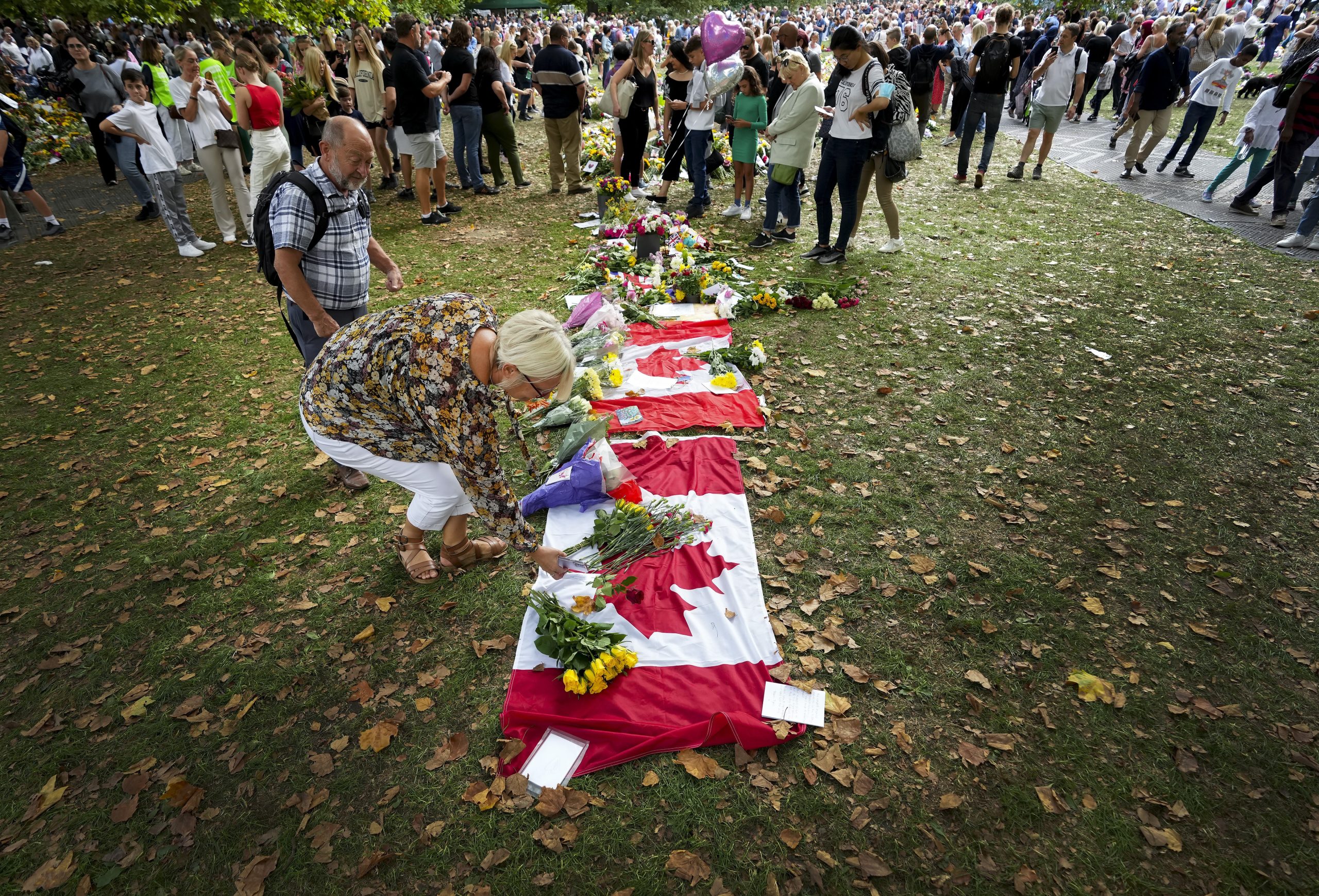
Queen’s death complicated for Indigenous peoples
The death of Queen Elizabeth II on Sept. 8 brought an end to the unique relationship she had with the Indigenous peoples of Canada. Canada remains a part of the British Commonwealth and recognizes the Queen as its own monarch.
Treaties were signed with the Crown and remain the foundational documents of the country, leaving the Queen’s image burned into the minds and some hearts of generations of Indigenous people, whether First Nations, Métis or Inuit.
Myeengun Henry, former chief of the Chippewa of the Thames and current Knowledge Keeper at the University of Waterloo, told ICT that the Queen ruled over years of Indigenous tragedy.
“We had 70 years of the Queen, who watched some drastic things happen in Canada — the residential schools, of course, the ‘60s scoop, murdered missing women, many of these terrible events that took place,” he said. “And I think what’s been going on with Indigenous people, they’ve been holding on to this anger.”
The Queen was also the symbolic head of the Anglican Church, which next to the Catholic Church ran the largest number of Indian Residential schools in Canada. The Queen never apologized.
Most-decorated Indigenous soldier honored with stamp
The most decorated Indigenous soldier in Canadian Armed Forces history, Sgt. Tommy Prince, was honored with a postage stamp in October.
Prince was from the Brokenhead Ojibwe Nation in Manitoba and a descendant of Chief Peguis, the famed Saulteaux chief. He was born in 1915 in a canvas tent and was one of 11 children of Harry and Elizabeth Prince. He learned to live off the land by hunting and trapping at a young age.
Read more:
—Honoring an Indigenous war veteran
He joined the Armed Forces in 1940 at the age of 24 and trained as combat engineer, where both building bridges and blowing them up were part of the job. He then spent two years with the Royal Canadian engineers before answering a call for paratrooper volunteers. He went on to train with the first Canadian Special Services battalion, a unit known to German soldiers as the Devil’s Brigade that began the U.S. Special Forces.
Serial killer targeted Indigenous women in Winnipeg
The long year came to a close in December with the announcement that a Winnipeg man had been arrested and charged as a serial killer targeting Indigenous women in the Manitoba capital city.
Jeremy Anthony Michael Skibicki, 35, of Winnipeg, who had reportedly posted racist, misogynist and white supremacist rants on social media, is charged in the deaths of four Indigenous women who were believed to have been killed between March and May.
Read more:
—Man charged as serial killer in Winnipeg
He initially was charged in the death of Rebecca Contois of Winnipeg, 24, of Crane River First Nation, after police found her remains near a garbage bin in the city and in a nearby landfill.
He has since been charged in the deaths of three other Winnipeg women: Morgan Beatrice Harris, 39, of Long Plain First Nation, who is believed to have been killed on or about May 1; Marcedes Myran, 26, also of Long Plain First Nation, who is believed to have been killed on or about May 4; and an unidentified woman known now as Buffalo Woman, or Mashkode Bizhiki’ikwe, who is believed to have been killed March 15.
Police said DNA linked Skibicki to the women’s deaths, but their bodies have not been found. Indigenous leaders are pushing for police to continue searching two landfills to hunt for their remains. Police have not ruled out the possibility that there are additional victims.
Unexpected deaths
For years, actor Pat John represented all of Indigenous Canada. John was the only Indigenous person on Canadian TV for nearly 20 years, playing the iconic role of Jesse in CBC’s “The Beachcombers,”a long-running series that was uniquely Canadian in a broadcast world dominated by American and British programming. John, of the Shishalh First Nation, died at home in Sechelt, British Columbia, on July 13, 2022. He was 69.
He was known to millions of Canadians as Jesse, the business partner of the series lead Nick Adonis, played by Bruno Gerussi. The pair shared a board and went up and down the coast combing for harvested trees that had drifted away. He played the role with intelligence and mischievousness, never falling into the role of sidekick. Perhaps one of the most popular episodes, “The Sasquatch Walks at Night,” from 1974, had Jesse fooling everyone when he dressed up as the mythical creature.
He had suffered from health problems in recent years but was reportedly sitting outside at home when he died.
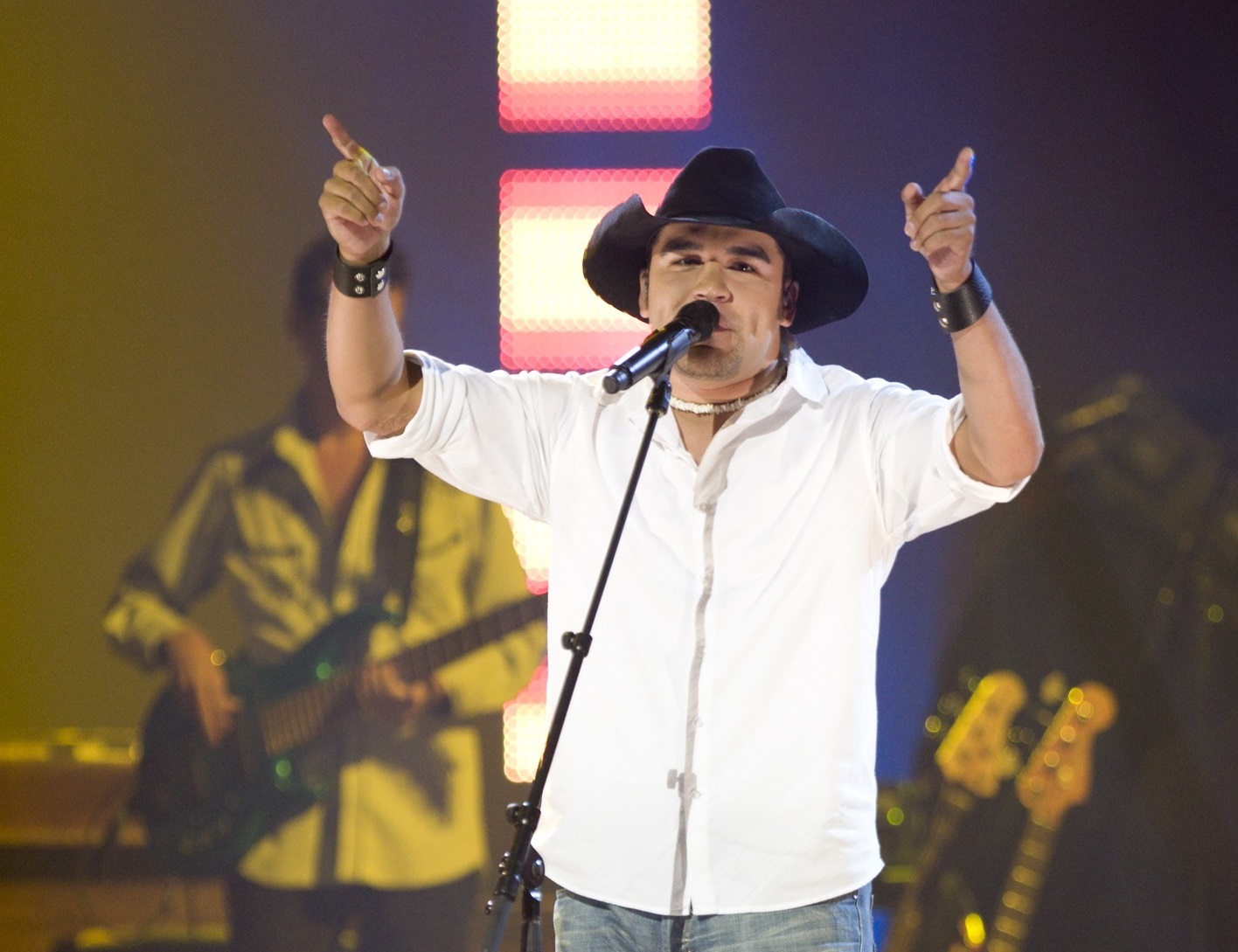
John’s death came not long after the Canadian country music scene was rocked by the sudden death on April 25 of Cree singer/songwriter Shane Yellowbird, whose childhood dreams of being a rodeo cowboy turned to performing when he began singing to help his stutter.
Read more:
—‘Sad day in Canadian country music world’
Yellowbird, 42, who had suffered from epilepsy, released his debut album, “Life is Calling My Name,” in 2007 to much acclaim, with the single, “Pickup Truck,” a top five hit on the Canadian country singles chart. In 2009, he became one of only three Indigenous artists ever to perform at the Grand Ole Opry in Nashville.

Our stories are worth telling. Our stories are worth sharing. Our stories are worth your support. Contribute $5 or $10 today to help ICT (formerly Indian Country Today) carry out its critical mission. Sign up for ICT’s free newsletter.