
ICT is working to shape the future of journalism and stay connected with readers like you. A crucial part of that effort is understanding our audience. Share your perspective in a brief survey for a chance to win prizes.
Felix Clary
ICT + Tulsa World
TULSA, Okla. — The Cherokee Nation is lobbying Congress to address justice system inequality for freedmen descendants, a result of the 2020 McGirt decision in the Supreme Court, by changing the Major Crimes Act.
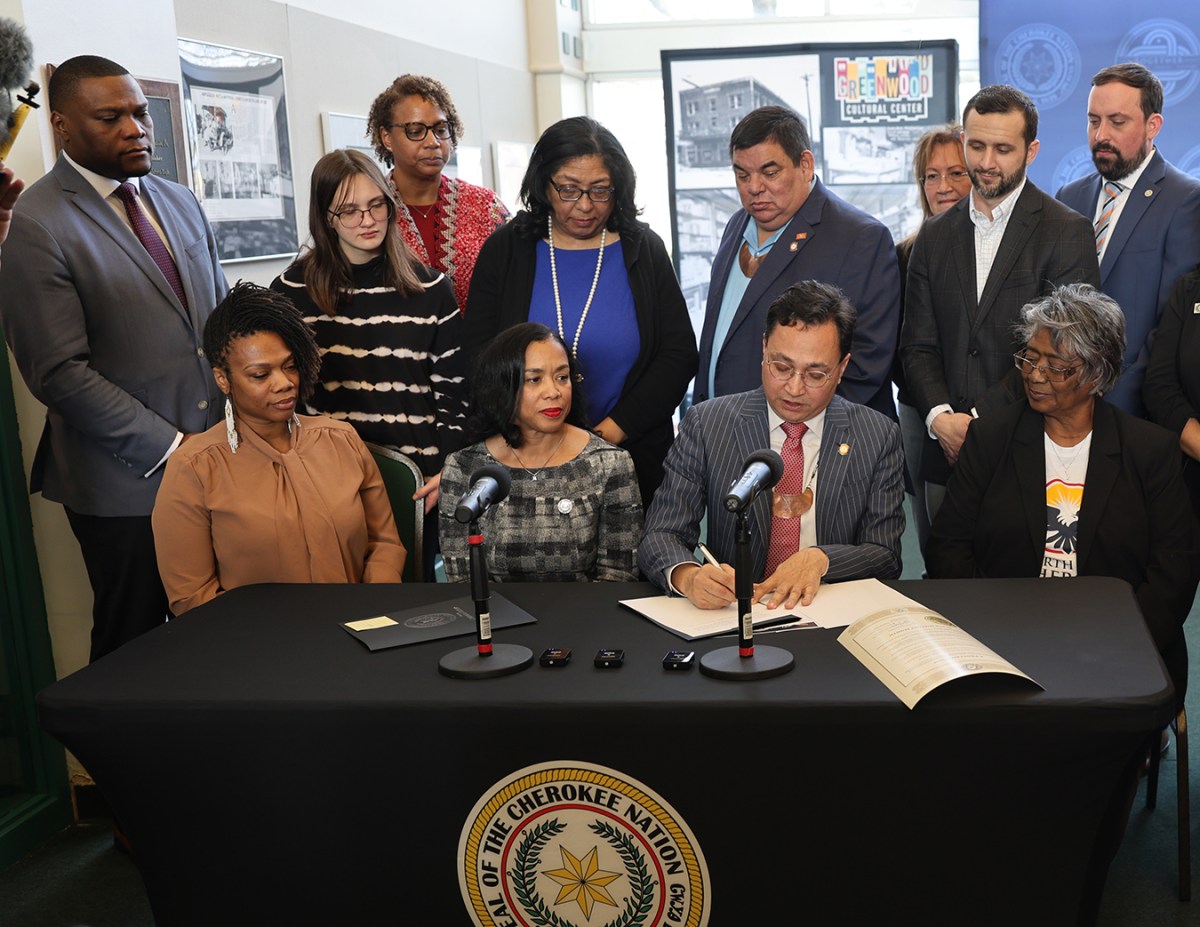
Hoskin made the announcement at a Black History Month celebration on Feb. 16 at the Greenwood Cultural Center in Tulsa. He discussed his plans further at a luncheon this week at Bramble Breakfast Downtown.
“In the Cherokee Nation, all citizens are equal, and we have different descendancy,” he said at the luncheon.
“So if you’re a Cherokee citizen, you might descend from a Cherokee family that goes back to time immemorial… or in the case of Cherokee citizens of freedman descent–the descendants of people who were enslaved by Cherokees under our laws.”
The Cherokee Nation has more than 15,000 citizens of freedmen descent enrolled. Hoskin said that the Cherokee Nation is now in an era where all descendants have equal citizenship. He said they are aiming for embracing equality. not only on paper, but the spirit of equality, reflecting it in their laws and investments.
The biggest issue of equality for black freedmen descendants today relates to criminal jurisdiction under the McGirt case.
The McGirt decision gave tribal sovereignty to tribal nations, ruling that criminal cases involving tribal citizens on tribal lands should not be tried in state court but rather tribal court, unless the crime falls under the Major Crimes Act (1885), in which it would be tried in federal court.
The Major Crimes Act treats Cherokee citizens as separate from the black freedmen. Since the McGirt decision appeals to the Major Crimes Act, this means that the jurisdictional rules under McGirt do not currently apply to the descendants of Black freedmen.
“The law does not treat a Cherokee citizen of freedmen descent the way it treats every other Cherokee citizen, and it’s just intolerable. It shouldn’t be that way. I don’t think it was intentional on the part of the United States, but it is the effect,” Hoskin said.
The Cherokee Nation is calling on Congress to change the Major Crimes Act.
Hoskin also signed an amendment to a 2020 executive order last Friday, calling for more data research on how much descendants of Black freedmen are utilizing the Cherokee Nation programs and services available for citizens.
The original executive order dedicated time and resources to going into the communities of black freedmen descendants, asking them about their needs and wants as Cherokee citizens, as well as reviewing Cherokee laws and service literature, ensuring that the Black freedmen descendants were included.
“We’d like them (black freedmen descendants) to participate in things like education programs, career services, programs, housing programs,” said Hoskin.
He said they are doing all they can to acknowledge that the Cherokee Nation enslaved black people under their laws and are apologizing for it.
“Then doing more than that, taking real steps at reconciliation, and I feel proud that the Cherokee Nation stands for that,” he said.
Hoskin also answered public inquiries about the Cherokee Nation’s recent efforts across the board, discussing how the tribal tag compacts financially support public education, how the Cherokee Nation supports hungry children through the Summer EBT program, and their ongoing efforts to get Cherokee politician Kim Teehee into Congress.
Teehee is a delegate-designate to the U.S. House of Representatives.
Hoskin said the The New Echota Treaty that removed the Cherokee Nation to Oklahoma stated they would have a Cherokee citizen and advocate within Congress. The tribal nation is still pushing for this promise to be upheld.

This story is co-published by the Tulsa World and ICT, a news partnership that covers Indigenous communities in the Oklahoma area.
Our stories are worth telling. Our stories are worth sharing. Our stories are worth your support. Contribute $5 or $10 today to help ICT carry out its critical mission. Sign up for ICT’s free newsletter.

