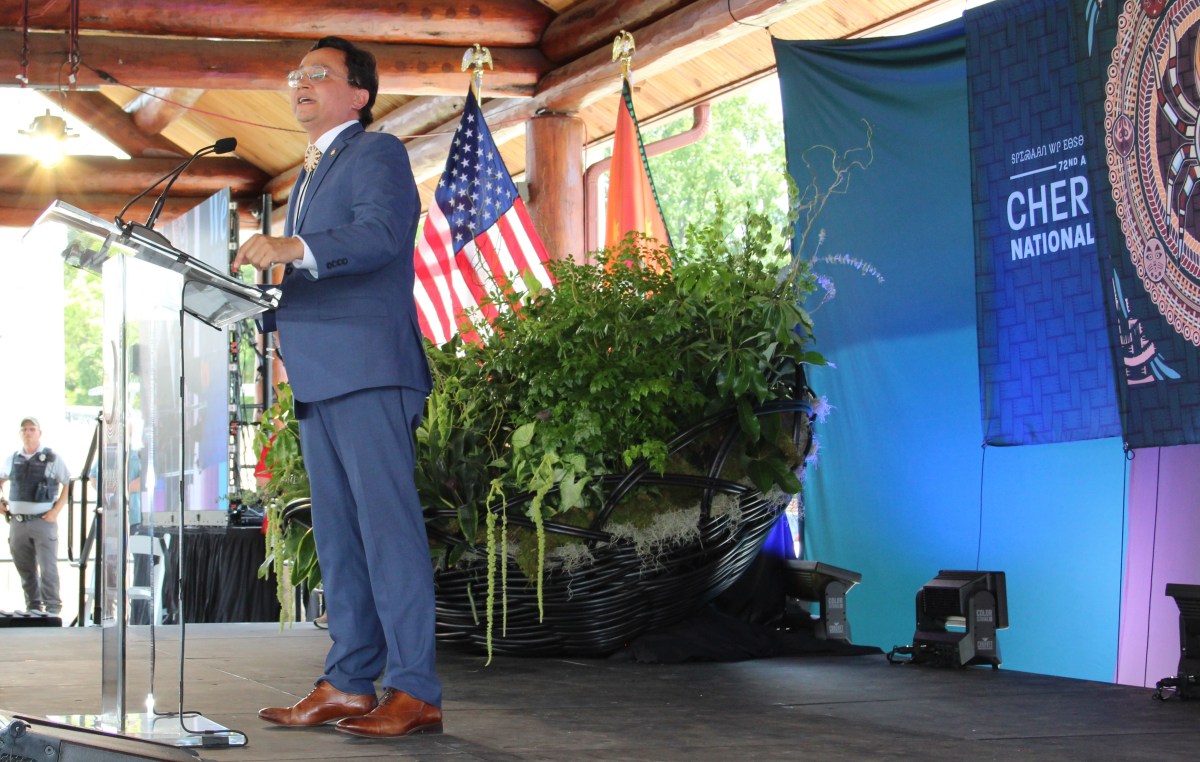
TAHLEQUAH, Okla. — Cherokee Principal Chief Chuck Hoskin Jr. said Saturday his tribe will continue to provide car tags to its citizens, even if Gov. Kevin Stitt does not renew its state compact.
“No matter what happens with our compact come January the first of 2025, we will continue issuing car tags and titles to Cherokee citizens, no matter what,” Hoskin said during his State of the Nation address.
Stitt has pushed against the Cherokee Nation’s right to issue car tags for fear of losing money from state-issued tags. In his Saturday speech, Hoskin said the tribe will continue to print vehicle tags on its reservation and share tag revenue with the state next year, if the governor agrees to renew a “fair compact.”
“So I ask Governor Stitt this, and I want you to help me,” he said to the crowd of around 400 Cherokee citizens, as well as state and federal representatives. “I ask Stitt to put aside his hostility to tribal sovereignty. I ask him to stop turning state-tribal relations into some sort of contest, and simply use common sense, and treat the Cherokee Nation with respect.”

Hoskin’s speech took place during the three-day annual Cherokee Nation Holiday that opened Saturday morning. Hoskin addressed challenges and successes that the tribe has experienced throughout the year. The vehicle tag compact, he said, is the one of the greatest issues facing the nation currently.
The housing crisis is another issue the tribe faces, said Hoskin. In 2019, he and Deputy Chief Bryan Warner proposed the Housing, Jobs and Sustainable Communities Act, which he said is the largest housing investment in the tribe’s history.
Hoskin said the tribe has completed 2,800 individual housing projects since the creation of the Cherokee housing legislation, which he compared to the federal Native American Housing Assistance and Self-Determination Act.
“We built 363 new homes, including four housing additions, for people who have been waiting for years to be served,” he said. “Too many of our fellow Cherokees continue to struggle when it comes to housing. We’ve got to be honest about it.”
He also mentioned the housing research study that will be completed to survey the tribe’s citizens and their housing needs.
Hoskin said the tribe’s housing act expires in one year and the tribe must decide, as a government, “whether we need to return to the days of waiting on the United States to come to the rescue, to hand down whatever inadequate funds Congress happens to approve.”
He said he plans to send to the tribal council not just a temporary housing act, but a permanent law that will put $40 million to the cause of housing every three years in perpetuity.
“That’s $40 million on top of what the Housing and Urban Development Department provides under NAHASDA, and it will include our own business profits,” Hoskin said.
Hoskin announced that he plans for the Cherokee Nation to take control of the Indian hospital in Claremore, Okla., which is currently run by Indian Health Services, by proposing legislation for ownership of the facility to the council.
“The IHS budget is seven times less than it ought to be,” he said. “Quite simply, we have proven that when the Cherokee Nation operates our own health care system, we do it better.”
He also announced that by 2026, the tribe plans to replace the Markoma center in Tahlequah with a new wellness center. Since 2019, Hoskin said the Cherokee Nation has expanded four health centers. The tribe is working on construction for a Carson Wellness Center in Stillwell, a $450 million hospital in Tahlequah, which will double inpatient capacity, and an $85 million health center in Salina.
He said it was the vision of his wife, January Hoskin, to build a $25 million drug treatment center near Tahlequah, which saw a ground-breaking in August.
The Cherokee Nation also recently broke ground on a new language immersion middle school, which he said means “more immersion students, more translation work, and more leveraging high tech to make our language accessible, more master apprentice students, more jobs in the language and more care for our elder fluent speakers.”
“The Cherokee language is making a come-back,” he said.
He reported that a record 6,700 Cherokee students received scholarships for higher education this year, and that this month, he plans to send the council the Sequoyah Schools Capital Plan, a $65 million investment to transform the campus into “a 21st century education complex worthy of the faculty, administrators, staff and students.”
He said this generation of Cherokee students are counting on the tribe to assure jobs for them after graduation. The nation currently employs 14,000 people worldwide.
“But small businesses remain the biggest driver of this economy,” he said. “So I’m excited to announce that we have reached a historic agreement with the U.S. Department of Treasury to support Cherokee entrepreneurs.”
He said over the next seven years, the tribe will open a pool of $86 million in loan funds to support Cherokee start-up businesses.

This story is co-published by the Tulsa World and ICT, a news partnership that covers Indigenous communities in the Oklahoma area.
Our stories are worth telling. Our stories are worth sharing. Our stories are worth your support. Contribute $5 or $10 today to help ICT carry out its critical mission. Sign up for ICT’s free newsletter.