
Felix Clary
ICT + Tulsa World
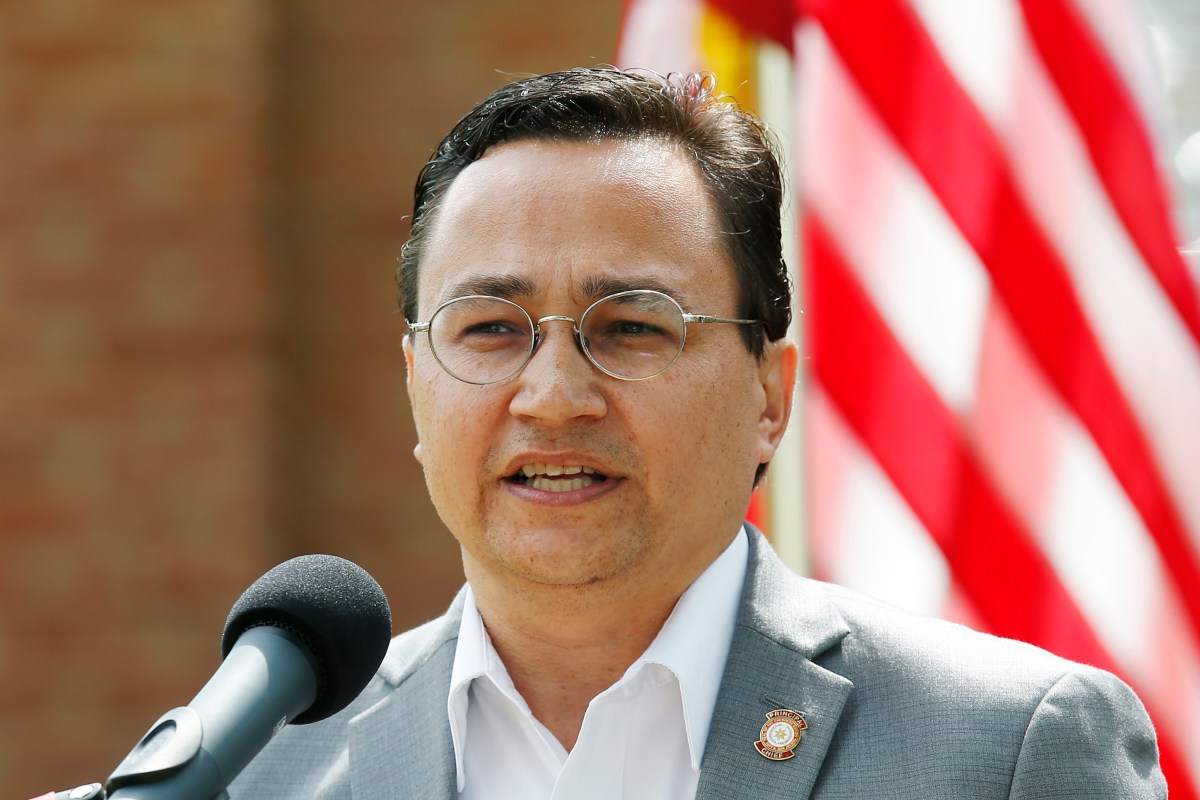
TULSA, Okla. – Cherokee Chief Chuck Hoskin Jr. said Gov. Kevin Stitt might see tribal sovereignty as a “zero sum game,” thinking the tribes keep any revenue they gain from Choctaw Nation vehicle tags that they issue to their citizens or traffic citations that Cherokee Nation police forces issue.
Hoskin said current negotiations with Stitt’s office over tribal tags are difficult because the two sides are operating on different sets of facts.
Stitt is worried that he cannot see all the revenue data that the Cherokee Nation makes from their tags, but Hoskin says millions of the dollars the tribe makes goes into building infrastructure for Oklahoma communities.
“He’s entitled to his own opinion but not to his own facts,” Hoskin said.
The tribe has its own tag agencies and issues its own titles and registrations. So Cherokee citizens have the choice of going to an Oklahoma tag agency and getting an Oklahoma tag, or they can go to a Cherokee Nation tag agency and get a Cherokee Nation tag.
Stitt thinks the state will benefit more if Oklahoma issues Cherokee tags for the tribe, but Hoskin says this should not be a concern. Hoskin said millions of dollars of Cherokee tag revenue are put back into tribal and non-tribal public schools, law enforcement, water infrastructure, cell phone towers and more within the tribe’s jurisdictional area.
Hoskin told ICT and Tulsa World on Thursday that he worries Stitt may not renew the tribe’s tag compacts as they are, and he said failure to renew would cost funds that “improve lives for all Oklahomans” and that they “could be lost forever.” Without the compact renewed, the tribes may lose their ability to issue tribal tags from their own agency.
The state and tribal tag compacts stipulate that tribes can have their own tag agencies and their own car tags, so long as they operate their business under certain conditions. This usually includes giving a portion of the money made from the tags to the state.
The Cherokee Nation actually has two motor vehicle compacts with the State of Oklahoma, one for Cherokee citizens who reside within the tribe’s reservation and one for those living outside the tribe’s jurisdiction. Those compacts specify that 38 percent of tag revenue from within the jurisdiction must be spent on schools within that same area and 20 percent must be dedicated to roads.
Stitt spokeswoman Abegail Cave told ICT and the Tulsa World that the state is looking for some changes in the Cherokee’s compacts during the negotiations. She said the administration would like them to “be more in line with the compact they have with the Chickasaw Nation.”
The Chickasaw Nation compact requires the tribe to issue tags through Service Oklahoma, which means the state prints the tags for the Chickasaw Nation and remits a portion of the money to the tribe.
Cave said the issue for Stitt lies in the fact that the Cherokee Nation prints its own tags and charges significantly less for them than the state would, as tribes are not subject to the same taxes as Service Oklahoma. She said state tags can be about $2,000, whereas she believes Cherokee Nation tags are only a few hundred dollars.
Cave also said the state doesn’t know how much money the Cherokee Nation gives to the state from the tag revenue it gains. Since the Chickasaw Nation issues its tags through the state, the state is able to keep track of those numbers easily.
Since they opened their tag agencies, the chief said $92 million has gone to local public school districts, $9 million to local law enforcement and municipalities, and $50 million to roads and bridge infrastructure improvements.
“In Kenwood, there used to be a really sad park with a barbed wire fence,” he said. “If you were a kid in Kenwood and saw that, you’d probably think, ‘This is what I deserve.’”
Hoskin said he is dedicated to rejuvenating rural Oklahoma with cell towers, road improvements, better public schools and multimillion-dollar health centers.
“Our strategy is to go into these communities that the rest of the world forgot about. We didn’t forget about them. And we will try to bring some life into them with infrastructure, and not only for the sake of keeping rural America alive, which is a good cause, but because these places are bastions of (Cherokee) language, culture and traditions,” said Hoskin.
Kenwood is one of the towns the Cherokee Nation is emphasizing on this project because it is a Cherokee community and because it is a community in need.
“If they wither on the vine, it’s not just an economic and … sentimental, romantic loss. It’s a real erosion of language and culture,” he said.
The Cherokee Nation is building a $65 million health center with much of that money coming from tag revenue, in Kenwood, reminiscent of its $460 million hospital in Tahlequah, which Hoskin describes as the tribe’s “crown jewel.”
The tribe built a cell tower in Kenwood last March.
“You used to not be able to make a cellphone call in Kenwood if you were a kid. If you’re a kid today, you have to be able to make one. You need access to education and all the opportunities online. You have to be able to see what you can be, and you have to see it on a smartphone,” said Hoskin.
The tribe is also building an expanded tribal language program with tag revenue to be held at its Kenwood community center, which will offer immersive Cherokee language courses to the community.
“Now people say we want to be like Kenwood, and nobody said they wanted to be like Kenwood before. People said the opposite. And it does seem to us that if you start there, then there’s pressure on us and our successors to say we can’t stop there.
“That’s why we’re in Marble City now, which is another community worth visiting and looking at its history, who founded it, and what’s happening now.”

This story is co-published by the Tulsa World and ICT, a news partnership that covers Indigenous communities in the Oklahoma area.
Our stories are worth telling. Our stories are worth sharing. Our stories are worth your support. Contribute $5 or $10 today to help ICT carry out its critical mission. Sign up for ICT’s free newsletter.

