

TRIGGER WARNING: This story contains material regarding missing and murdered Indigenous peoples. The National Indigenous Women’s Resource Center has a toolkit for families and communities. The U.S. Department of Justice’s Office of Justice Programs has a list of resources.
Luna Reyna
ICT + Underscore Native News
Josephine Pakootas was just 10 years old when her mom’s tattoo artist, Big Mama, would come by to tattoo her at their kitchen table. This was when her love for tattoos began.
When she turned 16, Pakootas begged her mom to take her to get her first tattoo. Her mom agreed and took her to get her first tattoos. Colville tattoo artist Jodi Day inked Pakootas with a red handprint on her hip to cover some scars, a reminder of what she’s overcome and to spread awareness about the missing and murdered Indigenous women epidemic. She also got the seed of life on her left hand to remind her that she’s in control of her reality.
Day encouraged Pakootas to explore tattooing after some praise from Pakootas’ mom and even let her practice on fake skin while she tattooed her mom after finishing Pakootas’ tattoos.
Even with the encouragement from Day, Pakootas wasn’t sure if tattooing was her path.
A few months later her mom bought her a tattoo gun and Pakootas began teaching herself how to tattoo at 17 years old.

“She bought me a little Amazon kit, and I started tattooing on fake skin,” Pakootas said. “I’m fully self taught. I never had an apprenticeship, which is definitely frowned upon in the tattoo community, but I feel like I approached it in the best way that I could with all the research that I did and all the time that I took to learn before actually tattooing people.”
Two years later Pakootas was offered a job at Auralite Art Collective, a Tattoo & Piercing Shop in Spokane, Washington. The 19-year-old who was raised on the Colville reservation, 100 miles west of Spokane, packed up her things and moved to the mid-size city within a month. She had no clients lined up. Pakootas slept on her massage bed for the first two weeks because she didn’t have a bed yet and cleaned houses on the side until her tattoo work picked up.
Pakootas’ story is one of many that marks National Tattoo Day, which is on July 17 every year.
Weaving stories with tattooing
At the beginning of Pakootas’ tattoo journey she did a lot of research, and talked to Colville elders and community members hoping to learn if her ancestors had traditional tattoos. She hasn’t gotten any clear answers.
Pakootas says she has always been a storyteller, and since she was just 10 years old she’s done that through traditional basket weaving.

“When I first started basket weaving that was my thing, telling stories through the baskets, whether it was older, Coyote stories maybe, or newer stories that I felt like just needed to be held on to or told more,” Pakootas said.
This love for weaving carried over in her tattooing as well, translating into traditional basketry designs in many of her tattoos.
“I feel like a lot of Native people, we have stories to tell, and a lot of my clients want to tell stories through their art on their bodies,” Pakootas said. “I really love doing research into different tribes. I’ll do research into their traditional stories, their creation stories, and their traditional arts, if it’s like basketry or painting or pottery, and I’ll get personal stories from my clients of their life, and then see how I can weave those together into the perfect piece for them.”
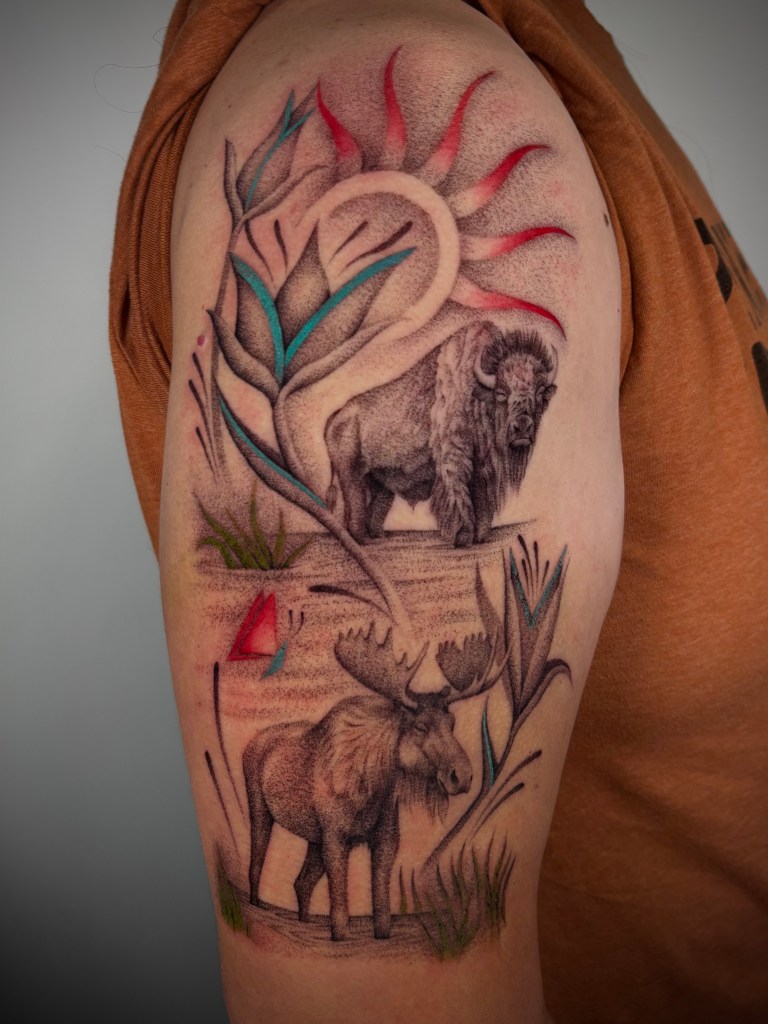
Pakootas gave an example of a leg panel for a Spokane Tribe of Indians citizen, who shared some of her personal battles that she overcame. Together they decided on a piece including ravens representing overcoming darkness, four ledger dancers that symbolize her and her siblings, traditional basketry designs, a coyote for the tribe, and berries with roots representing growth, and underneath that are two salmon swimming which illustrate her ancestors.
Being able to include her passion for traditional weaving into her tattoo work is incredibly meaningful for Pakootas. Her great grandmother was a master weaver but she never taught Pakootas’ grandmother because of the fear the boarding school era instilled in so many.
Fortunately, when Pakootas was 10 the Basket Weavers Association held a weaving class and her grandmother took her with her to learn.
“It’s a lot of old ladies and aunties at the basket weaving class and I’m like, ‘Grandma, I don’t belong here. I don’t want to do this.’ And she was like, ‘No, you’re going to learn. You’re going to be a master weaver someday,’” Pakootas said.
Pakootas says she caught on fast and fell in love with it.
“I always felt like it was really fun to build different designs and tell different stories, because I think I learned so young I understand the language of the basket,” Pakootas said. “Most people will draw their designs, draw with our patterns, but I can just kind of see the way it works in my head and just do it.”
“I don’t think I’m a master weaver yet, but I do have a basket in a museum,” Pakootas continued.
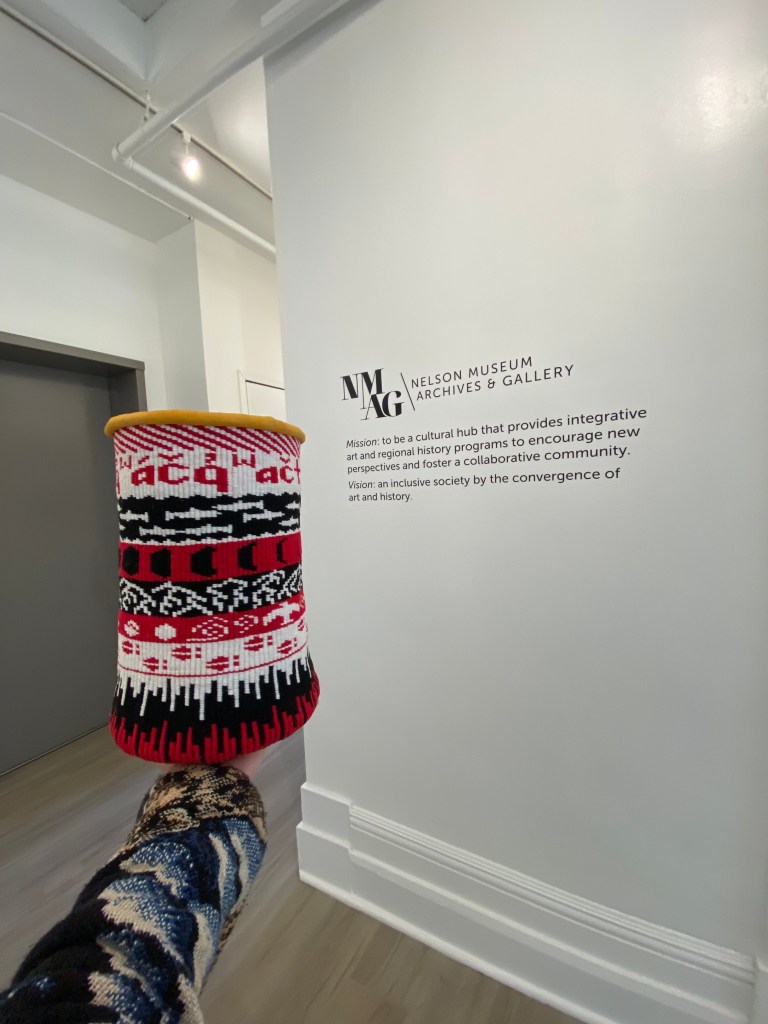
In 2023, on a trip to Nelson, Canada, with her uncle they ran into the Nelson Museum executive directors who asked to purchase a basket she weaved named, qwáčqwačt sktamqn, meaning strong family in Salishan.
The basket tells the story of the relationship between all living things, according to Pakootas. The design on the bottom row signifies balance, followed by rows for aspects of mother nature like the land animals, the sky, the moon, women, water and salmon.
MMIWG advocacy
Pakootas’ advocacy and artwork interweave on other issues as well.
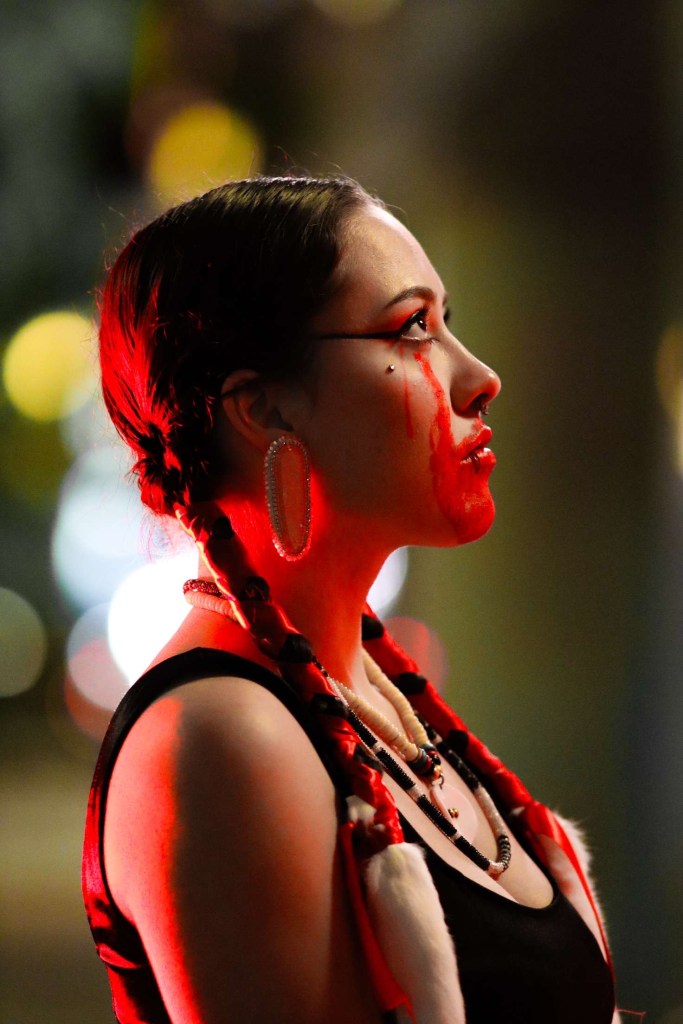
As a tattoo artist Pakootas has tattooed the red hand print on a client: a powerful symbol, signifying the silencing of Indigenous people through the high rates of violence, murder and trafficking.
Washington state has the second-highest rate of missing and murdered Indigenous women and girls cases in the US. In 2021, 46 of the 108 missing Indigenous people in Washington were from eastern Washington (where Spokane is located and Pakootas resides now), according to the Urban Indian Health Institute, YWCA Spokane and Washington State Patrol.
In February 2024, Pakootas filmed a five-minute poem, addressing the epidemic of MMIW and shared her personal experience with sexual violence in the Nelson Museum, Archives & Gallery Turret Performance Series.
TRIGGER WARNING: This film contains scenes where alcohol and sexual violence are discussed. Viewer discretion is advised.
Later that year her father honored her with a traditional name. Her father got really sick in 2023 and she wanted him to be the one to name her.
He named her šƛʼačínm šmʔamʼ, or Deer Woman.
The stories of Deer Woman vary a little among different Native nations but in every story of the shapeshifting Deer Woman, she is a protector of women and children, who punishes those who harm them, and a guardian of traditional values.
The unexpected name resonated deeply with her devotion to justice, and her personal experience with sexual assault and abuse, and her path to becoming a strong voice for Native women.
“When he gave me that name, I was kind of scared to carry it,” Pakootas said. “It’s powerful. I was expecting to get Little Basket Weaver or something. Something to do with being an artist. It was definitely hard for me to carry at first, but then I realized that it was to honor the way that I carry myself after what happened to me, and the way that I still use my voice to help speak for other Native women who didn’t make it out of that situation. I felt truly honored, and I feel like it definitely has helped me find my voice through all of it.”

Pakootas feels a need to spread awareness about the MMIWG epidemic since she lost her auntie Maria Sanchez in 2013. Pakootas called her Mia. Sanchez’s body was found in the Nespelem creek down the road from her family’s house where she was staying. Pakootas was just 8 years old.
“There was never any justice served,” Pakootas said. “I feel like that’s what started it, being so young and watching that. She left behind her babies and all of her family, and nobody did anything about it.”
To this day Pakootas never saw justice for what she endured either.
“For a long time after what happened to me, I shut down and didn’t want to do anything about it,” Pakootas said. “Then I realized, since I’m still here, it sounds insane that I have to say this, but since I was lucky enough to at least make it out alive. I feel like it’s my responsibility to spread awareness about it.”
A safe space
Having someone who culturally understands the historical trauma and continued genocidal impacts of colonialism, like the MMIW crisis, as well as the good medicine carried through the generations that leads to healing, has meant the world to Pakootas’ clients.
“With a lot of [Native] people, they’ve hinted at almost not feeling safe with non-Native artists,” Pakootas said. “I think because of the cultural disconnect.”
“I was always taught that, traditionally, in any of our work, or any ceremony, you’re not supposed to work on anything if you have heaviness in your heart, or you’re upset, or angry, and given how intimate tattooing can be. I’m leaving somebody with something permanent that I’ve created with my energy. Given all of that, it’s like the hugest honor to be trusted on that level with people’s bodies, and just being able to be a safe space for Native people in the tattoo industry,” Pakootas continued.
Pakootas explained that just being able to sit with somebody who you can relate to has been really important too.
“It’s the tiniest things, but it [makes] such a huge difference in everything — the humor, the slang, the way that you relate to people and laugh with them,” Pakootas said. “Being able to sit there and be yourself, and crack some rezzy jokes, I think that plays a role in that too, for sure.”

For a lot of people, tattoos are a form of art therapy and storytelling on their bodies, so naturally when people feel comfortable with their tattoo artist those stories are shared.
“I’ve heard it all and I’ve met some of the strongest, most beautiful people because of tattooing, and I feel like that inspires me to stay on this path and keep inspiring people, and keep going at my work to create space for Native art in the tattoo community,” Pakootas said.
Pakootas explained that it makes her really happy that people feel safe sharing their life stories with her and being able to make them really feel seen, and they do the same for her.
“There’s some people who just have everything against them,” Pakootas said. “They could’ve easily fell into something worse but then they still make it out on the other side. We still have warriors. Those are the true warriors, you know?”

One person she tattooed waited 12 years to find a Native tattoo artist that he wanted to do his dream tattoo.
“I brought the back piece to life,” Pakootas said. “He was ecstatic. He had me sign the piece, which kind of felt illegal. I asked him so many times if he was sure he wanted me to sign it. But just seeing that excitement on people and being able to be trusted to bring these pieces to life. It really is such an honor.”
This story is co-published by Underscore Native News and ICT, a news partnership that covers Indigenous communities in the Pacific Northwest.

