
This story was originally published by Cronkite News.
Anyon Fak-McDaniels
Cronkite News
VERMILION CLIFFS, Ariz. – The man from the Havasupai Tribe rose from his seat at the front of a crowd and walked along the desert dirt, passing clumps of shrubbery, toward the base of the red-orange Vermilion Cliffs that stretched wide to either side on a recent Saturday morning.
The man, Uqualla, wore a ceremonial mask on his face. He began to sing alone into the cool mountain breeze, toward the cliffs while behind him the sun shone upon rows of collapsible camping chairs and advanced bird-spotting equipment — telescopes, binoculars and cameras. He was performing a blessing for a group of California condors, once nearly extinct, that were set to be released in moments.
Quiet chatter, the smell of sunscreen and a calm, growing anticipation filled the air as onlookers awaited the release of five juvenile condors from cages atop the cliff into the wild for the first time — and then the moment came.
At precisely 11 a.m. Sept. 27, Tim Hauck, program director for the Peregrine Fund’s Condor Recovery Program, gave the word to release the captive-bred condors to take their first flights in the wild as part of the 29th annual public condor release event in Arizona.
“Alright, Aaron,” Hauck said, speaking into a walkie-talkie. “We are good to open the pens.”
About 25 minutes after the condors’ gates opened, gasps from the most perceptive onlookers cut through the chatter of the crowd, quickly replaced with a crescendo of murmurs as they shifted their gaze and adjusted their bird-spotting equipment.
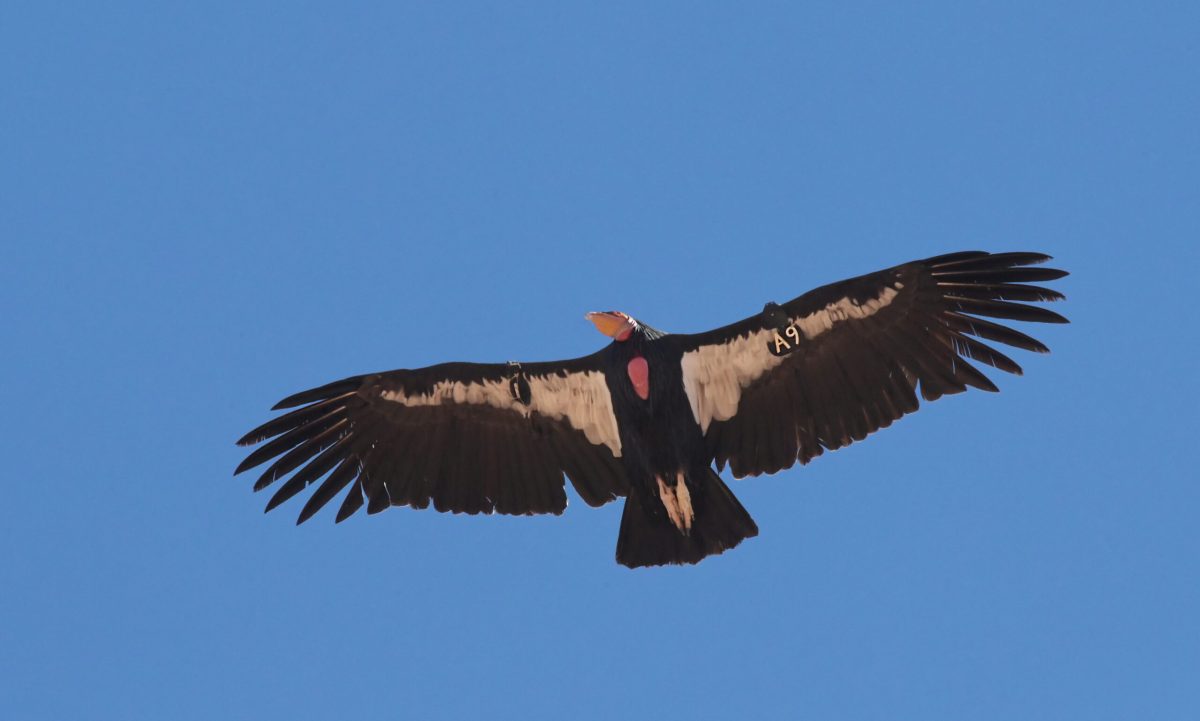
The released California condor was unmistakable among the birds that circled atop the cliff, even to the naked eye. As it soared, it stretched its full 9 ½-foot wingspan and beat its broad wings as it adjusted.
Hauck ran in front of the crowd and announced that, at 11:26 a.m., Condor 1254 emerged from its pen, took off and landed successfully further along the cliff.
The collaborative effort was spearheaded by the Peregrine Fund, an international nonprofit bird conservation organization, in partnership with the Bureau of Land Management’s Vermilion Cliffs National Monument.
Other partners included the Utah Bureau of Land Management, the Arizona Game and Fish Department, the Grand Canyon and Zion National Parks and the Kaibab and Dixie National Forests.
Some of the organizations set up tents behind the crowd, providing attendees with information about the condors, their environment, how they are protected and the danger they face from lead-based ammunition.
As scavenger birds, the greatest threat California condors face is the accidental consumption of shrapnel left in animal carcasses from hunters’ lead bullets. Experts say, when eaten, these bits of lead poison the birds and result in their deaths.
According to Shawn Farry, the Peregrine Fund’s California condor program manager, despite the efforts made to increase the number of wild California condors from 22 in 1996 to 88 in 2025, the population cannot sustain itself until the ammunition problem is solved.
The main effort to reduce lead ammunition is a statewide voluntary program that advocates for hunters to use non-lead-based bullets while hunting, typically with copper-based ammunition instead. There is about an 85 percent voluntary participation rate in Arizona for this program, Farry said.
Emma Heydenberk and Katherine O’Connell, two members of the Peregrine Fund’s field team, dedicated to tracking the released birds, visited the tents and greeted newcomers.
“This is always one of our favorite days of the year,” Heydenberk said. “It’s awesome to have so many members of the public joining us.”
O’Connell, wearing intricate condor earrings, said that, even though this was her first year, she was enjoying the festivities.
Kim Barton, a first-time attendee from Utah, said she thought it was nice to see people come together in support of the cause on National Public Lands Day.
“I feel like all of us are stewards of the land, and it’s up to us to protect these beautiful creatures and support these kinds of events,” Barton said. “So other people realize it’s important that we take care of our world.”
Hauck said that he and his team have the opportunity to be part of protecting these birds every day, not only because they care about them, but also as part of their jobs.
He became emotional as he took in the crowd of bird enthusiasts from across the country, some as far out as Michigan or Tennessee. It meant so much to him, he said while his voice betrayed emotion, to have so many people come and share this experience.
“I’ll remember this day forever. This is one of those days that sticks out in your mind,” Hauck said. “They’re all different and they’re all impactful.”
Uqualla, from the Havasupai Tribe, known as the “Guardians of the Grand Canyon,” was also a first-time visitor to the Condor release event, and said he was the first to represent any of the local tribes as a part of the event.
Uqualla said that he believes events that are “sacred and holy” to nature, when there is an acknowledgment of the land, as well as “the elementals, the life force, the wingeds, the four-leggeds” and other aspects of nature, the local tribes should always be a part of the sacred witnessing.
He said local tribes had not been invited to previous condor release events, and it took word of mouth to both find out about and get involved with this year’s event, he said, and seize the opportunity to “reconnect with the pristine essence of the Mother Earth and all of its creation.”
“But as it is done, the divine source, this great creator,” Uqualla said, “has ways of allowing for moments to come into fruition.”
For more stories from Cronkite News, visit cronkitenews.azpbs.org.

