
Sandra Hale Schulman
Special to ICT
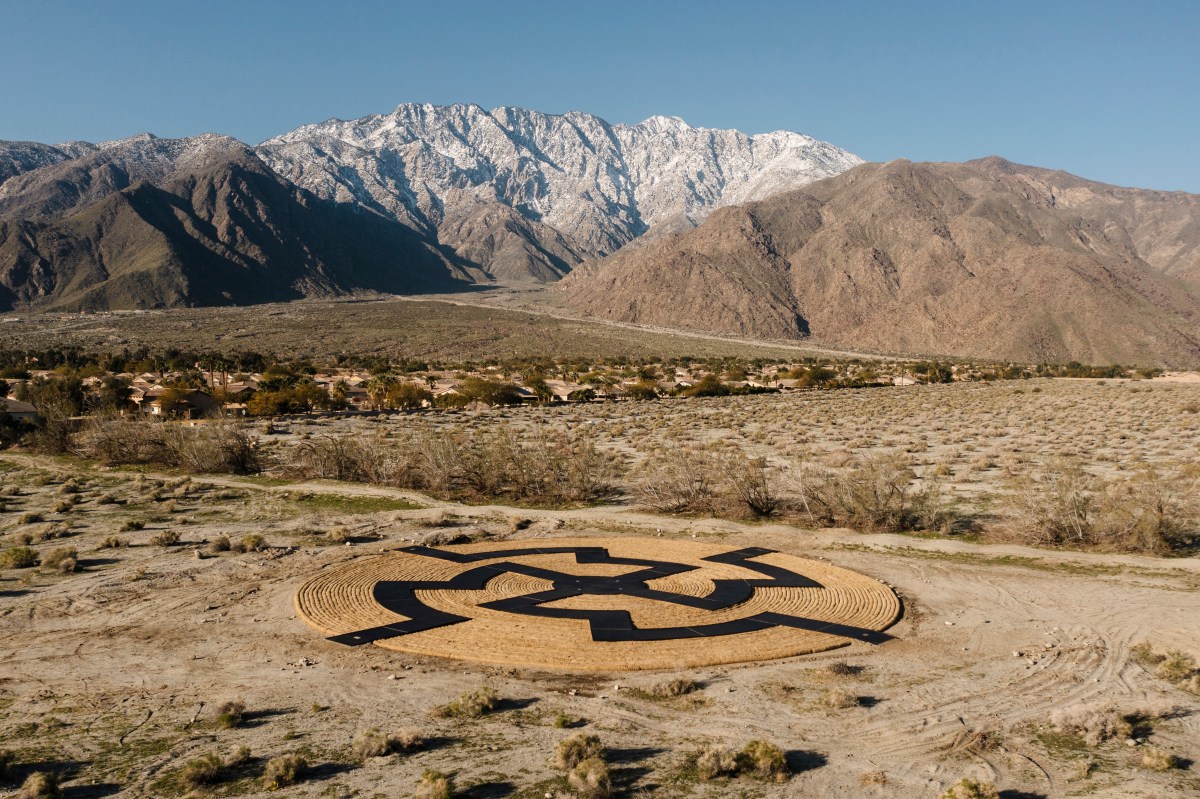
COACHELLA VALLEY, California — A giant walkable maze shaped like a Cahuilla basket is a lesson in Native history at this year’s Desert X art installation, which runs through May 7 in Coachella Valley.
The work, “Immersion,” was created by Indigenous artist Gerald Clarke, Cahuilla Band, who is also an educator, tribal leader and cultural practitioner.
SUPPORT INDIGENOUS JOURNALISM. CONTRIBUTE TODAY.
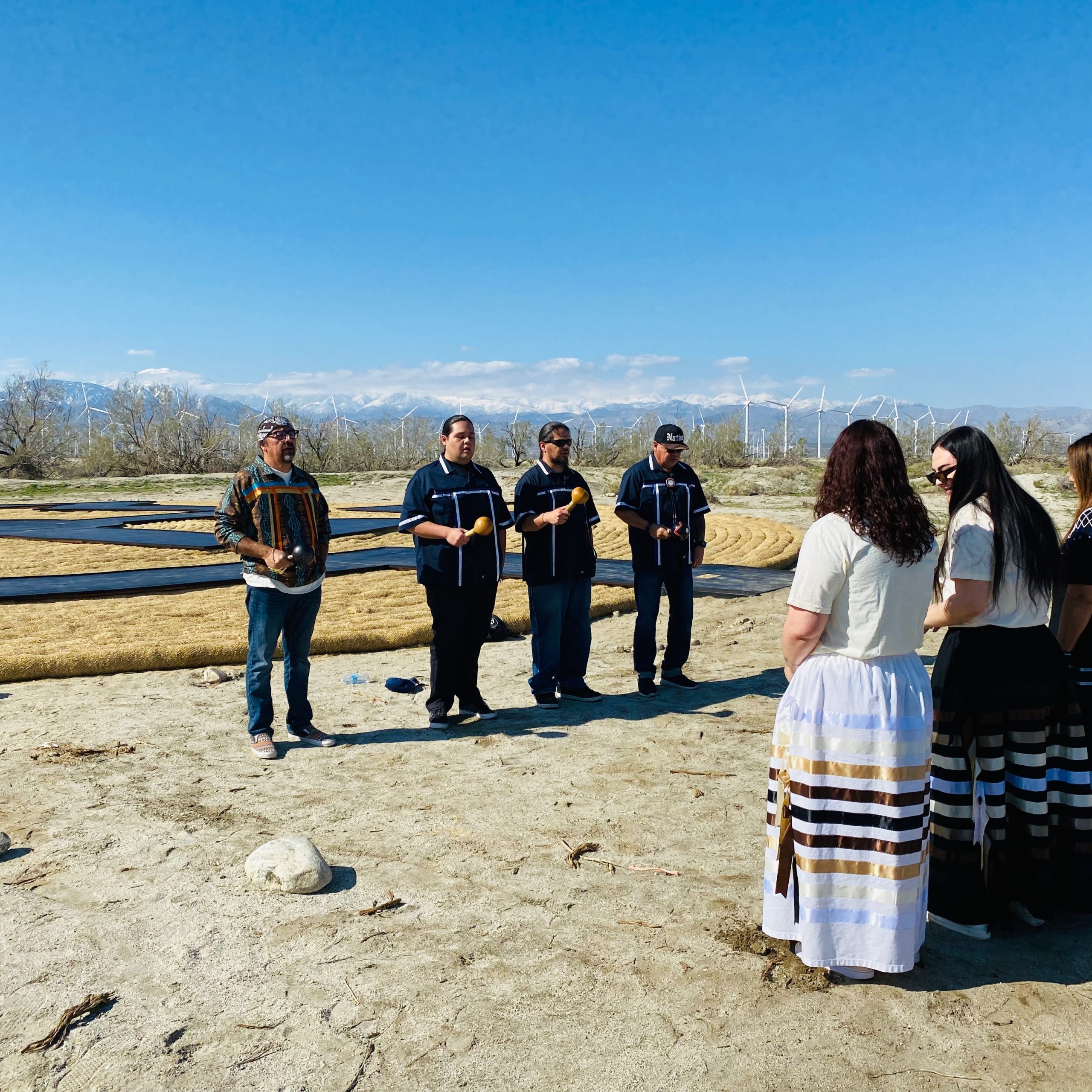
On opening day, March 3, Clarke and his daughters stood in front of the 100-foot maze in the Palm Springs desert and sang traditional Cahuilla bird songs, while media and VIPs from all over the world watched.
His daughters wore a special edition Desert X shirt with one of Clarke’s Brand designs – a map of the United States and the word Amnesia above it.
“The bird singing is prominent in Southern California,” Clarke told ICT. “It’s a regional thing. We have our gourd rattles and we sing those songs. It’s very meaningful to me. We perform in the Palm Springs High School, which has a team name of Indians but generations of Agua Caliente have graduated from there, and they’re very proud of it, so no problem with the name.”
Clarke is a breakout artist from the small band, having had a solo show at the Palm Springs Art Museum in 2020, “Falling Rock,” with more than 80 works.
He creates conceptual, humorous, small- and large-scale art addressing Native identity and how it intersects with U.S. culture and politics.
The Desert X installation marks another milestone for Clarke as the only American Indigenous artist this year in the international edition, which drew more than 1.2 million people to the Coachella Valley in 2021.
“I haven’t been successful in terms of selling things or showing a lot of things since the last five years or so,” Clarke told ICT recently. “I’ve done it the hard way. I’ve done it the long way. But I feel like I did it the right way.”
‘How can I use that?’
The Clarke family has lived in the Anza Valley for time immemorial, and he now lives in the ranch home his grandfather built in 1940 on the Cahuilla Indian Reservation.
Clarke lives off the grid, using a solar field behind a barn to power his car, home, cattle ranch and studio. He is currently a professor of ethnic studies at the University of California Riverside a few days a week, where he teaches classes in Native art, history and culture.
There are only about 50 houses on the reservation, as two-thirds of the tribe’s 300 enrolled members live off the reservation. There is a small casino and convenience store, but no museum or cultural center.
“We don’t get many tourists here — people come up here because, well, it’s up here,” Clarke told ICT, referring to the 5,000-foot elevation.
On a recent visit to his studio with a scenic drive through the San Bernardino Forest, he showed the model he created for Desert X in his Quonset hut that sits beside the 500-pound pig and goat pens.
“I had two different ideas I proposed to them,” Clarke said, showing the small yellow-and-black model, “and this is the one that they liked. Based on a basket design, it’s 100-feet across, made from a coil of rice straw wattles. If you go by construction sites where they’re battling erosion, they use these straw tubes about two feet around, and they put them on the ground so the soil doesn’t wash away.”
The wattles planted an idea.
“I like to see things out in the world and think, ‘How can I use that?’ There’s a thin, plastic webbing that holds it together, and it’s just stuffed with rice, or straw. So it’s a waste product, basically. I’m going to lay these out like a basket, then for the dark pattern it will be a wooden deck laid on top.”

The result became the maze.
“The idea is to walk on top of the deck in a maze pattern and work your way to the center,” he said. “But here’s the thing: There will be spaces, and when visitors come, they’re going to be given a deck of cards, which turns it into a game board. There are four paths. One path is going to be global Indigenous trivia. One is North American Indigenous trivia. One path, it’s California Native trivia. And the other’s Cahuilla Native trivia. You have to answer the questions to get to the center.”
Clarke said players advance or go back depending on their answer.
“I think your average American’s going to be really challenged to get to the middle,” he said. “It’s a learning thing. It’s a fun way of learning Native culture. I’m a teacher, so that’s the kind of piece I wanted to make.”
Clarke said when visitors make it to the center, they’re met with a QR code that, when scanned with a phone, will produce a Cahuilla bird song or a story about the Cahuilla Band’s history.
Art for the people
Clarke uses humor in all his work.
He shows a series of branding irons that he made by hand and exhibits as art. His studio has all kinds of metal-cutting machines and printers. The first one, now in the collection of the Autry Museum of the American West, says “Indian” and symbolizes how people stereotype and categorize Native art.
“I went to welding school out of high school because they said I was too dumb for college,” he said. “And what it really meant was that I was too brown and too poor. Now, I use these skills as an artist.”
Related stories:
—‘Indian Land’ art installation calls for return of lands
—Land, earth, art join forces at Desert X 2021
—Indigenous artist joins board of Desert X
He used those skills to make the design a sculpture.
“I made it as an art sculpture,” he said, “and I had it four years before it occurred to me I should use it to print. The other trick is I have to make the brand letters backward to print forward on the paper.”
That led to a series of brands and prints that say “art”, “Native,” “immigrant,” “amnesia,” and “$” on watercolor paper that he wets first so the brand doesn’t set it on fire.
“Branding is a violent act,” Clarke said. “It captures the emotional and physical violence that’s going on in the world right now.”
He also made a series of road signs based on the yellow-and-black signs the transportation department puts on the side of roads.
He modifies them with a picture of a Cahuilla item, a basket or animal, and then prints the Cahuilla language word for it underneath.
“There are a dozen of them down in Palm Springs and in all the public parks,” Clarke said. “In 2020, I didn’t ask any permission. I just put them up because I thought, if I’m calling myself a Cahuilla artist, I need to make some art for my people, not just the museum or gallery. Then nobody here thought it was art. They just thought it was pretty cool, which I think Is great.”
The original ones had the English translation in there, too, but he has gotten rid of that.
“Cahuilla is an endangered language, so it promoted interest in the language. I don’t think you need the English to understand what I’m trying to say or teach.”

Our stories are worth telling. Our stories are worth sharing. Our stories are worth your support. Contribute $5 or $10 today to help ICT carry out its critical mission. Sign up for ICT’s free newsletter.

