
ICT is working to shape the future of journalism and stay connected with readers like you. A crucial part of that effort is understanding our audience. Share your perspective in a brief survey for a chance to win prizes.
Mark Wagner
Special to ICT
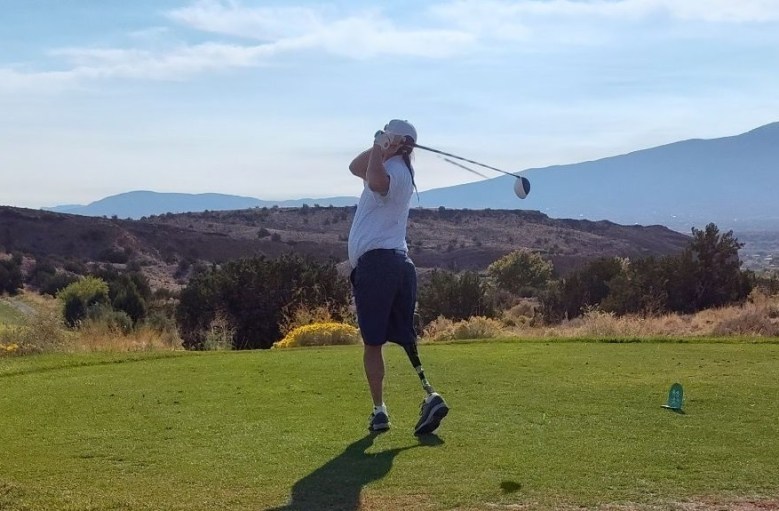
Jimmy Squire has been playing golf and working to help disabled athletes for more than 20 years, and the world is finally beginning to catch up.
Squire, a citizen of the Absentee Shawnee of Oklahoma, lost his leg to a lawn-mowing accident at age 3 and discovered golf at age 15. Now 46, he’s working to bring other disabled Native people and veterans onto the golf course.
SUPPORT INDIGENOUS JOURNALISM. CONTRIBUTE TODAY.
He represented the Shawnee in this year’s Native American Open golf tournament at the Santa Ana Pueblo in New Mexico in October, won back-to-back tournaments for disabled golfers in November run by the Veterans Golf Association, and won the 2023 Southwest Amputee Golf Association flight at the Winstar resort in Oklahoma.
“I’m not one to sit at home,” Squire told ICT. “I put my leg on in the morning and take it off at midnight when I go to bed. And if I can open some doors, so others don’t sit at home and stare at the wall, I’ve met my goal.”
Squire was one of two disabled golfers in the Native American Open in October, and he’s now working to help the Santa Ana Golf Club develop a special competition for disabled Native golfers in the 2024 tournament. The U.S. Adaptive Golf Association recognizes categories for golfers with impairments to level flights and expand competitions.
Squire’s mission is to educate golfing organizations about these categories — and to play..
“We need 10 disabled golfers for them to make a flight,” he told ICT. “We need to branch out and get Natives and veterans to be more involved.”
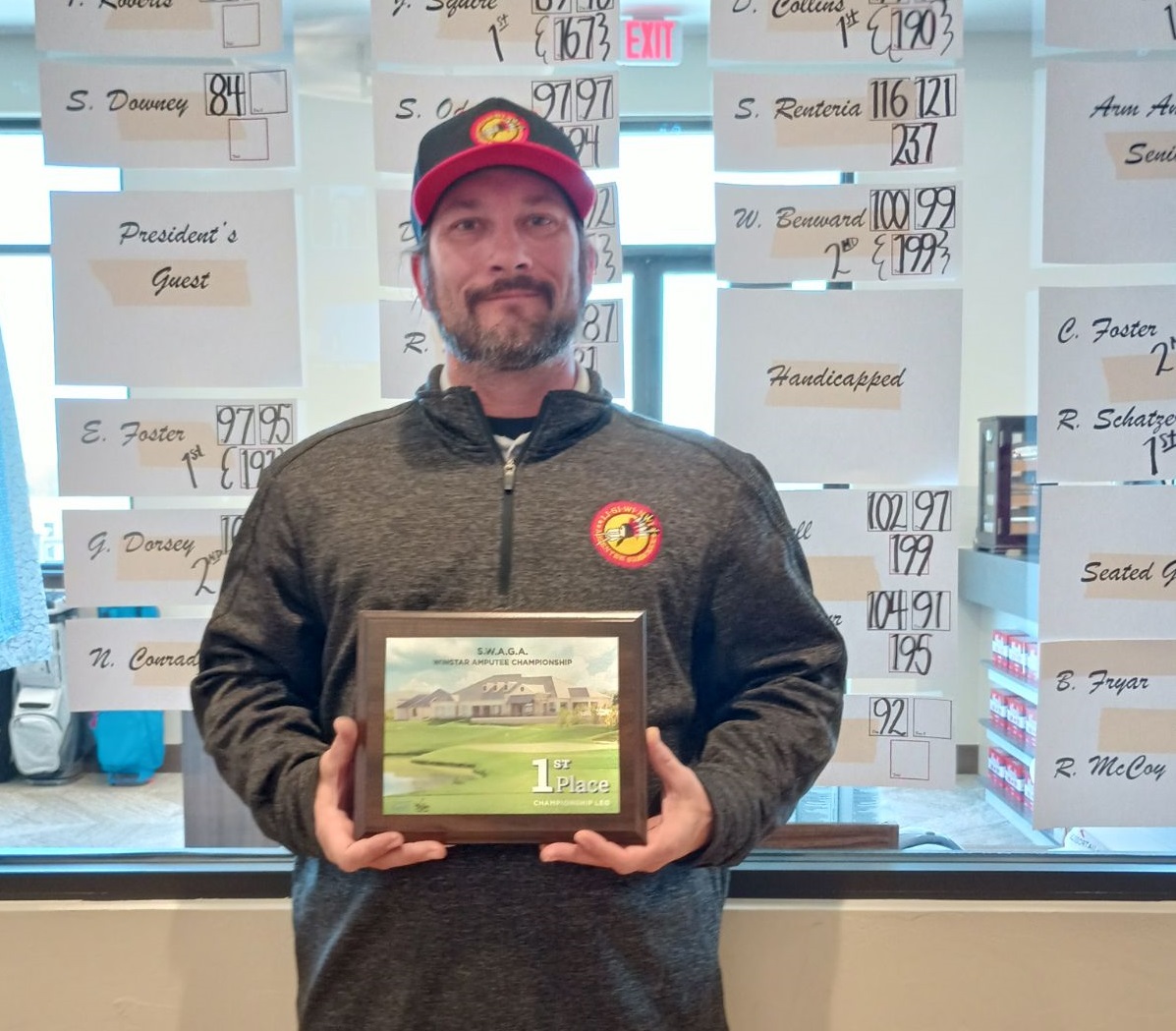
Roy McCoy, a leader in the Southwest Amputee Golf Association, a regional affiliate od the National Amputee Golf Association, said Squire is an ambassador to Native people. The association offers three yearly tournaments and clinics for veterans and amputees, most recently at Winstar Country Club, a Chickasaw Nation resort in Oklahoma.
“Jimmy is a great ambassador and a great help,” McCoy, who is based in Granbury, Texas, told ICT. “For many years now, especially for our outreach to the tribes. He carries our message to other tournaments and events he attends.”
Limb amputation affects Native people at a much higher rate than the general population, with a higher rate of diabetes among Indigenous populations, a greater concentration of war veterans and remote communities removed from health care services.
McCoy’s organization has developed clinics to help men and women who have lost limbs get active, and he sees Squire’s efforts in those communities as “invaluable.”
“Jimmy’s a great spirit,” he said. “A good guy.”
‘Work on your legacy’
Squire credits his adoptive grandfather, acclaimed Olympian Jim Thorpe, for the inspiration.
In 2008, Thorpe’s son, Jack Thorpe, adopted Squire into the Thorpe family, making him a son of the Thunder Clan of the Sac and Fox tribe. Squire cites the adoption ceremony as a key source of his determination to make the world of tournament athletics more welcoming to disabled Native athletes.
“The reason is because of my grandpa, Jim Thorpe,” said Squire, whose Sac and Fox name is Ko Ti Ke Pe Ya Se Ki, which means “Changing the Feathers of a Baby Eagle.’
“He is the one who gave us that motivation. If I open doors for other tribes, athletes and the disabled, as well as our veterans, to get them more motivated in playing a sport, or being an athlete, it begins with grandpa.”
The message was delivered by Jack Thorpe, he said.
“His son told me, ‘Work on his legacy. Work on your legacy. We want to be like him,’” he said. “Jim Thorpe is the one who gave us that motivation.”
Squire’s schedule is now as relentless as his good nature. He credits his team, Sherry Smith, Comanche, who is a “partner, rider and caddy,” and Robert Komahcheet III, whose mother is a Thorpe.
Financial sponsors for Squire’s golfing and outreach efforts include the Absentee Shawnee Tribal Veterans and Hill Country Prosthetics. He also counts Texas Adaptive Sports, and the Southwest Amputee Golf Association as supporters.
Reaching out to others
The lawn-mowing accident that caused the loss of Squire’s leg more than 40 years ago is indicative of his difficult childhood.
Squire credits his adoptive father, Doyle Black, a prosthetic technician who took him in at the age of 15, with giving him the love he needed to succeed. He has endured two operations, first removing his leg below the knee and then a second operation removing his leg above the knee.
To these challenges, Squire has responded with empathy, enthusiasm and good humor.
“If I throw my leg, rather than a club,” he said, “then you know I’m in trouble.”
The likelihood of such a meltdown is slim. Squire loves the game and loves to give back to those who need it, particularly veterans.
“I couldn’t serve,” he told ICT, “but I have buddies who came back from war without limbs. I don’t want to see them whine and cry. I encourage them to move with the world. To be with the [Veterans Golf Association] and the family flight and to represent my family, that’s the best honor to ever ask for.”
Of the estimated 290,000 veterans in Oklahoma, more than 100,000 have some level of disability, according to Randy Norris, president of the Oklahoma Branch of the Veteran Golfers Association.
Norris roundly welcomes Squire’s assistance.
“By Jimmy joining the Veterans Golfers Association, he has opened the door for other disabled amputee family members and veterans alike to get into the game,” he said.
Norris also wishes he were as good a golfer as Squire.
“For Jimmy, in his mind, he has no limitations,” Norris said. “He is out there to win and play the game and be a great advocate for his tribe, the Veteran Golfers Association and Oklahoma.”
Squire has worked at numerous golf clubs since he was 20, working on the range and in the cart barn and starter’s shed. He now works for the Shawnee Tribe in the tribe’s recycling center while continuing to thrive in the game he loves.
“You just need one leg to stand on,” Squire said, with a smile in his voice. “In golf, you’re on your own. It’s between you and nature. Walking was the best gift the game could give, to make me the best walker I could be. There was no time clock. No coach screaming in your ear. “
Making golf more welcoming
The number of disabled golfers is continuing to grow.
In 2021, the United States Golf Association and U.S. Adaptive Golf Association established categories for golfers with a variety of impairments. The classifications go from G1–G15, and cover legs, arms, eyes, intellectual diversity, and body size.
In addition to these classifications, the two organizations established a national Adaptive Open, which began in 2022 and ran again in July 2023 in North Carolina at Pinehurst Golf Resort, called “the Home of Golf,” fulfilling a 2017 pledge by the USGA to establish a championship for the adaptive golf community.
The Adaptive Open is the USGA’s 15th national championship, joining such iconic events as the U.S. Open, U.S. Women’s Open, U.S. Amateur and U.S. Women’s Amateur. Champions of the new event will see their names recorded in the annals of golf history alongside many of the game’s storied figures.
Eligibility is open to both male and female professional and amateur golfers with a World Handicap System (WHS) Handicap Index of 36.4 or less. There is no self-reporting of disabilities — eligible impairments are confirmed by a so-called WR4GD Pass issued through the World Amateur Golf Ranking.
The 96 players in this year’s Adaptive Open competed in one of eight impairment categories as well as for the overall titles. When the dust settled, Kipp Popert of England, who was diagnosed with cerebral palsy at birth, and Ryanne Jackson of Seminole, Florida, who was diagnosed with a form of muscular dystrophy at birth, came away as the overall men’s and women’s champions, respectively.
John Bodenhamer, the USGA’s senior managing director of championships, said the new Adaptive Open is an important step for golfers with special needs.
“Since 1895, our championships have provided the world’s best players with an opportunity to showcase their skills on a global stage, compete for a national championship and achieve their dreams,” Bodenhamer said in a statement released by the USGA after the 2023 Open in Pinehurst.
“After years of planning and delays caused by the global pandemic, we are proud to bring that same opportunity to the adaptive golf community through this championship, and to do so at Pinehurst, our second home,” he said. “We believe this effort will spur participation for golfers with disabilities and hope it inspires others in the industry to make the game and its competitions more welcoming to all.”
Ken Green, who was once a Professional Golf Association player who lost a leg in a traffic accident, competed in the Adaptive Open as a G1 golfer.
“To me, it’s as positive as any other tournament I’ve ever played,” he told ICT. “It’s about life and golf and then the mixture of both and what golf can do for a person who has been given the worst of the worst blows. They use golf to help them fight through all the negativity that happens sometimes when you lose limbs or eyesight or [have] paralyzation or any of those other impairments.”
Thorpe’s legacy lives on
Jim Thorpe was not a stranger to golf. A picture of Thorpe on a golf course from 1929 shows him standing beside Hollywood producer Brently Millard, with a putter stiff across his waist and looking toward the camera.
At the time, Thorpe would have been consulting on casting Native Americans in Hollywood pictures. He counted Bing Crosby and Bob Hope among his friends, and golf would be a way to network as well as continue his athletic journey.
Author David Maraniss, who wrote a 2022 biography of Thorpe, “Path Lit by Lightning,” told ICT that Thorpe tried golf initially to improve his coordination.
“Jim was inspired to play golf by his New York Giants teammate, the great Christy Mathewson, who said it would improve his hand-eye coordination,” Maraniss said. “He golfed off and on the rest of his life.”
According to his grand-nephew Komahcheet, the first time his uncle played golf he shot a 76. By the time of the 1929 photo, having been unjustly stripped of his Olympic medals, “the greatest athlete in the world,” as he was known, was rebuilding his life.
“The unending hustle for a living was on,” Maraniss told ICT.
Whatever hardships Thorpe faced, on a golf course or off, his stamina lives beyond his time. Squire said his unwavering enthusiasm for Native veterans and amputees is an extension of Thorpe’s legacy and motivation.
“If it means opening doors for Native American amputees,” Squire said, in his soft Oklahoma accent. “I’ll play.”
More info
*The Native American Open golf tournament will be held later this year at the Santa Ana Golf Club. Additional details are set to be released in July on the club’s website.
*The 2024 Adaptive Open will be held July 8-10 at Sand Creek Station in Newton, Kansas. Entries open on Feb. 22, 2024, and additional details are available on the association’s website, with a special link to the entry process.
*To learn more about categories, visit the Disabled Golfers Association’s website. Details about the WR4GD Pass application can be found on the U.S. Golf Association’s website.

Our stories are worth telling. Our stories are worth sharing. Our stories are worth your support. Contribute $5 or $10 today to help ICT carry out its critical mission. Sign up for ICT’s free newsletter.

