
Editor’s note: ICT will refer to individuals defending the Black Hills as treaty defenders. The Black Hills is unceded territory in the Fort Laramie Treaty of 1868 and acknowledged by the 1980 Supreme Court ruling of the United States v. Sioux Nation of Indians.
Amelia Schafer
ICT
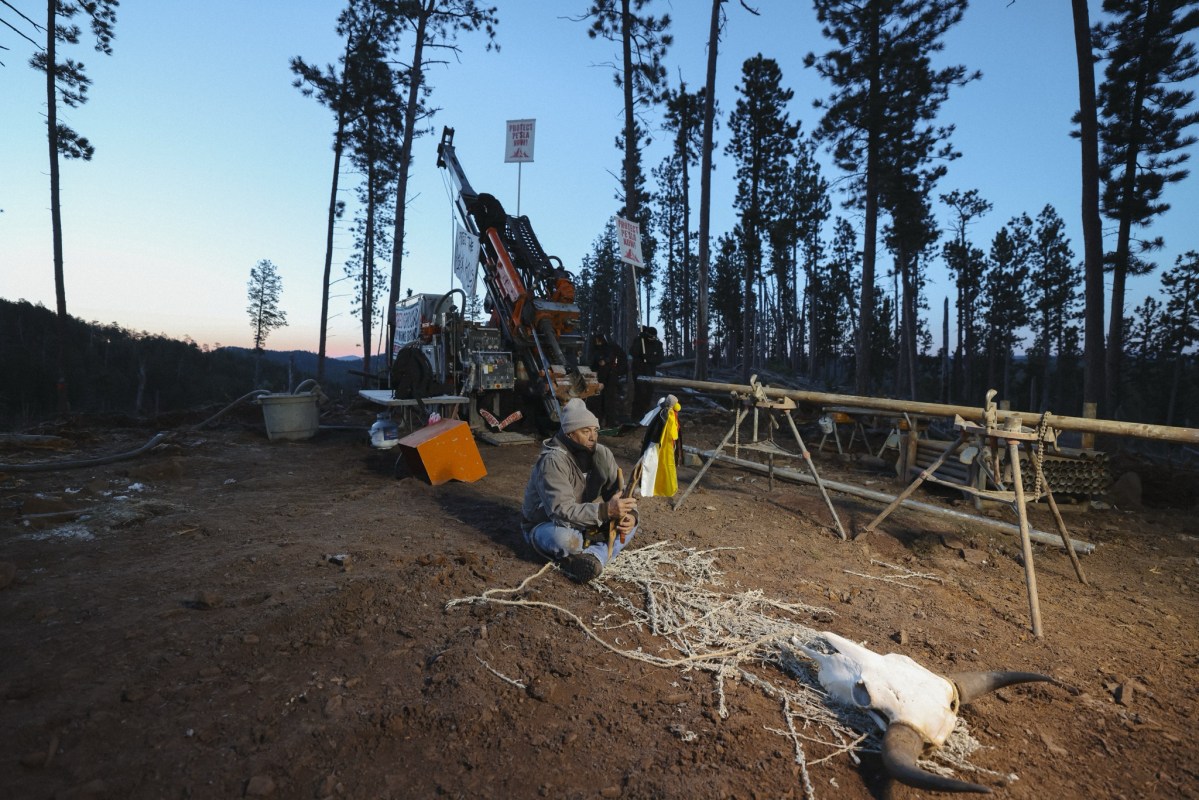
RAPID CITY, South Dakota – All drilling ceased for the weekend on Friday at an exploratory graphite drill site just north of Pe’ Sla, a sacred site in the Black Hills, as a result of an over 24-hour occupation by treaty defenders, according to representatives speaking on behalf of the group.
Roughly 12 Oceti Sakowin (Lakota, Dakota and Nakoda) treaty defenders began occupying the site around 5 a.m. MT on April 30. The group, organized by local Indigenous nonprofit organization NDN Collective, plans to stay at the site to ensure drilling does not continue ahead of a hearing on the matter scheduled for May 4. NDN Collective has been live streaming portions of the occupation since it first began.
The group, alongside tribal nations and allies, are demanding that the permit allowing for exploratory graphite drilling be rescinded.
The tribes and treaty defenders are all asking the U.S. District Court to stop the project until the court can hear and decide on the case.
Late Thursday afternoon, the Oglala Sioux Tribe announced that it and eight other tribes had filed a joint lawsuit against the U.S. Forest Service for allowing the project to begin drilling. Tribes involved in the lawsuit include the Oglala, Cheyenne River, Crow Creek, Lower Brule, Santee, Yankton, Standing Rock, Sisseton Wahpeton and Spirit Lake Sioux tribes.
Heading into the afternoon on May 1, representatives held a press conference in Rapid City to provide insight into the camp.
Local law enforcement have blocked off access to the area around the drill site, which is near North Fork Castle Creek south of Rochford, South Dakota, and are only permitting local access, the group said.
“They’re asking for IDs from everybody trying to pass that road,” said Zachary Martinez, facilities manager for NDN Collective and Oglala Lakota, during the press conference. “It’s all a prayer site, it’s for ceremony purposes for all of our people.”
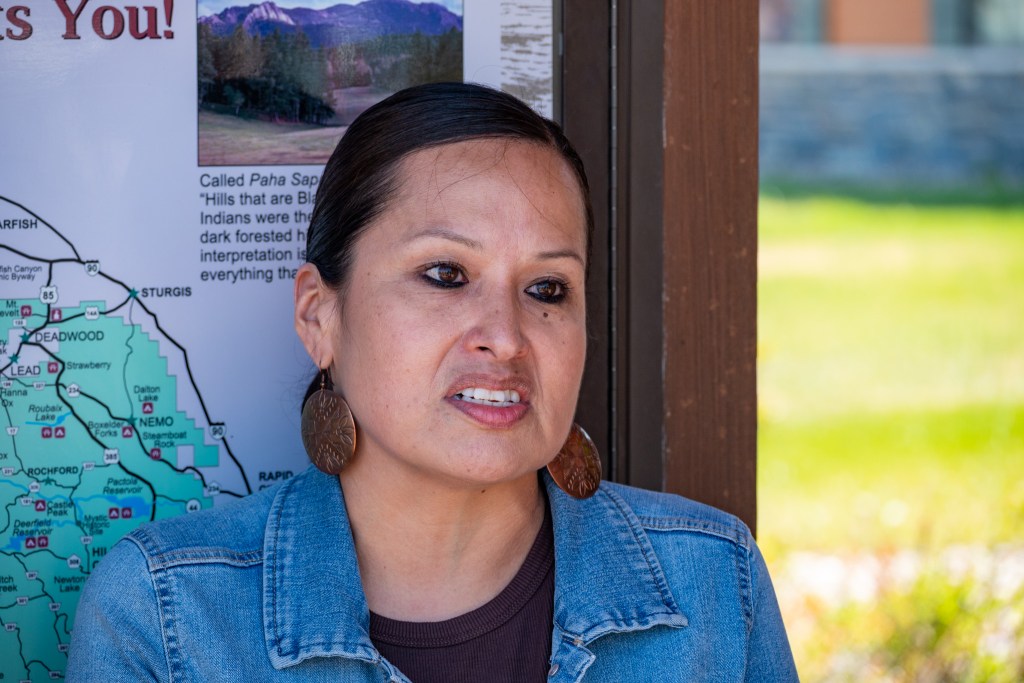
At least one Oglala Sioux Tribal Council member was denied access to tribally owned property within Pe’ Sla as a result of this, said Amy Sazue, Sicangu and Oglala Lakota and the executive director of Remembering the Children, at the press conference on Friday.
“They’re saying local traffic only but that was one discrepancy noted yesterday,” Sazue said. “There was an OST Tribal Council member trying to pass through who said, ‘We have land right there.’ He’s a local land owner and wasn’t allowed through. He said he went over the hill and saw somebody else be allowed through.”
No one is being blocked off from accessing Pe’ Sla itself, a spokesperson from the Pennington County Sheriff’s Office told ICT Friday afternoon. The spokesperson was unable to comment on limited access to the area around the drillpads, noting that reception is limited in the area making it difficult to correspond with officers regularly.
The group passed on a message from those still occupying the drill site, who said they remain in prayer and continue to demand the stop of all drilling activities and are asking for an Environmental Impact Survey to be completed on the project.
Several youth including members of the Oglala Lakota Youth Council, “locked down” to drilling equipment, meaning they restrained themselves to the machinery. NDN Collective is calling for more resources to be brought to those occupying the drill site and for community members to join them.
“I understand that there is a disconnect between our local community and understanding the history of this place and the people that have been here,” Sazue said. “We’re here to remind everybody that Pe’ Sla is important and we will always fight for the Black Hills. We will always fight for our sacred sites.”
At least 10 drill pads are operating within the two-mile buffer zone surrounding Pe’ Sla, according to NDN Collective. The buffer zone was created following the purchase of portions of Pe’ Sla by several Oceti Sakowin tribes, after which it was placed in federal trust.
The group is occupying the site of two drill pads, both operated by Pete Lien & Sons, a mining and processing company.
“We carry this history in our blood, we carry this history in our family lines, and that’s why we’re here. That’s why this is important,” Sazue said.

