
This story was originally published by South Dakota Searchlight.
Meghan O’Brien
South Dakota Searchlight
When Cheryl Schreier learned of plans for fireworks this summer at Mount Rushmore, she thought about the behind-the-scenes planning it takes to host thousands of people at the national memorial she formerly oversaw.
“It’s like having a rock concert in a phone booth,” she said.
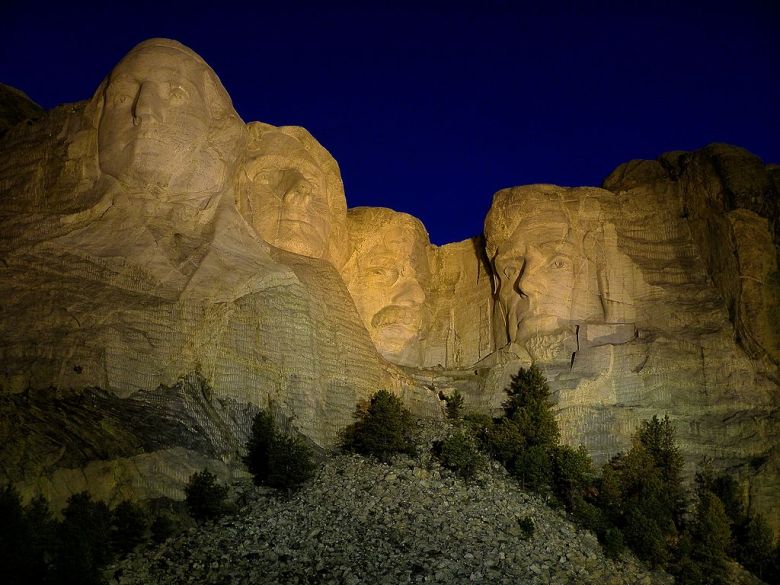
The event is scheduled for July 3, the day before the nation’s 250th birthday. Assuming weather or drought-induced fire risks don’t cause a cancellation, it will be the latest installment in the western South Dakota mountain carving’s on-again, off-again relationship with fireworks.
The National Park Service approved fireworks shows at Mount Rushmore during the 1990s and early 2000s. The agency then disallowed the displays for 11 years — including during Schreier’s time as the memorial’s superintendent — due to concerns about wildfires sparked by embers falling in the surrounding national forest, lingering litter from exploded fireworks packaging, and water pollution from fireworks chemicals.
Then, in 2020, South Dakota Republican Gov. Kristi Noem convinced President Donald Trump to bring the fireworks back and attend the event. Trump said then that “nobody knew why” the fireworks had ended, despite the well-documented concerns.
Those concerns remain, and some new ones have arisen.
Wildfire concerns grow amid drought
The National Park Service mostly relied on a six-year-old environmental assessment, updated with some new information, to justify the fireworks display this year.
Even though the Trump administration used the 2020 report to approve that year’s fireworks, the document acknowledged the water pollution and litter, said past fireworks had ignited a total of 21 small fires around the mountain, and cited concerns about disturbing wildlife and overwhelming the nearby city of Keystone with traffic.
A stray spark could turn into more than a small fire. More than half of South Dakota is under drought conditions, according to the U.S. Drought Monitor. Some of the most extreme drought conditions are in Pennington County, where Mount Rushmore is located. In neighboring Custer County, a wildfire burned more than 9,000 acres last month.
During fireworks shows at Mount Rushmore, firefighters are stationed around the mountain. It’s important to think about their safety in “very rough terrain” at nighttime, Schreier said. She also worries about the safety of event attendees.
“If you place thousands of people in an area like that, and fire starts from fireworks, potentially, you have to evacuate all of those people on limited roadways that are going to be already impacted by a huge number of support staff and vehicles,” she said. “It doesn’t make a lot of sense.”
Effects on endangered species, water pollution
This year’s report also reveals the potential for negatively affecting northern long-eared bats, an endangered species, and tricolored bats, which have been proposed for listing as endangered. Both species live near the mountain and have experienced “severe population declines” from a fungal disease known as white-nose syndrome, according to the environmental assessment.
The fireworks will occur during a time of year when many young northern long-eared bats are still dependent on their mothers. The report says “several life stages” of the species “may be affected, with the greatest potential for adverse effects affecting pups.”
Impacts of fireworks noise on northern long-eared bats who recently learned to fly may range from “temporary stress to separation from their mothers (upon which they may still be dependent by the date of this event), to mortality,” according to the assessment.
There’s also a pair of nesting peregrine falcons near the mountain, Schreier said. The birds are a state-threatened species. If found to be within a quarter-mile of the fireworks launch site, the assessment says, the finding will prompt the National Park Service to consult with South Dakota Game, Fish and Parks for mitigation and safety measures.
Fireworks also leave chemical compounds known as perchlorates in surrounding water, posing a threat to fish, wildlife and people who might drink the water. The fireworks event this year will raise perchlorate levels, according to this year’s environmental assessment.
“Over time, it can dissipate, but it’s still one of those chemicals that really are not good for human beings,” Schreier said. “People say, well, it’ll dissipate over time, but the point is, here we are, we’re actually placing those chemicals into this particular environment when we really shouldn’t be, especially, a National Park Service area.”
Tourism impact touted
Costs for fireworks, security, wildfire prevention and other aspects of the event are covered by a mix of local, state and federal funding sources. A Government Accountability Office report estimated that the total cost of the 2020 event was about $4 million, with the state’s share surpassing $1 million.
Tourism officials estimated the 2020 fireworks brought about $22 million worth of global advertising to the state, through promotion, live coverage and news stories.
“They were brought back in 2020, during a difficult time in America, in the world, with COVID,” said Jim Hagen, the state’s secretary of tourism. “It just brought a tremendous spotlight again to South Dakota.”
The board learned “a lot of lessons” from the 2020 event, Hagen said. There were questions about how to ticket and promote the event and how to manage traffic flow, among other details.
“As a team, we had never coordinated the fireworks before,” Hagen said. “This time around we have a playbook in place.”
The environmental assessment anticipates a “maximum of 4,700 attendees” for this year’s fireworks. In 2020, 7,500 tickets were awarded.
On a typical summer day, the park staff can see tens of thousands of visitors, Schreier said, “but it’s not all at once.”
“People come throughout the busiest times of the day, normally from 10 a.m. to 2 in the afternoon, and then there would be a lull of people,” Schreier said. “You had a nice flow of people where you could plan it, so you could be there at the first part of the day, and not really experience huge crowds.”
This year, the fireworks are an America 250 event, and will return fireworks to Mount Rushmore “in a safe and responsible manner,” according to an agreement between Noem’s successor, Gov. Larry Rhoden, and the U.S. Department of the Interior.
Rhoden’s office said it’s “optimistic” Trump will accept an invitation to attend. If he does, it could add extra motivation for protesters.
Indigenous resistance expected
This year’s environmental assessment cited opposition from Native American tribes that consider the Black Hills — where Mount Rushmore is located — to be a sacred site in their spiritual traditions. During the 2020 event, a Native American protest turned into a clash with law enforcement.
Nick Tilsen, an Oglala Lakota organizer and executive director of the Indigenous advocacy organization NDN Collective, said many Native American people remain opposed to fireworks at Mount Rushmore.
“My guess is that Lakota people all across the homelands from this area won’t sit on the sidelines,” he said.
Law enforcement arrested more than a dozen people, including Tilsen, when they blocked the road to Mount Rushmore on the day of the 2020 event. The National Guard helped law enforcement officers break up the protest, using pepper spray and pepper ball projectiles. The charges against the protesters were eventually dropped.
The protest was about more than fireworks, Tilsen said. The 1868 Treaty of Fort Laramie designated an area including all of western South Dakota as the Great Sioux Reservation, but the United States broke the treaty during the 1870s Black Hills gold rush and subsequently pushed tribes onto smaller reservations.
Some Native American people and groups, including Tilsen’s organization, advocate for the return of the Black Hills to Indigenous ownership.
“To think that this is about fireworks at Mount Rushmore is to oversimplify the issue, and I think that we need to be having meaningful conversation about what the return of the land in the Black Hills is back to Indian people,” Tilsen said.
After the president of the Rosebud Sioux Tribe delivered the annual State of the Tribes address to South Dakota lawmakers in January, Rhoden told reporters he held an impromptu, closed-door meeting with tribal leaders from across the state. He said some of the leaders asked him to cancel the fireworks.
“I told them very politely, that was not negotiable,” Rhoden said during a February press conference. “We’re too far down the road.”
The memorial will be closed July 3 except for visitors with tickets for the event. Tickets will be awarded by a lottery system, similar to 2020’s event. The lottery is open now through Sunday.

