
WARNING: This story has disturbing details about residential and boarding schools. If you are feeling triggered, here is a resource list for trauma responses from the National Native American Boarding School Healing Coalition in the U.S. The National Indian Residential School Crisis Hotline in Canada can be reached at 1-866-925-4419.
Mary Annette Pember and Stewart Huntington
ICT
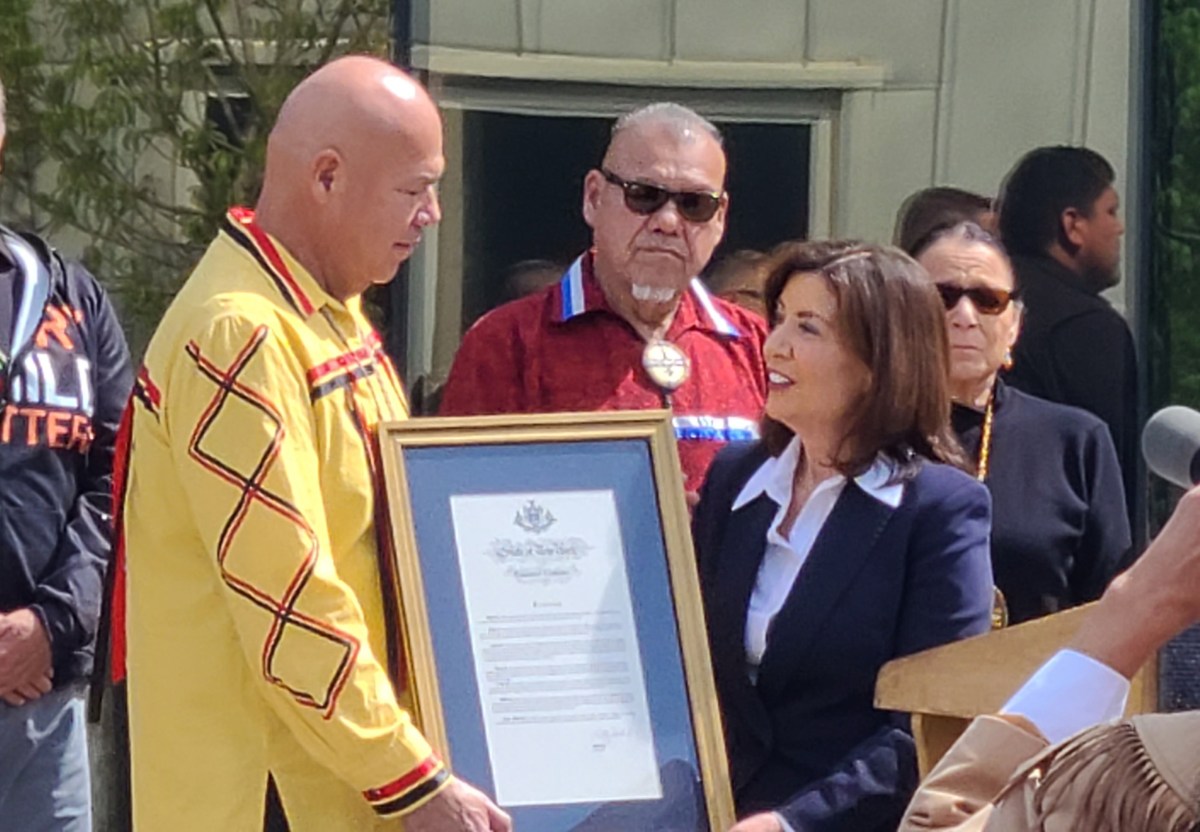
New York Gov. Kathy Hochul presented perhaps the strongest worded government apology to date for her state’s role in operating an Indian boarding school from 1875 to 1957.
“Today, on behalf of the State of New York, I apologize to the Seneca Nation of Indians – and the survivors and descendants from all Nations – who attended the Thomas Indian School,” Hochul said. “We cannot change the horrors of the past, but I recommit to the truth, justice, reconciliation, accountability, and healing that are so essential to move forward together.”
“Today, on behalf of the State of New York, I apologize to the Seneca Nation of Indians – and the survivors and descendants from all Nations – who attended the Thomas Indian School,” Hochul said. “We cannot change the horrors of the past, but I recommit to the truth, justice, reconciliation, accountability, and healing that are so essential to move forward together.”
The Democratic governor spoke on the grounds of the former Thomas Indian School on Seneca Nation land on Tuesday, May 20, during what organizers described as the first official visit by a sitting governor to the tribal nation.
The move is part of a growing effort by states to address the history of U.S. boarding schools and to work toward reconciliation with survivors and their families.
“Instead of being a haven for orphan children, it became a place of nightmares,” Hochul said. “A place some would call a torture chamber, the site of sanctioned ethnic cleansing. That’s what was going on here. Trying to eradicate the long, proud story of the Senecas.”
Hochul said students at the school were subjected to “unthinkable physical, emotional and sexual assaults,” during the institution’s more than 100-year existence.

More than 2,500 students from tribes across the state attended the school in western New York, which operated for 20 years before being taken over by the state. It was among hundreds of such boarding schools across the U.S.
Seneca President J. Conrad Seneca, whose father attended the school, said the apology was an important reckoning for the “dark and tragic period” in the tribe’s history.
“I think it gives us some ability to start the healing process. Intergenerational trauma has encompassed, all of the generations, throughout the boarding school era,” Seneca said in an interview with ICT.
“It is a day that many people thought would never happen,” he said in a statement after the event. “Healing takes time, but it also requires accountability for the pain that people caused. We still feel the pain. Now, with Governor Hochul’s words of apology, our healing process can continue.”
Hochul met with school survivors and their family members. She said she learned about how the school’s harsh environment affected generations of tribal members.
“The children in that school didn’t feel like they had a family. They were lonely,” she said. “No one gave them hugs or kisses goodnight, so when they became parents themselves, they were not conditioned to nurture or give love.”
Hochul vowed her budget will propose the creation of new education materials about local Indigenous communities and their contributions.
“A deeper understanding of the people whose land we are on and what they have gone through,” she said. “That is a first step forward.”
An ugly history
Originally called the Thomas Asylum for Orphan and Destitute Indian Children, the school was established by Presbyterian missionaries in 1855 and taken over by the state in 1875. It was named after Philip E. Thomas, an early benefactor and president of the Baltimore and Ohio Railroad.
The institution was among more than 400 government-supported schools established throughout the country with the goal of assimilating Native American youths.
Students, forcibly separated from their families, endured physical, mental and sexual abuse from school officials.
The total number of children who died at the schools has proved elusive due to decentralized record-keeping during that period. Although the second volume of an investigation commissioned by then-Interior Secretary Deb Haaland in July 2024 found that around 900 children died at government boarding schools, a subsequent investigation by The Washington Post found that deaths exceeded 3,000 students.
The total number, experts agree, is likely far greater. Preston McBride, a scholar at Pomona College in California, estimates that up to 40,000 children died in the boarding schools operated in the U.S.
Although the U.S. has lagged behind Canada’s years-long reconciliation process for its Indian residential school past, Native people in the U.S. have been encouraged by recent efforts to acknowledge the ugly history.
Then-President Joe Biden in October 2024 visited the Gila River Indian Community in Arizona to formally apologize to Native Americans for the nation’s government-run boarding school system, calling it a “sin on the soul” of the nation.
But in an effort by the new Donald Trump administration to scrub White House archives of any mention of policies or proclamations considered to be allied with diversity, equity and inclusion, or DEI, Biden’s apology is no longer available on the White House website.
Neither White House press representatives nor government agency leaders responded to ICT questions about the missing apology, but notably there has been no public mention that the apology has been formally rescinded.
At least $1.6 million in federal funds destined for research projects on the boarding schools, however, have been among the casualties of Trump’s efforts to eradicate funding for any projects with perceived connections to DEI.
State apologies a ‘first step’
Efforts among tribes and states to face the country’s Indian boarding school history are continuing, however, despite Trump’s antipathy to such work.
Although not a comprehensive listing, ICT found that the states of Nevada, Wisconsin, Oregon and California have also issued apologies for their state governments’ roles in operating Indian boarding schools. The four states included varied commitments to work with tribes in researching their respective boarding school history; California promised to create a Truth and Healing Council to help clarify the records regarding the state’s history.
Other states including Colorado, Michigan, Montana and Minnesota have issued proclamations recognizing or investigating their boarding school pasts. Michigan allocated over $1 million to conduct a study of the state’s boarding school history including collecting and preserving survivors’ stories. Colorado Gov. Jared Polis signed a law instructing the state archeologist to work with tribes in locating burial grounds at schools and collect stories from survivors.
Seneca noted that he has been working on building better relationships between the Nation and the governor and state legislature since the beginning of his presidency.
“We’ve been working on this for quite awhile. Gov. Hochul agreed that it was her moral responsibility to come and apologize to the Seneca people,” he said.
Ben Barnes, chief of the Shawnee Tribe and president of the Native American Boarding School Healing Coalition, said the state actions continue the movement toward reconciliation.
“Seeing states like New York offer their own apologies following President Biden’s apology is important,” Barnes said. “I think everyone agrees that an apology is not enough for those who survived boarding schools, but it is a first step.”
Looking ahead
The apologies in the U.S. share a common element, however – the lack of direct deliverables addressing the impacts of boarding schools on survivors and their descendants, though California’s apology includes a promise of government-to-government consultation with the state’s tribes in creating policies.
And although Hochul’s description of boarding school policies as “ethnic cleansing” breaks new ground, critics describe her previous policies as hostile to Native nations. In 2022, she froze Seneca Nation bank accounts in order to force payment of $564 million in gaming revenues and has still not negotiated a casino compact with the nation. The New York Times described the state’s current agreement, which requires the tribe to give up more than 25 percent of its revenue, as one of the worst arrangements for tribes in the U.S.
Barnes said more work needs to be done beyond offering apologies such as finding out what happened to children who went missing and establishing a full physical accounting of how many federal dollars were spent in trying to stamp out Indigenous languages, cultures and communities.
“How can we have policy discussions about healing Indian Country,” he asked, “without knowing what kind of money it will take to remediate the damage done from boarding schools?”
This article contains material from The Associated Press.

