
Stewart Huntington
and Shirley Sneve
ICT
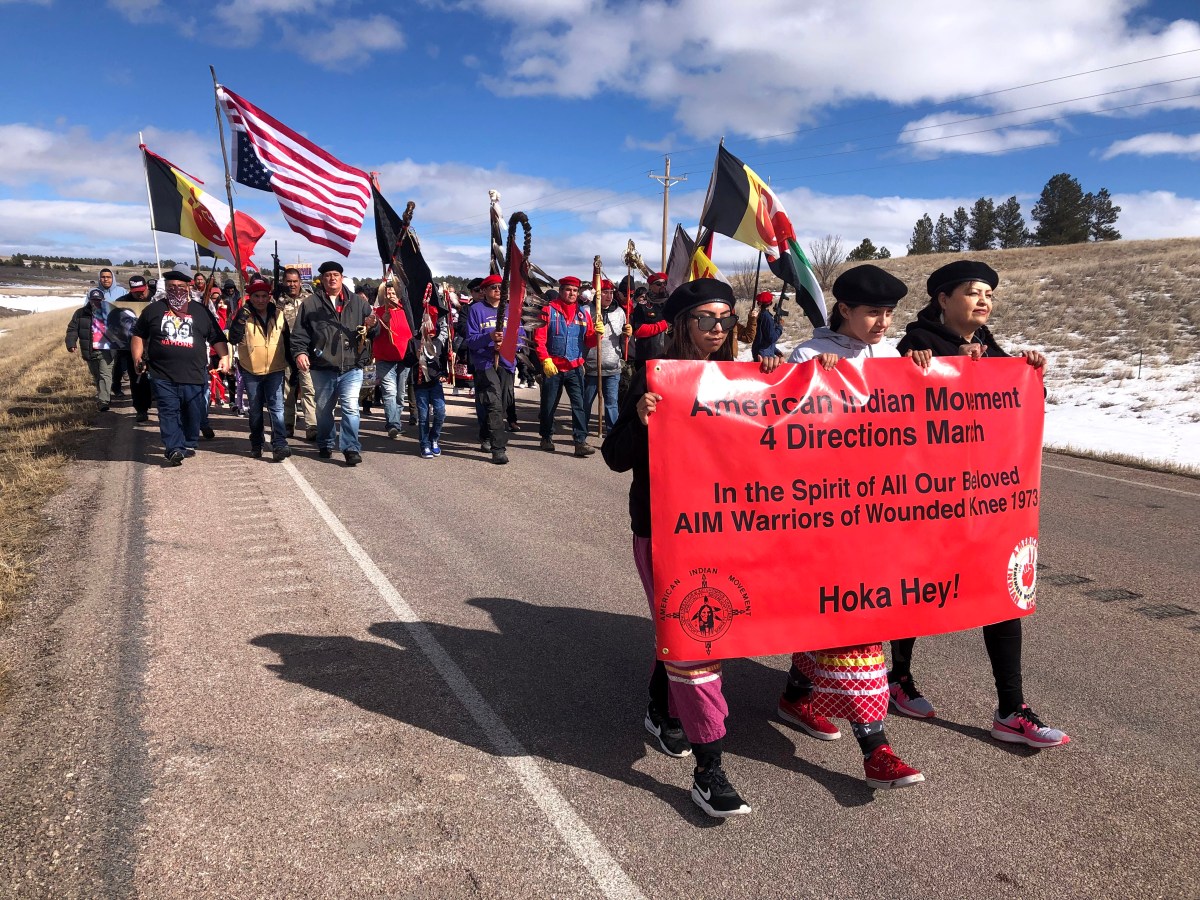
PINE RIDGE INDIAN RESERVATION, South Dakota — Drums and protest songs echoed across the prairie on Monday, Feb. 27, as hundreds of people marched to the Wounded Knee Memorial to honor the activists who revived the Indigenous fight against injustice 50 years ago.
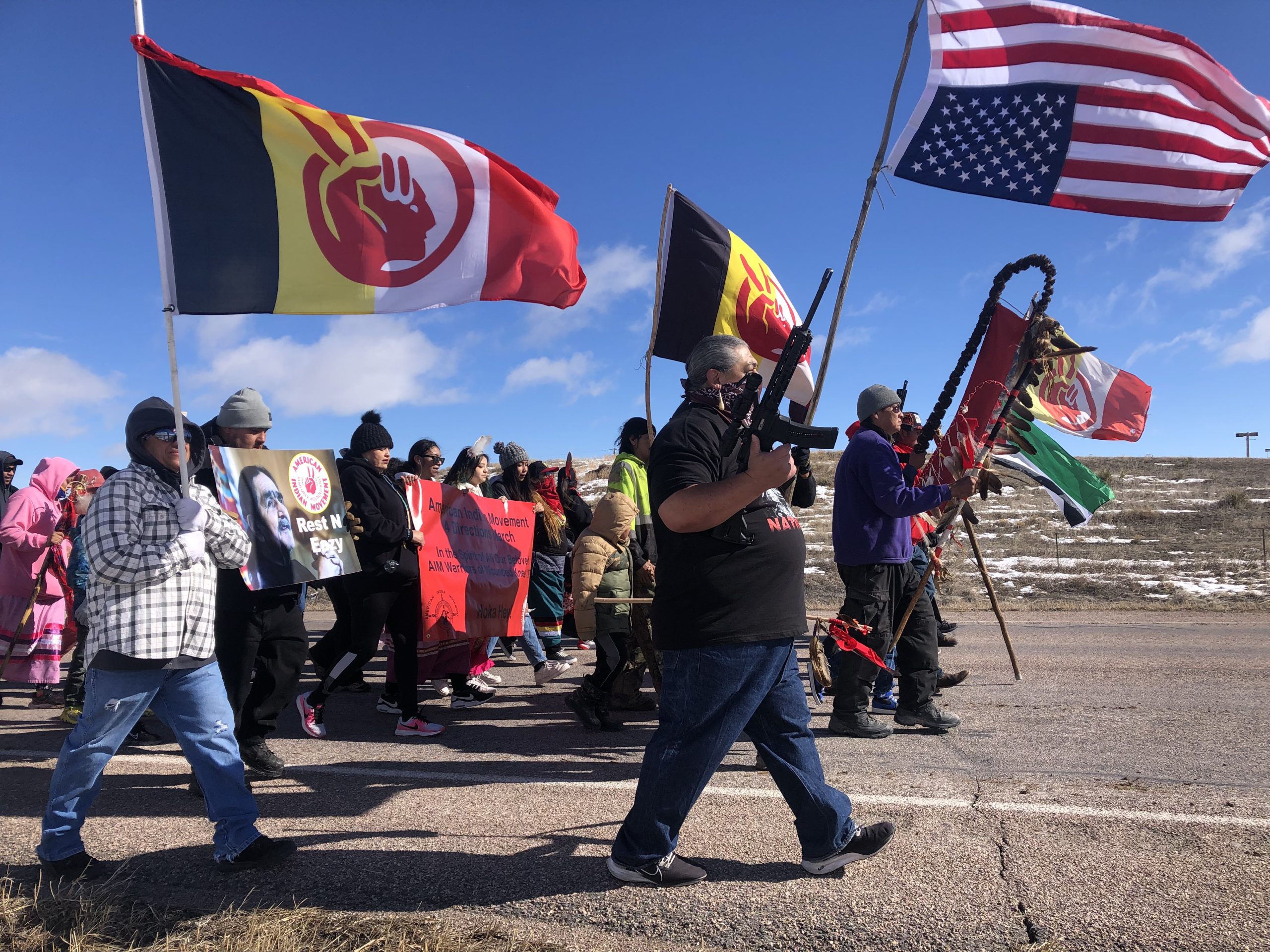
The song of the American Indian Movement mingled with the eruptions of celebratory gunfire at the site where hundreds of Lakota people were slaughtered by U.S. soldiers in 1890.
SUPPORT INDIGENOUS JOURNALISM. CONTRIBUTE TODAY.
They came to mark the day in 1973 when a new generation of warriors slipped into the town of Wounded Knee under cover of darkness for what became a 71-day occupation that AIM leaders called a “liberation.”
Most of the original AIM leaders are gone now, but others have picked up the fight.
“Today, we are still here,” Victorio Camp, the son of the late AIM leader Carter Camp, who led the first wave of warriors into Wounded Knee, told the crowd gathered at the memorial.
“Today we are strong because of our relatives who fought here in ‘73. Today we are proud to be who we are as Native people, the Indigenous people of this land. Today, our youth are proud and strong because of the sacrifices our aunties and uncles and mothers and fathers made.”
Bill Means, brother of the late AIM leader Russell Means who helped lead the occupation, reminded the crowd not to forget the suffering of those who died at the hands of U.S. soldiers more than 100 years ago.
“We start by honoring the nearly 300 of our relatives who are buried right behind us,” Means said at the memorial. “Every time we go by we are reminded of what the federal government did to our people. That’s the reason we resist.”
But he also warned that the fight is not yet over.
“The Black Hills are not for sale,” Means said, to cheers from the crowd. “Don’t be surprised if the Indian people make another stand.”
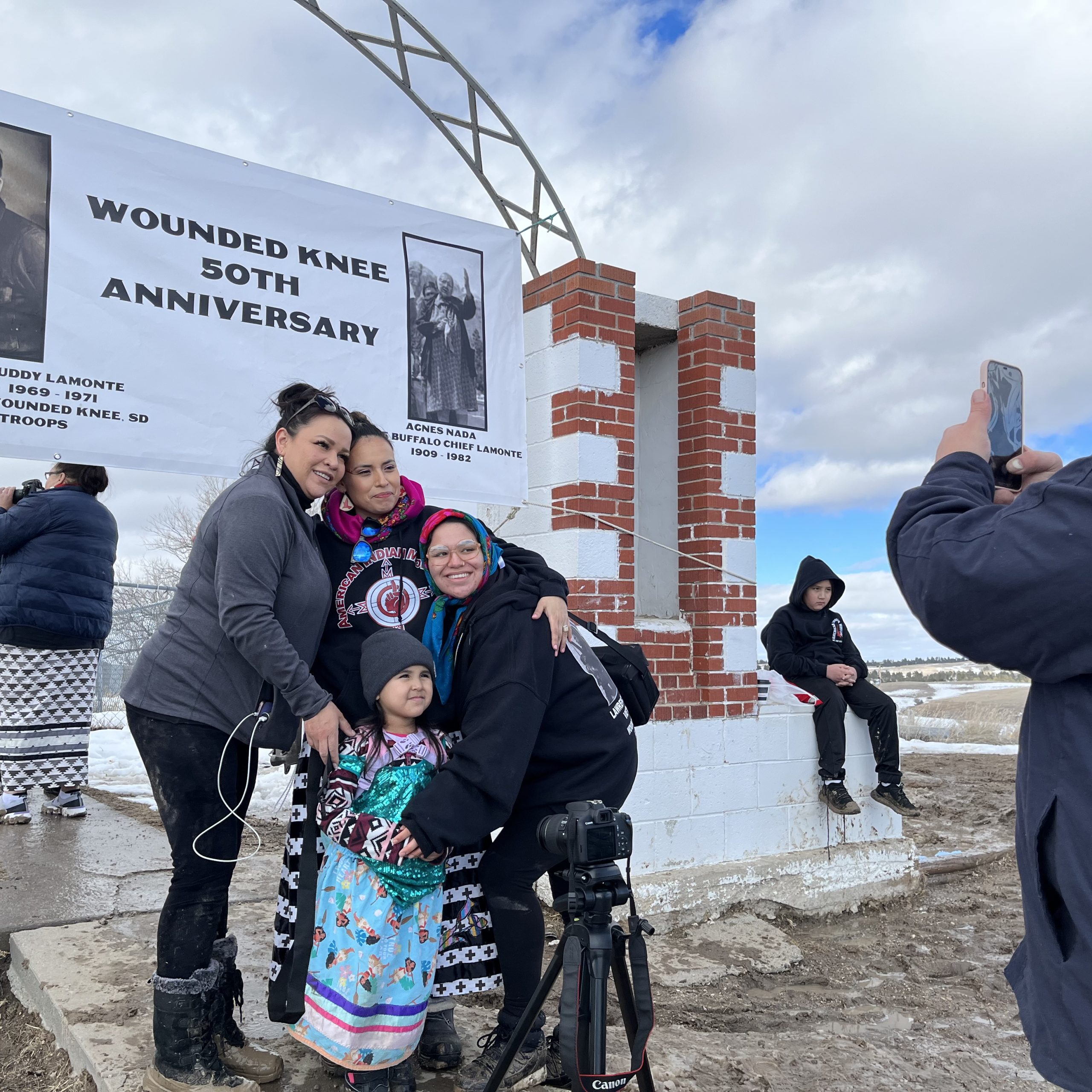
Generations of activists gathered for the 50th anniversary celebrations, which stretched over four days starting on Friday, Feb. 24. They ranged from veterans of the occupation, now in their 70s and 80s, to small children still learning about the past.
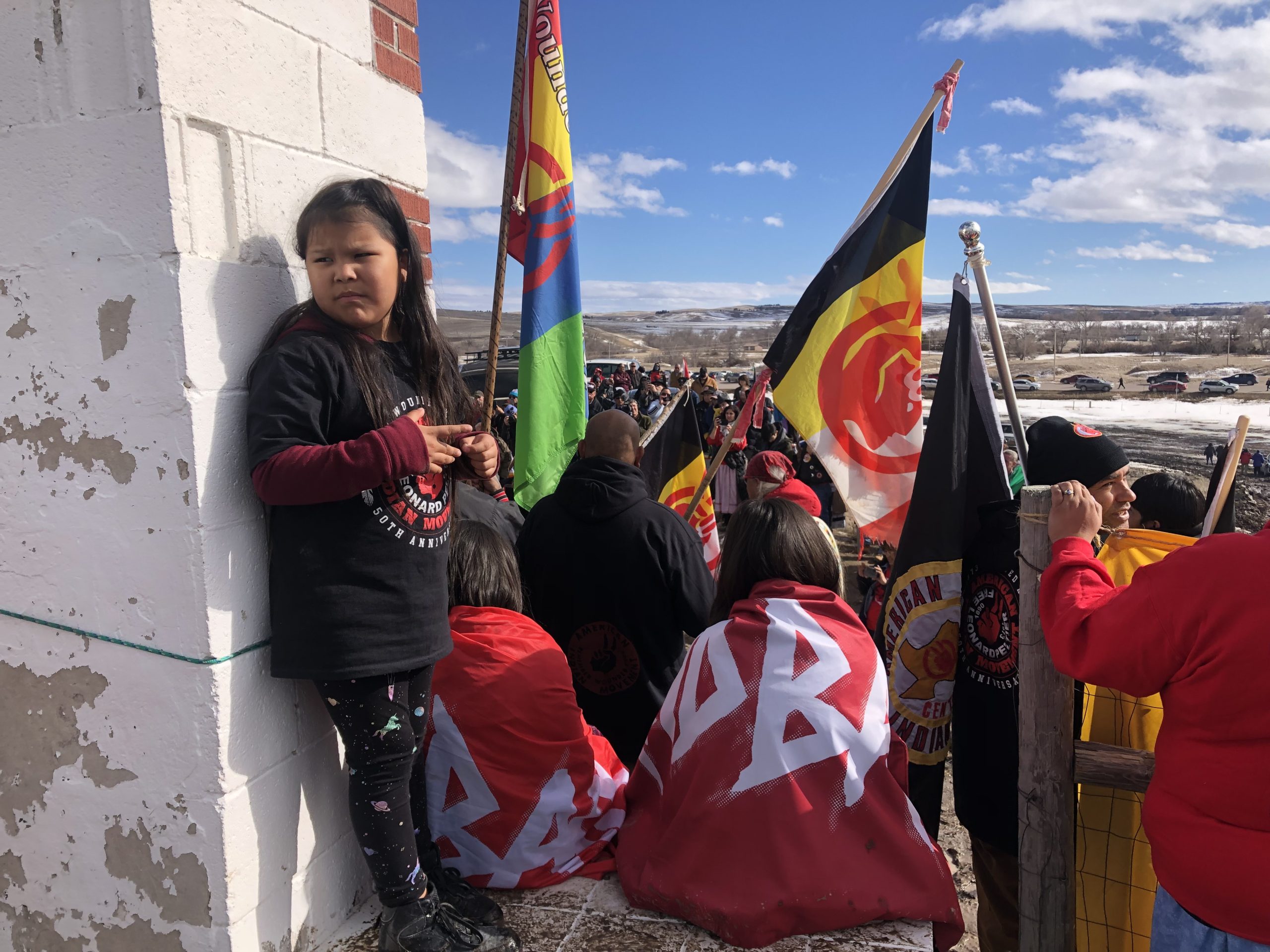
For many, it was personal.
“I didn’t know anything about my Kiowa ways, but AIM taught me,” said Lavetta Yeahquo, a Kiowa woman who was behind the lines at Wounded Knee and returned for the anniversary events.
“I found my spirituality, and I don’t regret it,” she said. “There’s help out there. Get brave enough. Get courage in your heart to take a stand for yourself. That’s what AIM taught me … to be more bold, speak up. Creator created you with a mouth, not to say nothing. Use it. Speak up.”
Making history
The marchers came together Monday from across South Dakota and beyond after a Four Directions walk, exactly 50 years to the day of the occupation.
They waved the AIM flag, carried an iconic, upside-down American flag like the one flown at the AIM occupation in 1973, and brought photos of lost loved ones. An assortment of weapons was also scattered among the crowd, and gunfire broke out when the groups finally converged at the memorial, though no one was reported injured.
The historic Wounded Knee occupation was one in a string of AIM protests from 1969 to 1973 that pushed the American Indian Movement to the forefront of Native activism, igniting a legacy that endures today in the protests at Standing Rock and in the Black Hills, among others.
Read more:
—Wounded Knee legacy lives on 50 years later
—My story: Behind the lines at Wounded Knee
—Women of Wounded Knee
—Wounded Knee anniversary events
—Wounded Knee land comes home at last
The occupation began on the night of Feb. 27, 1973, when warriors led by Carter Camp, Ponca, slipped into town past a growing number of FBI, U.S. marshals and other law enforcement officers.
They took over the trading post and established a base of operations along with AIM leaders Means, Oglala Lakota; Dennis Banks, Ojibwe; and Clyde Bellecourt, White Earth Nation. Within days, hundreds of activists had joined them for what became a 71-day standoff.
It was the fourth protest in as many years for AIM. The organization formed in the late 1960s and drew international attention with the occupation of Alcatraz from 1969-1971. In 1972, the Trail of Broken Treaties brought a cross-country caravan of hundreds of Indigenous activists to Washington, D.C., where they occupied the Bureau of Indian Affairs headquarters for six days.
Then, on Feb. 6, 1973, AIM members and others gathered at the courthouse in Custer County, South Dakota, to the lenient sentences handed down to people who committed violence against Indigenous people. Three weeks later, they moved into Wounded Knee.
The takeover grew out of a dispute with Oglala Sioux tribal leader Richard Wilson but also put focused on demands that the U.S. government uphold its treaty obligations to the Lakota people.
AIM leaders declared the Wounded Knee territory to be the Independent Oglala Nation, granting citizenship papers to those who wanted them and demanding recognition as a sovereign nation.
A build-up of law enforcement officials brought escalating violence, however, and firefights occurred most every night. Supplies behind the lines grew scarce as the government tried to cut off support for those inside, but government officials and AIM leaders continued with ongoing discussions to end the stand-off.
The occupation finally ended on May 8 with an agreement to disarm and to further discuss the treaty obligations.
By then, three people had died: Frank Clearwater, identified as Cherokee and Apache, who was shot April 17, 1973, and died eight days later; Lawrence “Buddy” LaMonte, Oglala, who was fatally shot on April 26, 1973; and Black activist Ray Robinson, who had been working with the Oglala Sioux Civil Rights Organization.
The occupation has had an enduring impact on those who were there.
Richard Ray Whitman, Yuchi-Muscogee, an actor and multi-disciplinary visual artist, was part of the occupation 50 years ago. He said he was drawn to the action as a young man seeking something missing from his life.
“We were looking for something to validate ourselves at a time when it wasn’t a good thing to be Indian,” he said.
He learned an important lesson from the Red Power movement and AIM.
“You have to be yourself — you should be yourself,” he said.
Diane Bird, Santo Domingo Pueblo, also returned to the place where she spent time 50 years ago. Bird left her faculty position at California State University Long Beach to join the occupation after hearing a grandmother on the radio calling from Wounded Knee.
She and two of her students drove out days later.

“I was a nighttime radio operator,” she said, in charge of keeping in touch with the various bunkers spread out under control of the AIM activists. One of her tasks was to plead with her compatriots to conserve bullets.
“We didn’t have many guns or much ammunition, and we were surrounded by federal marshals, FBI, tanks — all these weapons,” she said. “And all we had was little rabbit plunkers.”
Bird said she grew up listening to her grandfather’s tales of going to Washington, D.C., to fight for her Pueblo’s water rights, so when she heard about the Indians standing up for their rights on the Pine Ridge Reservation she knew she had to join the fight
“It wasn’t just one Indian tribe,” she said. “It was many Indian tribes standing together at that time in 1973 at Wounded Knee, where we all got together and stood together and fought against the government.”
Anniversary celebrations
The four-day celebration to mark 50th anniversary of the occupation included two pow wows, an event honoring the hundreds of women who supported Wounded Knee and an event recognizing the founding of KILI Radio on the Pine Ridge reservation by AIM members 40 years ago.
The launch of the station, known as the “Voice of the Lakota Nation,” was designed to address a lack of communication on the reservation.
On Friday, more than 200 people crowded into Oaye Luta Okolakiciye, a Rapid City center run by a Lakota cultural organization devoted to instilling hope, promoting wellness, prevention and healing in the urban Indian community based on Indigenous values and traditions.
KILI was the first reservation radio station in the nation. Today, there are stations in tribal territory coast to coast and radio plays a central role in Indian Country communications.
KILI “is very important not only for our Native people to know what’s going on, but it’s also really important for our allies to know who we are and how they can support us,” said Robert Pilot, Ho-Chunk, who hosts the Native Roots Radio show based out of Minneapolis, Minnesota.
“The importance of the 40th anniversary for KILI is that they were the first – there was no other message out there in Native country, in Indian Country,” Pilot said. “It’s just an important legacy that we need to celebrate.”
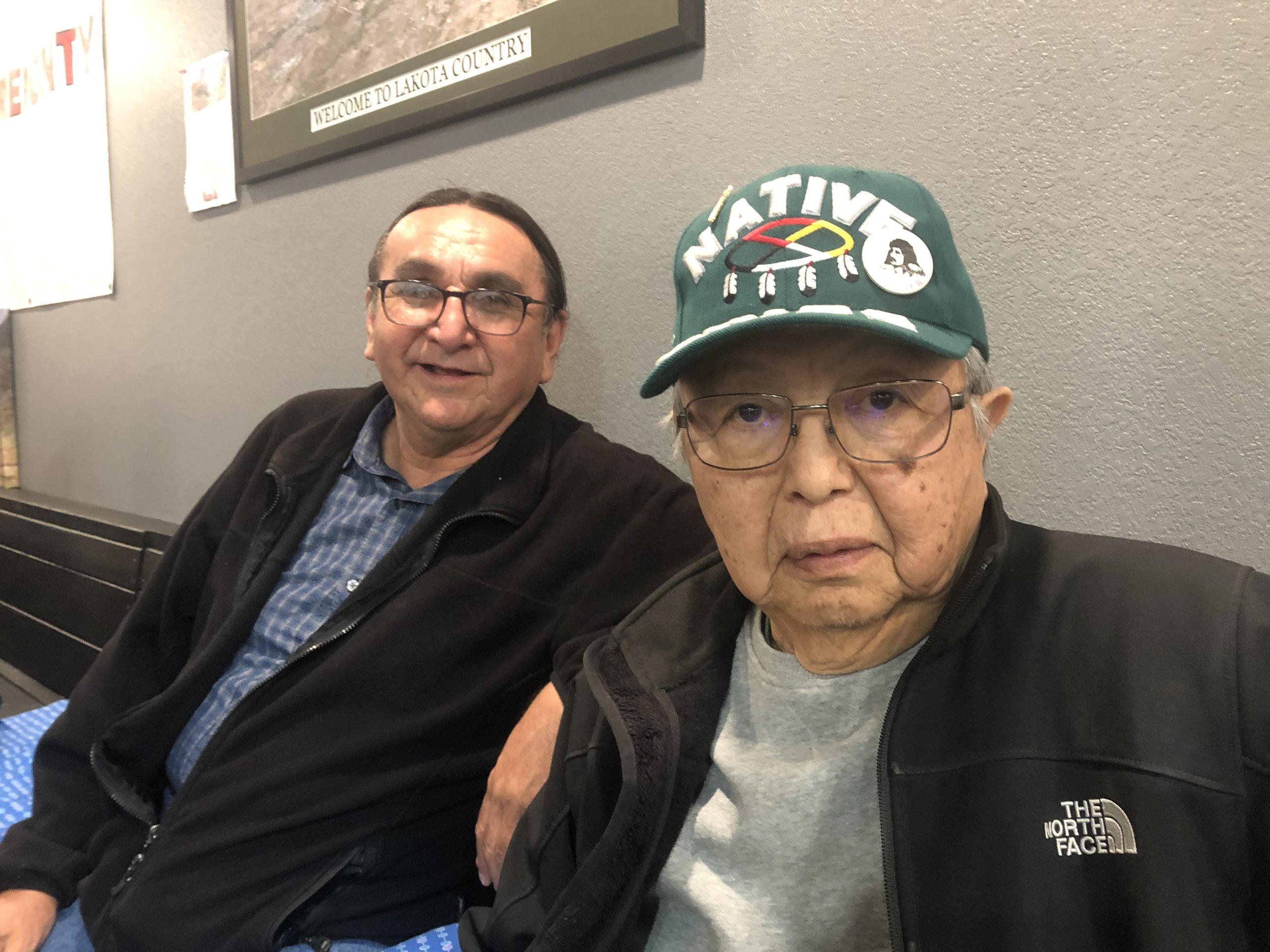
On hand to celebrate KILI’s anniversary was Herb Butler, Atahabaskan, who was present for all 71 days of the 1973 Wounded Knee occupation. He noted the importance of honoring a direct AIM accomplishment – the launching of a radio station – in the home of an indirect one.
Butler looked around the room in the Oaye Luta Okolakiciye center and talked about what it represents: Native people standing up and addressing problems in their community using their own ancient traditions, shedding the yoke of imposed cultures and paradigms.
He leaned over to the center’s founder, Gene Tyon, Oglala, to ask how he might connect Tyon with community leaders in Alaska to spread the model and with it the underlying message of AIM: Reclaim our ways.
“That’s how it works,” he said.
Warrior women
On Saturday, a special event in Porcupine, South Dakota, near Wounded Knee, honored the women of the American Indian Movement and the occupation.
About 250 people gathered at the Porcupine Day School, or Pahin Sinte Owayawa, for a celebration of and roundtable discussion with some of the women who participated in the Wounded Knee occupation.
Madonna Thunder Hawk, Oohenumpa Lakota, shared wisdom from her decades of work in the American Indian Movement. She said she is sometimes called the “Zelig of AIM” because she was part of the occupations of Alcatraz, the BIA headquarters and Wounded Knee, as well as the protests at the Custer County Courthouse and later, in 2016, at Standing Rock.
She said that women have always been leaders in Indian Country, including the mostly female members of the Oglala Sioux Civil Rights Organization that formed to challenge the leadership of Oglala tribal leaders in the 1970s, and who eventually called on AIM activists to come to Pine Ridge to help.
“There’s nothing new going on here,” said Thunder Hawk, a principal of the Warrior Women Project. “Our ancestors laid the groundwork and those of us that wish to take on the responsibility and the accountability, that’s the continuation of what our ancestors left for us.”
She said that the focus on and visibility of male leadership in the media and even in tribal government has roots in a system imposed on Native communities. She said tribal governments are patterned after the federal government.
“You have to remember that is a result of the colonized thinking of where that government came from,” she said. “But in actuality, how things are run, and especially when it comes to getting things done … when the Red Power movement came … it was automatically a matriarchal system. Still is today, because it’s culture, it’s tradition, it’s the way it is.”
Former U.S. Rep Ruth Buffalo of North Dakota, who is Mandan, Hidatsa and Arikara Nations, was among those who attended the event. She said she drew inspiration from seeing and hearing the women leaders who came before her.
“It definitely has made an impact in showing us what can be possible,” she said Saturday. “It is still sad that we unfortunately face some of the same struggles today. And so that’s what keeps many of us, as helpers, continuing to show up and help where we can for future generations and of course, honoring those that have gone before us.”
Looking ahead
The message from the AIM occupation at Wounded Knee in 1973 continues to resonate with today’s new generation of activists, who turned out in force for the Standing Rock pipeline protests in 2016.
They are continuing to fight for Indigenous people with a new force that carries on the work of those who came before.
Russell Means’ grandson, musician Naca Charging Crow, Oglala, was among those who attended the anniversary event Monday.
“The fight is not over,” he said. “The fight continues to this day, and I think it will continue for the rest of our lives, generation through generation. We’re still here today 50 years later.
“We continue to do our daily battles with the government, with everyday life,” he said. “The system is basically set up for us to fail as Indigenous people, and we continue to fight to prove them wrong.”

Our stories are worth telling. Our stories are worth sharing. Our stories are worth your support. Contribute $5 or $10 today to help ICT carry out its critical mission. Sign up for ICT’s free newsletter.

