Dan Ninham
Special to ICT
Indigenous filmmaker Mark D. Williams has caught the attention once again of the film industry with his latest documentary about Choctaw stickball, one of about a half-dozen stickball games played in North America.
The film, “The Journey of Tiak Hikiya Ohoyo,” about a women’s Choctaw stickball team from Mississippi, is set for a series of showings at film festivals in Mississippi and Oklahoma in March, with others likely on the way.

It captures some of the things Williams likes best about making films — Indigenous sports, underdogs, and the cultural importance of a game still played across the southeastern United States and beyond.
Williams, who is both Oklahoma and Mississippi Choctaw, credits the Indigenous core values of the Choctaw people for his work.
“Indigenous people, the youth in particular, love sports and most are natural athletes,” he told ICT recently. “But unfortunately, a lot don’t make it to the next level due to different reasons … I wanted to make films to show the struggles of the people that they look up to, so they could relate to it – maybe make them think, ‘If they can do it, so can I.’
“That was my driving force to tell the early films,” he said. “Then it became showcasing our cultures when it came to games like stickball. In each case there is a passion behind it. From myself and the subjects on camera.”
An award-winning filmmaker from Shawnee, Oklahoma, Williams has been making films for more than 15 years through his Native Boy Productions and Digital Feather Media companies.
His latest film is his second on Choctaw stickball. The first, produced by the Choctaw Nation of Oklahoma, was “Tvshka Nowvt Aya (A Warrior’s Journey),” in 2018, which followed the Choctaw Nation’s stickball team as it advanced to the World Series of Stickball held annually in Mississippi.

The new film has already won awards for best documentary feature film at the Indigenous People’s Day Film Festival and the Fort Smith International Film Festival, and has been tapped as an official selection for NatiVisions Film Festival, The IndieFEST Film Awards, LASkinsFest and Storytellers Cinema.
SUPPORT INDIGENOUS JOURNALISM. CONTRIBUTE TODAY.
Williams was also recently inducted into the North American Indigenous Athletics Hall of Fame in the media category.
“I grew up playing and loving sports, so it became natural to me to connect to the journey of athletes,” Williams said. “After a few awards and receiving great feedback of how it inspired others to keep going, I saw these films were needed. I enjoyed learning about what drives these athletes.”
Choctaw stickball has been part of Choctaw communities for centuries, but was first documented in the early 1700s by a Jesuit priest’s account of a game in what is now southern Mississippi, according to the Mississippi Band of Choctaw Indians website.
It originally started as a way to resolve disputes, but developed into an aggressive game played between two goal posts at each end of a field.
Today, the game is played in four, 15-minute quarters. Players cannot touch the ball with their hands, and instead use handcrafted sticks, known as kapucha or kabocca, with a woven leather ball, or towa. Points are scored when a player hits a post set up between the opposing team’s goal post.
Other tribes also play their own variations of stickball, which is similar to lacrosse.
“Stickball stands as an enduring part of Choctaw culture not only as a sport but also as a way of teaching traditional social structure and family values,” according to the Choctaw Nation of Oklahoma website. “Today, we continue to use the equipment as a way to teach children about working together.”
Off to a good start
Having never been to film school, Williams taught himself about filmmaking using friends and family for his first few projects.
His first film, “The Dare,” in 2006, was made on a $200 budget.
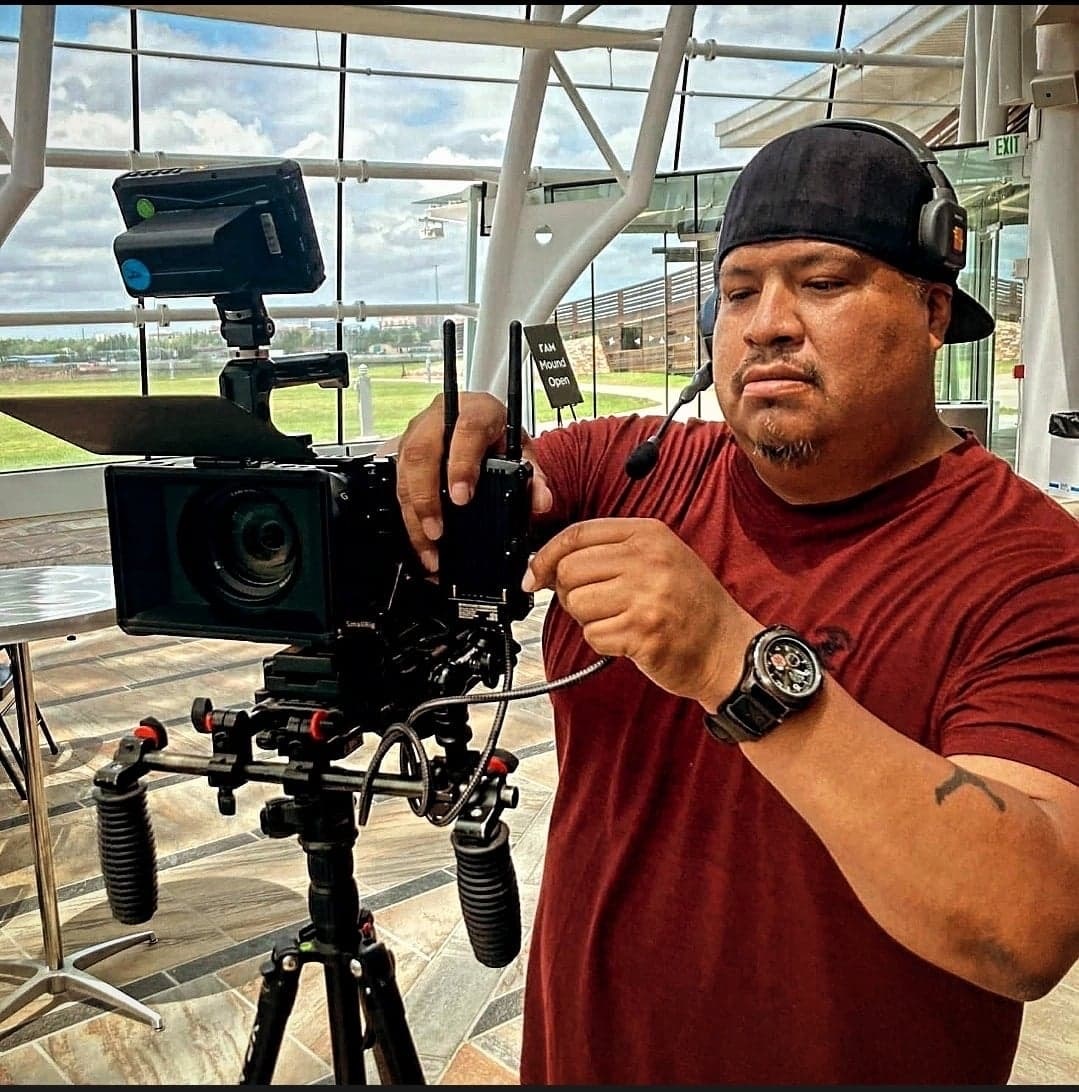
“At the time, it was something more for fun because it was something creative, which I always enjoyed doing,” he said. “I made a short thriller with my friends and family. We even had a garage sale and Indian taco sale just to have money to feed everyone and buy wardrobe. It ended up being about 20 minutes long and after it was done, I kind of forgot about it.”
Then he got an email from a Tulsa film festival that wanted to screen the film. Luckily, the screening was scheduled right after a showing of a Johnny Depp film, which drew huge crowds.
“I agreed at the time not knowing what a film festival really was,” Williams said. “But when I went, it was a sold-out event, mainly because of the film before mine, so I was pretty nervous.”
The audience reaction was inspiring, he said.
“It got great reactions and feedback,” he said. “People in the audience were screaming or looking away — all the reactions you want them to do for a horror film. At that point, I was hooked. I knew this is what I wanted to do for a living. So I began making more short films, paying for each one and making mistakes along the way, but also learning along the way. That was my film school.”
He wrote and directed his first feature-length film, “The Unrest,” in 2012. The 53-minute film is a horror story that tells the true events of Indian boarding schools in the U.S. and “the dark attempts it sometimes took to look the other way,” according to a synopsis of the film.
The success kept him going.
“It was fortunate enough to win some awards and do well,” he said. “The films began getting bigger, and I was able to work with working actors at this point.”
In 2015, he wrote and directed the acclaimed film, “Violet,” about an escaped mental patient who dies at the home of her former doctor.
“Violet” also won a string of awards, receiving top honors at the Red Nation International Film Festival, the Fort Worth Indie Film Festival and the Gallup Film Festival, where it won awards for best drama, best actor and actress, best editing, best cinematography and best director.
Williams was also named best director at the Tribal Film Festival for “Violet,” and lead actress Happy Frejo was nominated for best actress at the American Indian Film Institute’s American Indian Picture Awards in 2015.
“To this day, it was the film that has won the most awards and received the most recognition,” Williams said.
Sports documentaries
By 2016, Williams had shifted to documentaries. For that, he turned to another friend.
“I reached out to a friend of mine whose daughter was doing wonderful things on the golf circuit, local and nationally,” Williams said. “The neatest thing about it was she was Native and only eight years old. So I made a short documentary about her.”
The resulting film, “Beans,” tells the story of golfer Peyton “Beans” Factor, who is Chickasaw, Choctaw, Creek and Seminole. Factor was ranked #1 in golf at the time for her age group in Oklahoma and Texas. The film went on to win best documentary at a Fort Worth film festival, he said.
He then directed several other sports films, including “Shiloh,” about a Native female boxer; “Knifechief,” about Pawnee boxer Dennis Knifechief who struggled with addiction; and “Warrior Coach,” about a coach at a small Indigenous school on the Seminole reservation.
“I came across a champion boxer named Shiloh LeBeau whose story … I found inspiring,” he said. “She had a huge following with the Native youth, and I felt like her story could be on an even bigger stage, so we made ‘Shiloh.’”
He made his first film about Choctaw stickball, “Tvshka Nowvt Aya (A Warrior’s Journey),” in 2018.
The film follows the Choctaw Nation stickball team known as Tvhska Homma, or Red Warrior, along its journey to the 2018 World Series of Stickball.
The film helped him better understand the importance of stickball to the Choctaw community. The game wasn’t popular when he grew up, so he had never played it. He learned as he went.
“I began learning more about stickball and what it means to the Choctaw people,” Williams said. “I then went and made a film, ‘The Journey of Tiak Hikiya Ohoyo,’ about a women’s Choctaw stickball team from the smallest reservation in Mississippi, trying to make history by winning its first title. They were from the Standing Pine Reservation, which is where my family was from, so the film took on a special meaning to me.”
A Native perspective
Friends and supporters say he brings a new view to Indigenous film.
“It’s great that Mark gets to work on documentaries about his people, because when you are telling stories about your people, you know some of the specifics that others don’t know,” said Jeremy Fultz, Seminole Nation of Oklahoma, who has worked on projects with Williams and shares his passion for storytelling.
“I’ve never understood how outsiders are brought in to tell these stories,” he said. “These are our stories and it’s great to see someone from within tell those stories.”
Fultz, who is language director for his tribe and is also a digital creator specializing in audio and video, said he met Williams about 10 years ago, when a television producer approached him.
“I knew Mark had worked with this producer in the past, so I sent Mark a message asking if he was free to meet up so I could ask him some questions about the business and the producer, and we’ve been friends ever since,” he said. “Soon after this meeting, we started working together.”
He continued, “Being friends with Mark makes it easy to bounce ideas off each other, and with both of our experiences, we can plan out shoots and spot any potential issues before we start the project. It’s great having a close friend that is a creative person that is Indigenous, because we can talk about a great narrative film and then talk about preserving our culture and heritage and the challenges of both.”
Dewayne Hornbuckle, who is Oklahoma Choctaw and works as a youth outreach advisor for the tribe, said he met Williams on the first stickball documentary. They are now friends, and Williams’ son plays on their youth team.
“We share a lot of the same goals when it comes to cultural education,” Hornbuckle said. “I work with Choctaw youth and have utilized Mark as a … motivational speaker a few times. I believe passing on knowledge of cultural traditions and values gives our youth a positive sense of identity, self-worth, and ability to share their own experiences.”
Being able to see someone who looks like them and who grew up in the same area can be important for today’s youths, he said.
“The opportunity for kids to see and experience different cultures in multiple settings allows them to feel safe and more comfortable expressing and sharing their own culture and traditions,” Hornbuckle said.
“Native culture and language are making a resurgence with this generation and Mark does more than his fair share to encourage that,” he said. “We agree that teaching about our history and some of the hardships their ancestors had to endure is key to restoring pride and confidence for our youth to become successful adults and maintain their identity.”
Looking ahead
Williams is currently focused on the screenings of his films throughout the country, which take up a good bit of time. But he is looking ahead to getting back to making more films.
“I still have a love of writing and directing; I miss it,” Williams said. “I’ve been working on a script, something that can take me back to that, but shot in a style like a documentary and have it be about our ancient game of stickball. I’m hoping to finish the script this year and film within a year or two.”
He is researching more cultural projects to give Native people an authentic voice, but he has also picked up a stick himself and joined a Choctaw stickball team.
“Because of my work with the Choctaw Nation for their film about stickball and producing my own film about Mississippi Choctaw stickball, it has taught me a lot about the game and inspired me to pick up sticks and play,” he said.
“I’m past my prime, but I am teaching my son the game, and he’s beginning to enjoy it. I’m hoping someday he can watch these films and be proud of it as much as I am. I look forward to seeing him on that field someday.”
More info
Choctaw filmmaker Mark D. Williams has been making films for more than 15 years through his Native Boy Productions and Digital Feather Media companies. His latest film, “The Journey of Tiak Hikiya Ohoyo,” which follows a women’s Choctaw stickball team along its journey to the World Series of Stickball, is set for several screenings in March. Follow Williams on the Native Boy Productions Facebook page.Upcoming screenings
“The Journey of Tiak Hikiya Ohoyo”
—Holba Pisachi Film Festival, Saturday, March 11, at the Chickasaw Cultural Center in Sulphur, Oklahoma
—Sunny Side Up Film Festival, Friday, March 24, at the Coleman Theatre in Miami, OklahomaOther films
—”The Dare,” 2006, his first film was a horror story made with a $200 budget and the help of family and friends. It captivated audiences with a showing in Tulsa.
—”Violet,” 2015, a psychological thriller released in 2015, tells the story of an escaped mental patient who dies at the home of her former doctor. It premiered in Oklahoma City and was screened at a number of festivals.
—”Beans,” 2016, is a documentary on an 8-year-old Indigenous golfer, Peyton “Beans” Factor. It was featured at the Fort Worth IndieFilm Showcase in Texas.
—“Shiloh,” also in 2016, about Native boxer Shiloh LeBeau, who had won the 2015 intercollegiate title.
—“Tvshka Nowvt Aya, (A Warrior’s Journey),” 2018, tells the story of a Choctaw Nation stickball team known as Tvhska Homma, or Red Warrior, and the team’s journey to compete in the 2018 World Series of Stickball.
—”Knifechief,” 2019, tells the story of Pawnee boxer Dennis Knifechief.
—“Ikhayana La Chi (I Will Remember),” 2021, tells the stories of the last Choctaw removal from Mississippi to Ardmore, Oklahoma, in 1903 by train, and the cultural impact on the people and the community. The 35-minute documentary was produced by the Choctaw Nation of Oklahoma.
—“The Journey of Tiak Hikiya Ohoyo,” 2022, follows a Mississippi Choctaw women’s stickball team on its way to compete in the World Series of Stickball. It has already won best documentary feature film awards at the Fort Smith International Film Festival and the Indigenous People’s Day Film Festival.

Our stories are worth telling. Our stories are worth sharing. Our stories are worth your support. Contribute $5 or $10 today to help ICT carry out its critical mission. Sign up for ICT’s free newsletter.