
ICT is working to shape the future of journalism and stay connected with readers like you. A crucial part of that effort is understanding our audience. Share your perspective in a brief survey for a chance to win prizes.
Amelia Schafer
CRAZY HORSE MEMORIAL, S.D. – The 18-year-old Northern Cheyenne man inhaled the pine trees, felt the crunch of newly fallen snow beneath his feet and guarded himself against the bitter cold. As he ran through the Black Hills, Mario “Winter Hawk” Spotted Elk Jr. Day found himself lost in prayer.
“When I’m in prayer, I go into this room in my mind, there’s this little me and he’s answering me telling me these prayers. It’s like I’m not there, I’m just running,” he said. “Today when I woke up I was sore, my hamstrings hurt and my calves hurt. I could barely walk out of bed, but I sat up and prayed. I was so happy to run. You don’t wanna stop when you’re out there.”
His ancestors followed the same path 145 years ago, escaping from confinement at Fort Robinson in northwestern Nebraska. More than 149 Cheyenne from Chief Dull Knife’s band had been taken into custody at Fort Robinson in October 1878 after 343 members escaped from Oklahoma. The group planned to return to their homelands in southeastern Montana where they’d lived for as long as they could remember, and they had no plans to give up.

For the last several weeks of their confinement at Fort Robinson, the Cheyenne lived off nothing but the soles of their moccasins and condensation gathered from the windows and walls of their cells. At 10 p.m. January 9, 1879, they broke free and ran toward the Black Hills.
Over 60 Cheyenne were killed and recaptured along the way by the United States military. Those who survived traveled more than 400 miles north to the Northern Cheyenne Reservation in southeastern Montana.
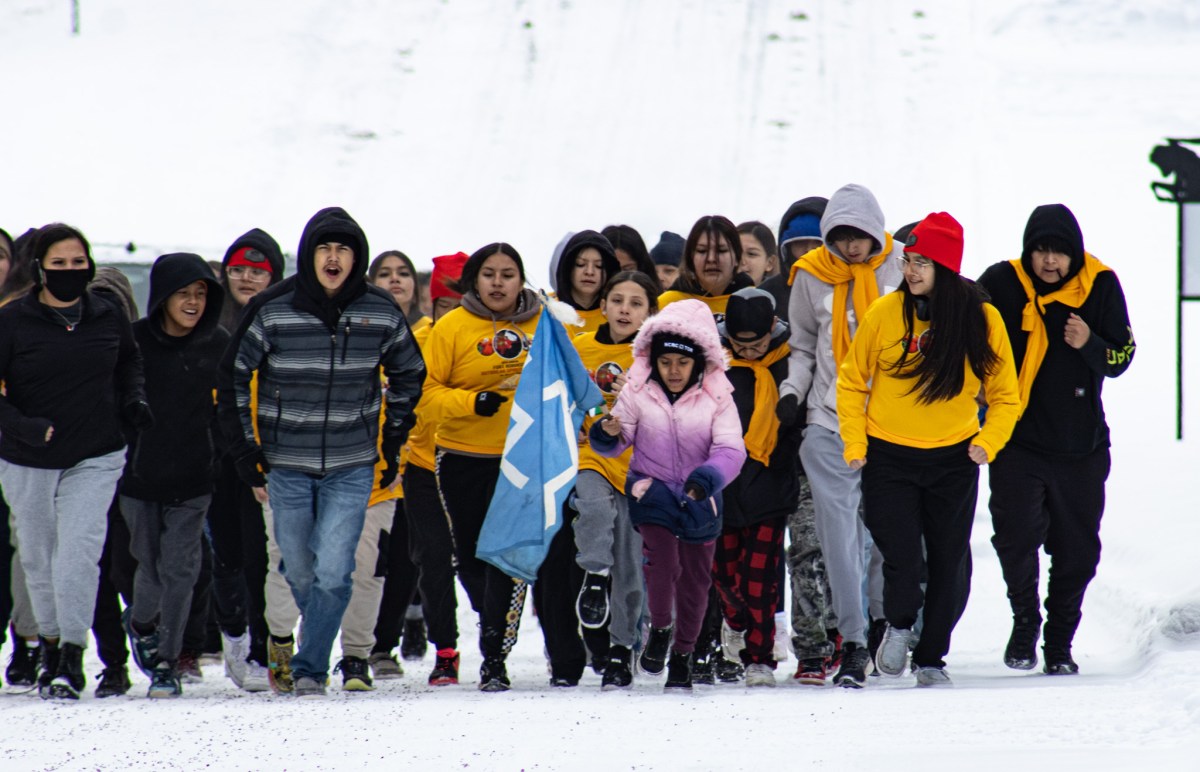
For the past 25 years, their descendants have run that same path on the anniversary of the day Chief Dull Knife’s band broke free. During the second week of 2024, a group of more than 90 youth ages 12 through 18 led by the Montana-based Yellow Bird Life Ways Center continued the tradition of traveling the 400-mile path their ancestors once took to freedom. As they neared the Crazy Horse Memorial last week, they endured temperatures that dipped below 0 degrees.
“If you can imagine those conditions (at Fort Robinson), the youth hear those stories and it’s (the run) nothing compared to what our ancestors went through,” said Lynette Two Bulls, Oglala Lakota/Northern Cheyenne and executive director of the Yellow Bird Life Ways Center.
In the mid-1990s the remains of those killed at Fort Robinson were returned to the Northern Cheyenne and buried in Busby, Montana. For three years, runners ran around the reservation ending in the spot where the remains were repatriated. In the fourth year, traditional Northern Cheyenne Chief Phillip Whiteman Jr. requested a run from Fort Robinson to Busby.
That first year, 14 youths participated. Now in 2024, the group grew to over 90 paticipants. Despite rain, snow and dangerous windchill, the group runs. Nothing stops their journey.
“To see the transformation in these kids, how it connected them to (their) identity, to self-esteem, to their homelands – we see the need to do it again, and again, and again,” Two Bulls said. “This addresses all the issues they experience today … all the things that disconnect them from who they are. On this run, they see the spirit that lies in each one of them. When they reconnect to that, they reconnect to life, to hope and to belief.”
For eight winters, Spotted Elk Jr. Day has completed the Fort Robinson Outbreak Spiritual run.
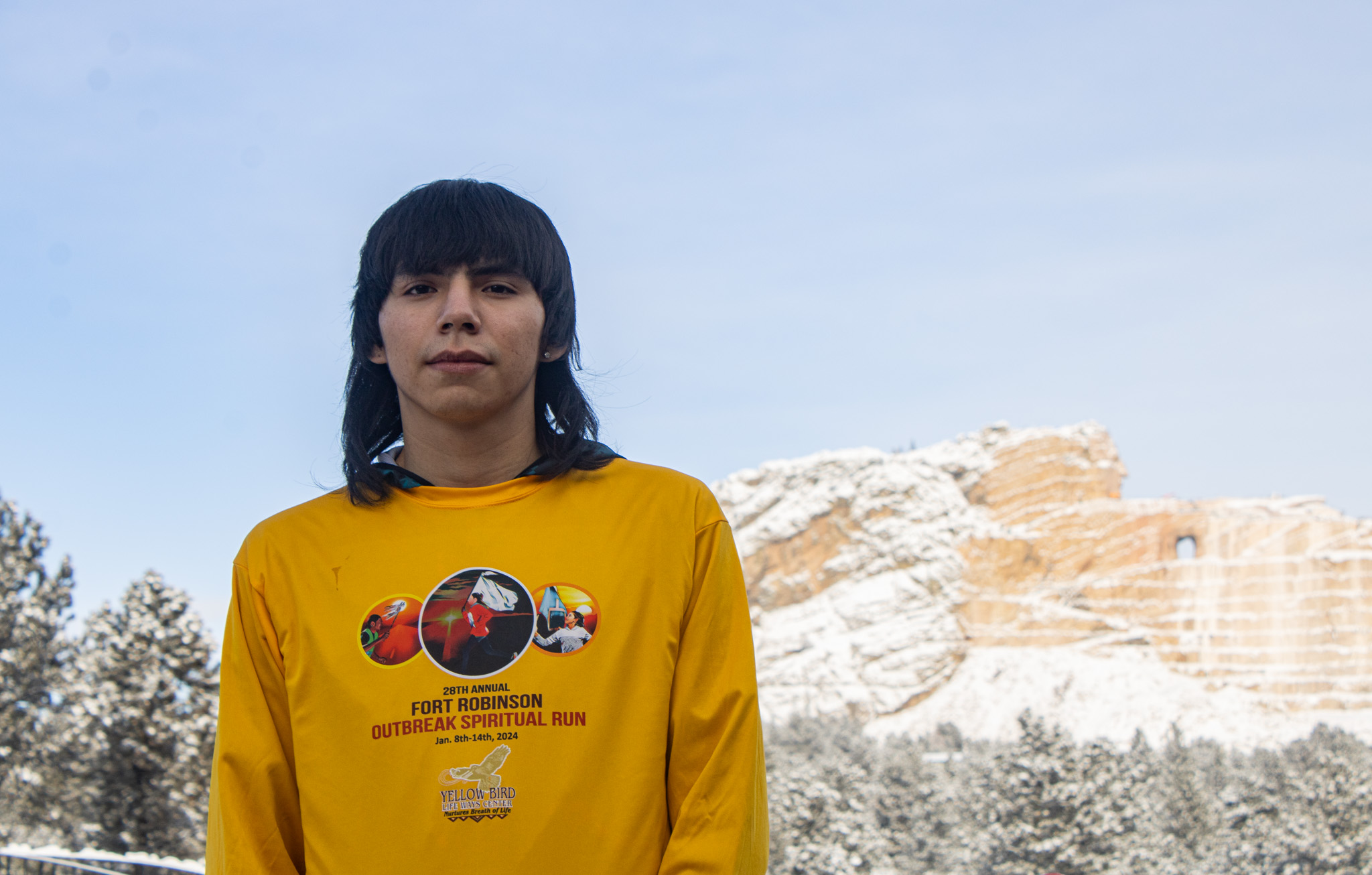
“This is something I really base my life on,” he said. “Growing up I knew I was Cheyenne. I went to powwows and handgames, but I wasn’t actively praying or knowing my ways. I was living a white man’s life. When I learned how to pray and learned how to war cry, I felt connected to something.”
His first year he was a fifth-grader traveling in a van full of elders. Looking out the window, he saw an elder grab the eagle staff and jog while the youth rested, keeping the run going.
“(I saw) a man eight times my life out there running in harsh conditions just trucking through. I remembered thinking, ‘Man, that’s what it means to be Cheyenne,’” he said.
On January 11, as they ran into the Crazy Horse Memorial, cheers and war cries elicited laughter and smiles from the youth.
Along their path, the runners make several stops in different Indigenous communities they run through, the Crazy Horse Memorial being one of them. Crazy Horse himself was imprisoned at Fort Robinson, then called Camp Robinson, 10 years prior to the Cheyennes’ imprisonment. Crazy Horse was killed trying to escape from the camp.
“Our relationship goes back to the Battle of Little Big Horn. We have a longstanding relationship and historical allyship. This is just another way to continue that into the future,” said Crazy Horse Memorial CEO Whitney Rencountre Jr., Hunkpati Dakota. “In that way, it’s important for us to have these relationships. When we form these relationships, the students see that. This is how our ancestors would come together and this is how we come together today.”
Spotted Elk Jr. Day said he plans to continue participating in the run every year and mentoring more youth as they run.
“One of my goals next year is to come back and do a marathon. This is just for family. That’s the best part about it, we’re all family,” he said.
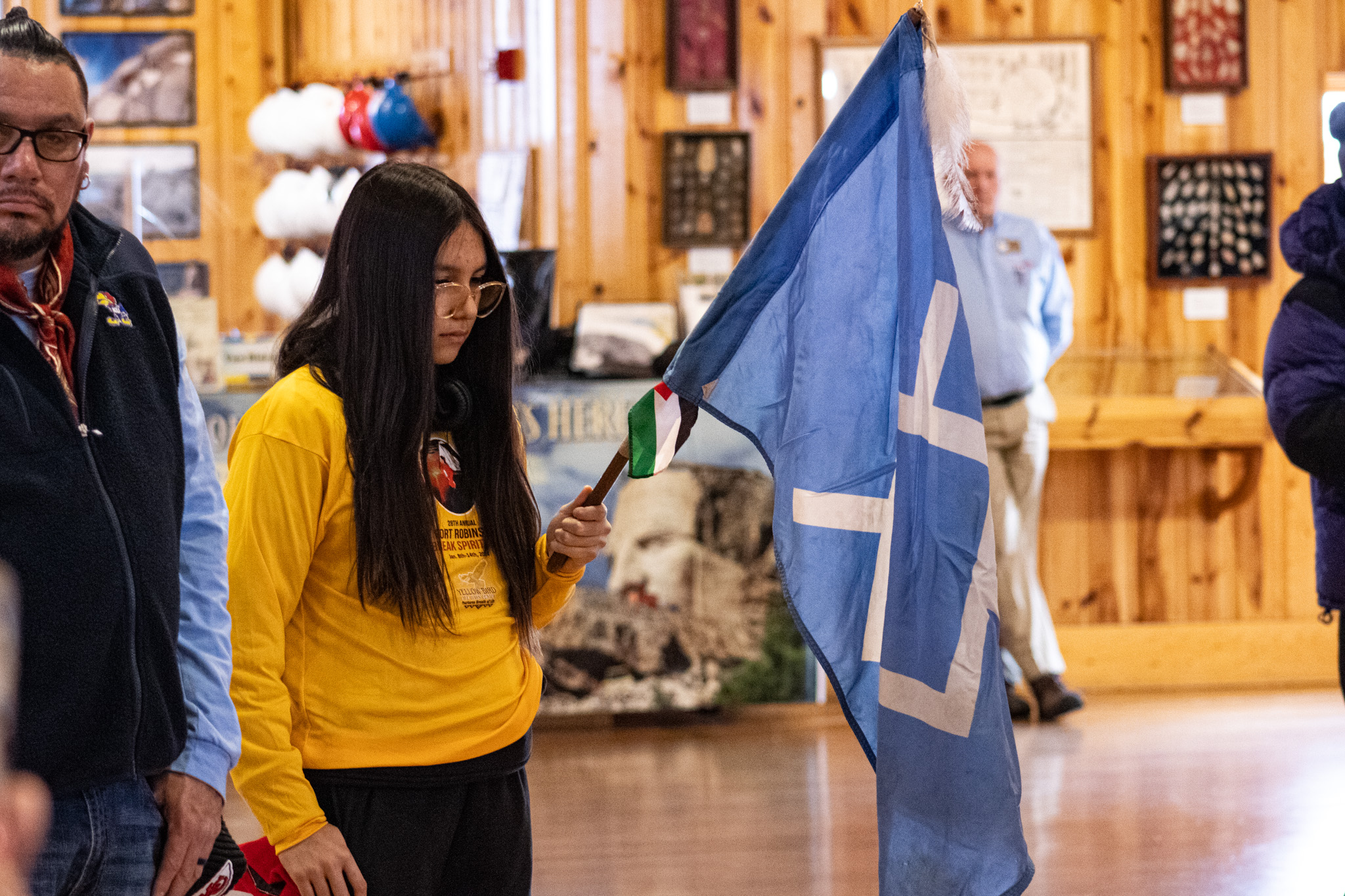
This year Spotted Elk Jr. Day’s little sister joined him. He said he played a major role in raising his sister ever since she was two weeks old, and this year he got to watch her hold the Northern Cheyenne flag while she ran.
“Last night she looked at me and she said, ‘You’re a good brother Mario.’ Being able to step up, it’s the best feeling. … I never had that. Being able to give that? That’s what the spirits did it for. That’s what the ancestors did it for,” he said. “I feel it every year on this run. It’s just a feeling in your body. It wakes your soul, tightens your soul and hugs your soul. That’s how I feel when I come here – loved, appreciated, wanted.”

This story is co-published by the Rapid City Journal and ICT, a news partnership that covers Indigenous communities in the South Dakota area.
Our stories are worth telling. Our stories are worth sharing. Our stories are worth your support. Contribute $5 or $10 today to help ICT carry out its critical mission. Sign up for ICT’s free newsletter.

