

WARNING: This story contains disturbing details about residential and boarding schools. If you are feeling triggered, here is a resource list for trauma responses from the National Native American Boarding School Healing Coalition in the U.S. In Canada, the National Indian Residential School Crisis Hotline can be reached at 1-866-925-4419.
Felix Clary
ICT + Tulsa World
TULSA, Okla. – The remains of a Carlisle Indian Industrial School student who died at the age of 15 was recently returned to the Wichita Nation in Anadarko, Oklahoma, part of the tribe’s homeland.
“We were not removed from here, so we are truly bringing our children back home. Their ancestors’ blood was in this land. It’s monumental,” said Tasha R. Mousseau, vice president of the Wichita and Affiliated Tribes, which are based in Anadarko.
Mousseau said it feels like the tribes are living in an “Indigenous renaissance.”
“We’re getting our land back, our culture back, our languages back, and these, these are our children we’re getting back.”
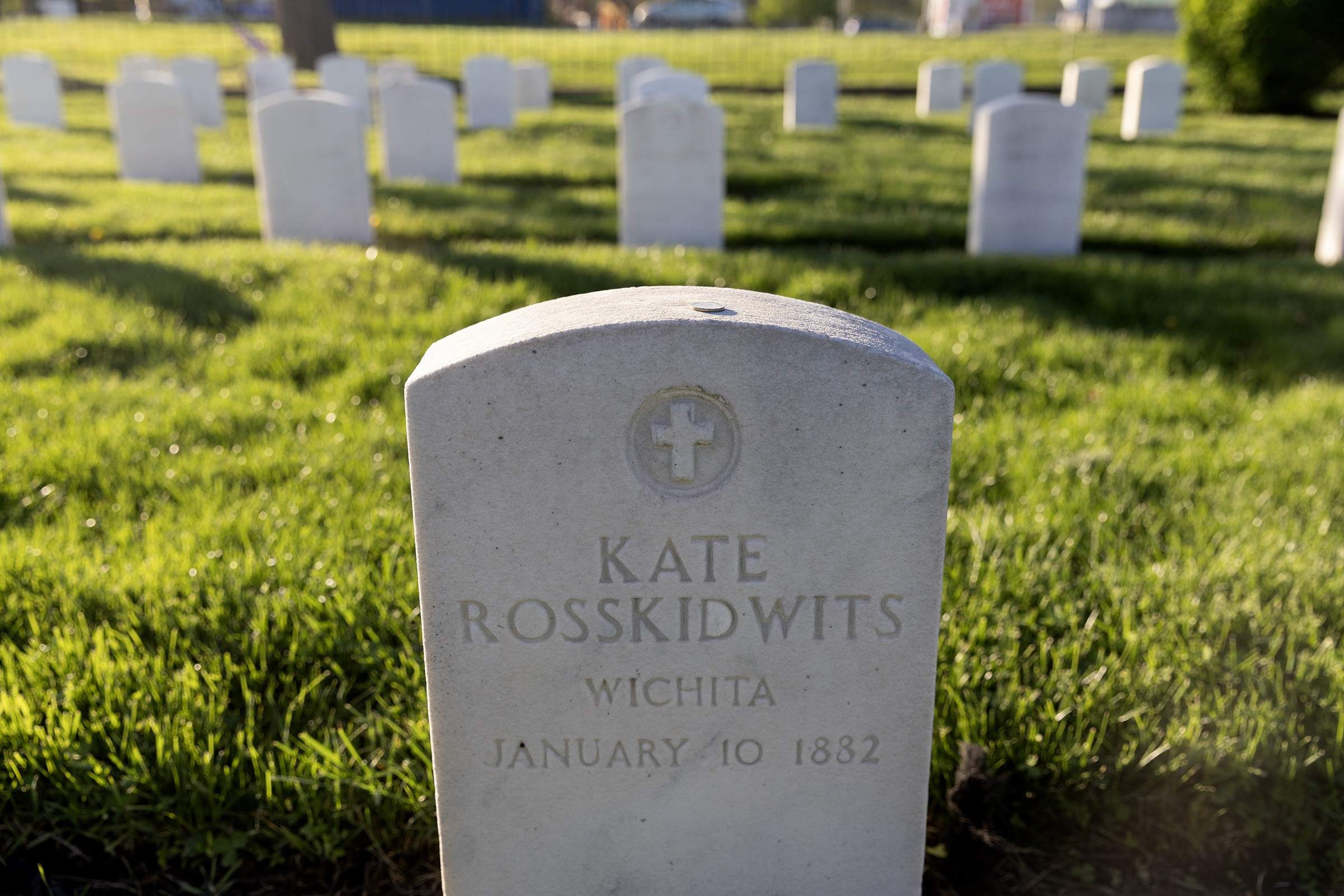
Wichita tribal leaders went to Pennsylvania this month to retrieve the remains of Kate Ross, as well as another Wichita Nation child who died at the school, Alfred Charko. The remains in Alfred’s grave were not able to be identified as belonging to him, so only Kate’s remains were able to be returned to Oklahoma.
“It’s a painstaking process and takes a lot of time. There could be something different than expected in the grave as far as gender, age, or the remains could be missing,” said Mousseau, who believes this could be due to a lack of oversight and care the school took in laying the children to rest.
Kate arrived at the school Oct. 27, 1879. Three years later, her cause of discharge was listed as “died” on Jan. 10, 1882. Alfred also died at age 15 on Dec. 16, 1882, only four months after arriving at the school.
“We know that the amazing team at Carlisle will continue to look for our relative and return him to our people one day,” said the Wichita and Affiliated tribes in a statement about Alfred.
The Wichita and Affiliated Tribes held an all-night wake for Kate on Friday, Sept. 20. Mousseau said community members planned to take turns sitting beside her to not leave her alone, as she had to be alone at Carlisle for three years and alone in her grave for nearly 142.
The tribe hosted a private burial ceremony and a celebration of life on Saturday, Sept. 21, at its community center in Anadarko.
According to Mousseau, confirmed descendants of Kate and Alfred cannot be found, as the tribe’s census records do not date back far enough. She also said the Wichita Nation has fewer than 4,000 tribal members.
“A tribe as small as we are, we’re essentially all related,” said Mousseau. “We can only go to the 1895 censuses, we don’t know the descendants that we would need to in that respective time frame.”
From 1880-1910, the United States operated Native American boarding schools as part of an assimilation initiative. Carlisle Indian Industrial School in Pennsylvania is considered the most well-known boarding school and one of the most strict in its treatment of its students. Neglect and physical abuse were rampant there and often led to the death of students.
The U.S. Interior Department has released investigative reports that uncover the truth behind this dark history. The reports offer resolutions to promote healing for the school survivors and their descendants. One of those resolutions is to find the students who died at the school and return their remains to their tribes.
The U.S. Office of Army Cemeteries began its annual process in September of disinterring, identifying and returning the remains of Carlisle students to their tribes. At least three of the students discovered were children from Oklahoma tribes, Kate, Alfred and a Seminole child named Albert Mekko.
Albert arrived at Carlisle in 1879 at age 17 and died two years later. The Army said that plans to return Albert to the Seminole Nation are set for later this fall.

This story is co-published by the Tulsa World and ICT, a news partnership that covers Indigenous communities in the Oklahoma area.
Our stories are worth telling. Our stories are worth sharing. Our stories are worth your support. Contribute $5 or $10 today to help ICT carry out its critical mission. Sign up for ICT’s free newsletter.

