
Deusdedit Ruhangariyo
Special to ICT
Around the world: Indigenous people in Russia are suffering from Putin’s war, a debate in Finland over Indigenous identity turns ugly, a Cree designer breaks through on a New York runway, and Australia’s Parliament is considering new protections for Indigenous children
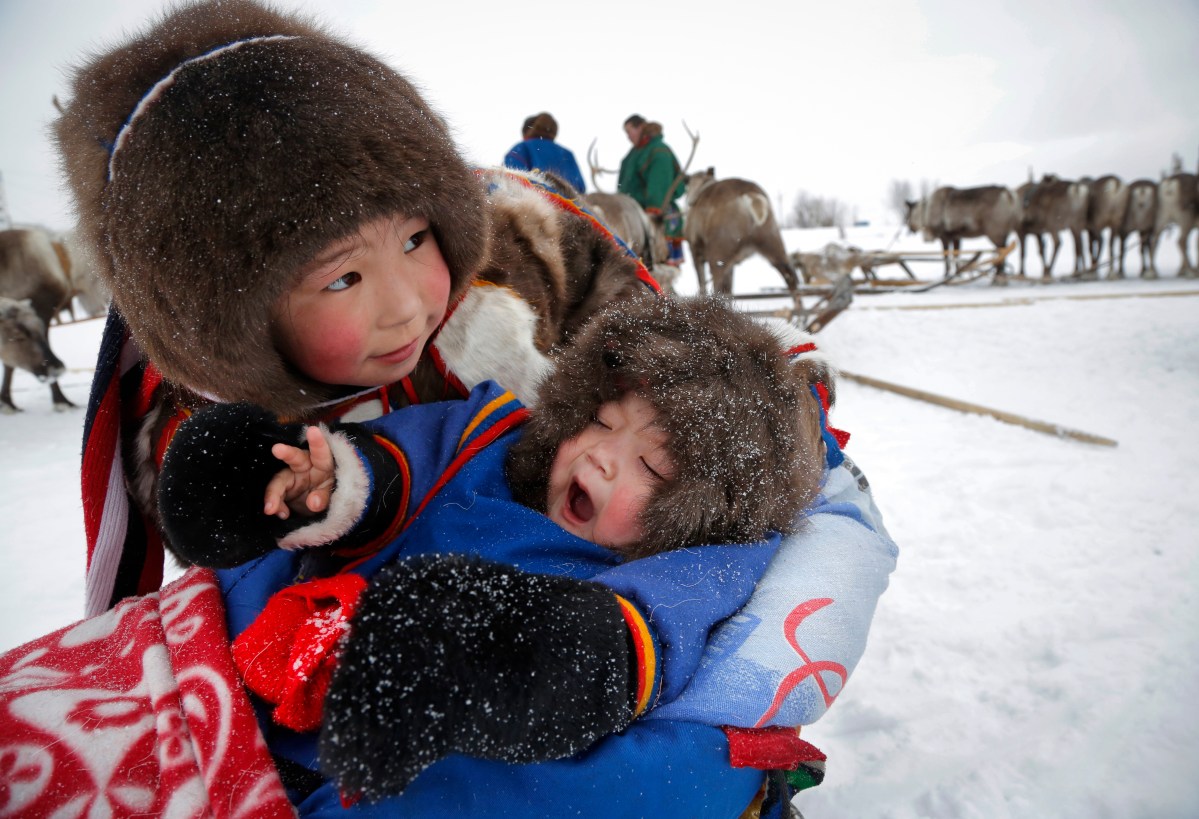
RUSSIA: Putin’s war hurts Indigenous Russians
Many of the consequences of Russian President Vladimir Putin’s war in Ukraine is falling on Russia’s Indigenous population, who were already facing a steady decline in population, WorldCrunch.com reported on Feb. 7.
SUPPORT INDIGENOUS JOURNALISM. CONTRIBUTE TODAY.
Indigenous communities are more prone to being mobilized and experiencing the effects of Western sanctions, according to WorldCrunch.com. They are also suffering from a loss of state benefits, with those funds now being redirected to the war effort.
Russia is home to 47 indigenous groups, some with populations as small as a few dozen people. The 2021 All-Russian Population Census revealed a significant decline in their numbers over the past decade, WorldCrunch.com reported.
Russia’s Indigenous people include the Kereks in Chukotka, the smallest Indigenous group with just 23 members reported in the 2021 census, to the Nenets of Russia’s Arctic region, the largest indigenous group with just under 50,000 individuals recorded in 2021.
The accuracy of the census data is questionable, however, since the government can manipulate the numbers, according to Dmitry Berezhkov, editor of the Indigenous Peoples website of Russia and a representative of the Itelmens, an Indigenous ethnic group of the Kamchatka Peninsula.
The Nenets, for example, could be even larger, but under Russian law, groups with more than 50,000 members are not considered Indigenous. The government may have chosen to reduce the reported numbers since the Nenets are heavily involved in traditional economic activities, such as reindeer herding and nature management, Berezhkov said.
“Removing them would affect the government’s framing of Indigenous people,” he said, according to WorldCrunch.com.
FINLAND: Debate over Indigenous identity turns ugly
The Sámi community in Finland, Europe’s only recognized Indigenous group, has been facing growing hostility in recent weeks over legislation that would limit political participation by hundreds of Indigenous people, Mongabay.com reported on Feb. 21.
The bill seeks to redefine the eligibility criteria for voting in the country’s Sámi Parliament, and would exclude hundreds of Inari and Metsä Sámi, Mongabay.com reported.
Some Sámi leaders, legal experts and historians, however, argue that the groups do not meet recognized Indigenous definitions and emerged only recently in response to efforts to secure Sámi rights to land, water, and resources.
The bill would strengthen negotiations with Sámi leadership on development projects and protect their traditional activities, but some Sámi organizations object to these expanded requirements and rights.
“This movement … really is rooted in a fierce opposition to Indigenous rights,” said Laura Junka-Aikio, a professor of northern politics and government at the University of Lapland, according to Mongabay.com. “[When] outright opposition wasn’t a good strategy anymore … the same groups that were opposing the Sámi identity started looking for their Indigenous roots.”
With opposition growing, factions within the coalition government of Finland have postponed a vote on the bill. Progressive Prime Minister Sanna Marin is not expected to run again in upcoming elections.
The Sámi people have been engaged in hunting, reindeer herding, and fishing throughout the northernmost regions of Europe for thousands of years, creating settlements in Norway, Sweden, Finland, and Russia. They have developed environmentally sustainable use of land, including rotating fishing lakes and herd cycling to avoid overgrazing.
More than 90 percent of the traditional Sámi territory in Finland is categorized as state-owned, and it is exploited for timber by Metsähallitus, a state logging enterprise that operates without clear consultation guidelines with the Sámi.
CANADA: Cree designer debuts on New York runway
Two-spirit Cree fashion designer Scott Wabano from Canada debuted at New York Fashion Week in February, taking over one of the world’s most significant fashion runways, CBC News reported on Feb. 21.
With family roots from the Quebec Cree Nation of Waskaganish and a Mushkegowuk from Moose Factory on the west coast of James Bay, Wabano’s goal is to challenge colonial binaries, including gender terms that were introduced by early settlers, CBC News reported.
Wabano plans to create gender-neutral, sustainable streetwear with an Indigenous flair, thereby eliminating gender distinctions, CBC News reported.
“The future is going to be Indigenous-led,” Wabano said, according to CBC News. “It’s going to be two-spirit-led as well. I’m really honored to be able to showcase that on the runway.”
The designs include black-and-white patterns featuring a stylized teepee. The show featured mostly Indigenous models, including activist Michelle Chubb, a swampy Cree from the Bunibonibee Cree Nation, and actress-model Braydee Cardinal.
AUSTRALIA: Landmark bill would acknowledge mistreatment
A landmark bill pending in Australia’s Parliament would require judges and child protection workers in Victoria to consider historical mistreatment of Aboriginal families when making decisions about Indigenous children, The Guardian reported on Feb. 20.
The bill – the first of its kind in Australia – also includes an acknowledgement of the past wrongs and mistreatments of Aboriginal people by the government.
The bill has support from both the Coalition and Green parties, and is expected to pass Parliament in coming weeks.
The proposal would empower organizations such as the Victorian Aboriginal Child Care Agency to investigate child protection cases and provide support to families before a court order is issued.
The aim is to decrease the number of Aboriginal children taken into care in Victoria through culturally appropriate and early support measures, The Guardian reported.
“The proposed bill enables us to not just stop the cycle of higher rates of Aboriginal child removal, it will also help address the cycle of family violence,” said Muriel Bamblett, chief executive of the Victorian Aboriginal Child Care Agency.
“Strengthening the whole family is the only way forward.”
Recent statistics show that in Victoria, the state removes one in nine Aboriginal babies under the age of one from their parents – a rate more than twice the national average. One in 10 Aboriginal children are in out-of-home care and one in three have a history of involvement with child protection services.
My final thoughts
My final thoughts are in Victoria, Australia, where Aboriginal children are being taken away from their parents. It is unfortunate that children are denied the opportunity to be children. When children are given the opportunity to flourish, they live a life that is befitting of human beings. It is unfortunate that the Aboriginal children are being treated in this manner. It must stop.
Global Indigenous is a weekly news roundup published every Wednesday by ICT (formerly Indian Country Today) with some of the key stories about Indigenous peoples around the world.

Our stories are worth telling. Our stories are worth sharing. Our stories are worth your support. Contribute $5 or $10 today to help ICT carry out its critical mission. Sign up for ICT’s free newsletter.
