
Deusdedit Ruhangariyo
Special to ICT
Around the world: Stó:lō Nation confirms student deaths at three residential schools and a former hospital, protesters march in Panama over a mining agreement, insurance network supports First Nations employment, and China warns UN members to stay away from a human rights panel
CANADA: More residential school deaths confirmed
The Stó:lō Nation has confirmed the deaths of at least 158 children at three residential school sites and a former hospital in British Columbia as part of an investigation into missing children and unmarked graves, CBC News reported on Sept. 21.
SUPPORT INDIGENOUS JOURNALISM. CONTRIBUTE TODAY.
The investigation used archival research and interviews to conclude that at least 37 children died in connection with Coqualeetza Industrial Institute/Residential School in Chilliwack, 20 at St. Mary’s Residential School in Mission, five at All Hallow School in Yale, and 96 children between the ages five and 20 at the Coqualeetza Indian Hospital.
The use of ground-penetrating radar also indicated multiple anomalies signifying unmarked graves at St. Mary’s, CBC News reported.
Most of the children died from tuberculosis, pneumonia or related complications, officials said – conditions that likely were spread by the crowded conditions found at many of the residential schools.
“The heaviness of the work today cannot be summed into words,” said Chief David Jimmie, president of the Stó:lō Nation in British Columbia’s Fraser Valley, according to CBC News.
First Nation leaders and residential school survivors emphasized that the work is a tribute to their ancestors and other survivors, and not solely a tally of the number of lives lost.
“This isn’t a victory. This isn’t a win. This is justice,” said Cyril Pierre, a member of the Katzie First Nation and a survivor of St. Mary’s Indian Residential School, in a statement on Thursday, Sept. 21, according to CBC News.
“This is a validation of what me and my people have gone through in residential schools driven by the government with the backbone of the church,” Pierre said. “The hurt and the pain the generations have faced is now coming to the surface, and this is the part of the truth that Canada must face.”
Jimmie called upon the federal government to offer sustained funding for First Nations involved in such investigations, to streamline the process for nations to access essential documentation from the National Centre for Truth and Reconciliation in Winnipeg.
PANAMA: Protests erupt over new mining agreement
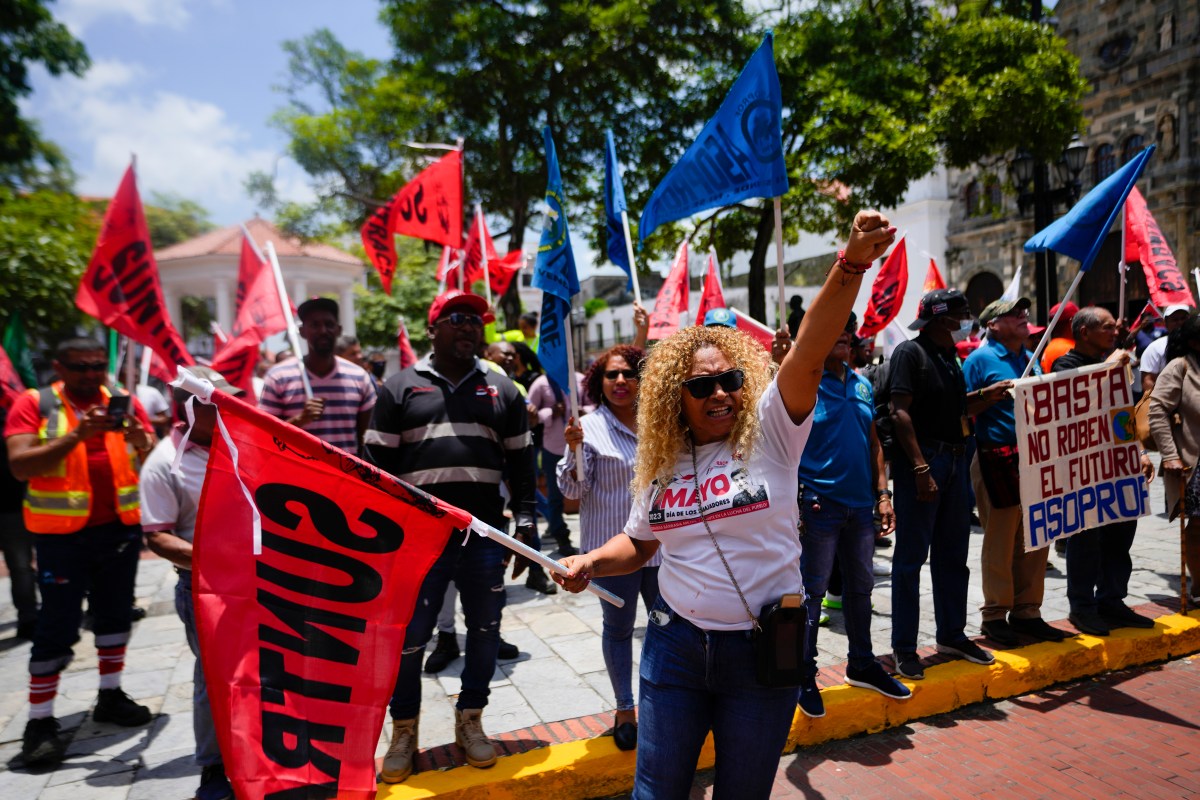
Mass protests erupted in Panama against a government deal with Central America’s largest copper mine over concerns about sovereignty, environmental damage, and the impact on the Panama Canal, Mongabay reported on Sept. 18.
Demonstrations began in early August in Panama City and quickly spread across the nation, uniting various groups, including environmentalists, students, workers’ unions, politicians, Indigenous communities, and campesinos, Mongabay reported.
Thousands marched through the capital city in recent weeks, leading up to a crucial National Assembly vote on the agreement.
The protesters vehemently oppose a new contract between the government and First Quantum Minerals, a Canadian mining company that operates the Cobre Panamá open-pit copper mine in a rural area of Colón province.
The agreement, which was extended for another 20 years, includes terms that require the company to increase royalties to the government to a minimum of $375 million annually and gives the company authority to acquire future land rights.
Protesters say the agreement will allow continued environmental damage and threatens water resources, including the Panama Canal, a crucial shipping passageway, Mongabay reported.
Protesters say it also violates the so-called Escazú Agreement, which requires public involvement through consultation.
“It is a contract to basically completely put up for sale our entire national park system and watersheds that are critical for the survival and operation of the Panama Canal,” said Juan Carlos Monterrey, Panama’s former lead climate negotiator and executive director at Geoversity, a non-government organization that supports conservation communities, according to Mongabay. “Ultimately what we’re risking is global trade and global economic stability.”
AUSTRALIA: Insurance network signs partnership deal
One of Australia’s largest insurance networks has reached a partnership with the Indigenous charity organization, Bandu, that officials said will strengthen its commitment to First Nations employment, National Indigenous Times reported on Sept. 19.
The company, Steadfast, is the largest general insurance broker network in Australasia, a region that includes Australia, New Zealand and some neighboring islands in the Pacific Ocean, officials said.
The new initiative with Bandu follows Steadfast’s partnership last year with the EM-Power Foundation to help Indigenous people launching careers and business ventures within the agriculture and food sectors.
Founded by Edward Morgan and Aidan Porter, who is Wiradjuri, Bandu means “fly” in Wiradjuri. It was founded to offer support and resources to young Indigenous people seeking higher education and careers after high school.
The agreement with Bandu includes cultural safety sessions for staff members through the region, officials said.
“It’s been heartening to see and hear the ways Bandu embarks on the journey alongside their participants during one of the most challenging and exciting life stages,” said Robert B. Kelly, Steadfast’s managing director and chief executive.
“The team cares about empowering young First Nations people every step of the way, and this is an ethos we’re delighted to support.”
In 2019, Steadfast acquired a 26 percent take in Origin Insurance, which was founded and run by Aboriginal people. Morgan, the managing director of Bandu, said the agreement demonstrates a sincere commitment to the cause.
“It is exciting to be able to offer our young participants the opportunity to join a professional workplace that is also a culturally safe and caring community,” he said, according to National Indigenous Times.
CHINA: UN members told to skip human rights panel
In what a Human Rights Watch official called “shocking bad behavior,” China warned United Nations member states against attending a panel on human rights abuses in Xinjiang organized by a think tank and two rights groups during the U.N. General Assembly, according to the National Review. Radio Free Asia reported on Sept. 19.
The event, organized by the Atlantic Council, Human Rights Watch, and Amnesty International, will likely bring increased pressure on China to halt its repression and violence against predominantly Muslim Uyghurs and other Turkic minorities in the far-western region of China, Radio Free Asia reported.
The UN General Assembly began Sept. 19 and will run through Wednesday, Sept. 26.
“A major pillar of the U.N.’s mandate is the protection of human rights, so for a U.N. member state to intimidate other member states to not discuss or attend even a meeting on the U.N.’s mandate is incredibly shocking behavior or shocking bad behavior from the Chinese government,” said Maya Wang, associate director of the Asia division at Human Rights Watch, according to Radio Free Asia.
China referred to the three co-sponsors as “notorious anti-China organizations” and emphasized its stance against any interference in its internal affairs.
“They are obsessed with fabricating lies and spreading malicious disinformation about Xinjiang with no respect for truth, and are plotting to use human rights issues as a political tool to undermine Xinjiang’s stability and disrupt China’s peaceful development,” according to a Sept. 14 letter.
Human rights and Uyghur advocacy groups have lambasted the U.N. for its lack of substantive action in holding China accountable for abuses. Despite a report a year ago, which indicated potential crimes against humanity, they argue that the international body has taken minimal steps, Radio Free Asia reported.
My final thoughts
My final thoughts are in Panama where mass protests have erupted condemning the government’s pact with Central America’s largest copper mine.
Demonstrators have raised pressing concerns over sovereignty, environmental devastation, and the far-reaching implications for the crucial shipping canal, the Panama Canal.
To chart a way forward, it is imperative that the government engages in open dialogues with Indigenous communities and environmental organizations. Collaboration must center on sustainable practices, stringent environmental regulations, and equitable sharing of resources.
Respecting human rights should be paramount, with a focus on protecting Indigenous land and addressing any potential harm to vulnerable populations.
By prioritizing these principles, Panama can forge a path forward that respects human rights, safeguards the environment, and ensures equitable development.

Our stories are worth telling. Our stories are worth sharing. Our stories are worth your support. Contribute $5 or $10 today to help ICT carry out its critical mission. Sign up for ICT’s free newsletter.

