Deusdedit Ruhangariyo
Special to ICT
Around the world: Western Australia’s parliament apologizes for long-standing exploitation of Aboriginal workers, Finland extends the work of its Sami Truth and Reconciliation Commission, and a Māori leader guides intergenerational healing at the United Nations COP28 summit
AUSTRALIA: WA parliament agrees to pay reparations
Western Australia’s parliament issued an historic apology and agreed to reimburse Aboriginal and Torres Strait Islander workers who were exploited between 1936 and 1972 under a system that some leaders compared to “slavery,” National Indigenous Times reported on Nov. 28.
Help ICT make strides in 2024. Our goal is to raise $150,000 by the end of the year with generous contributions from funding partners and collaborators like you. We’re thankful for your support, and we’re thriving because of it. DONATE TODAY!
The apology acknowledged decades of withheld wages and payments of up to $165 million to the workers – mostly stockmen – or their surviving family members, according to Tony Buti, the minister of Aboriginal affairs.
Western Australia Premier Roger Cook introduced the motion, saying it “doesn’t change what happened,” but is a crucial step that brings closure to what he called a “shameful” part of Western Australia’s history.
“The fact that this treatment existed for Aboriginal workers for decades is a blight on the legacy of successive governments,” he said, according to National Indigenous Times. “We are sorry.”
The class action was launched in the federal court by Senior Gooniyandi Elder Mervyn Street, who was in parliament to receive the apology.
Divina D’Anna, a Yawuru, Nimanburr, and Bardi member of parliament, said the decades of stolen wages were not accidental and compared the policies, in some cases, to “slavery.”
Aboriginal people served as the backbone of the cattle industry, enabling businesses and non-Indigenous individuals to profit from the exploitation of Aboriginal labor, she said.
Liberal leader Libby Mettam said the exploitation of workers included injustice and mistreatment.
“These workers faced not only economic exploitation, but also the erasure of their dignity and agency,” Mettam said, according to National Indigenous Times. “We are sorry. It is our responsibility as a society to confront this truth, learn from it and ensure such injustice is never repeated.”
Class action member Barbara Moore expressed relief outside of parliament, saying the settlement had taken a long time but that she was glad the government had acknowledged the pain and suffering.
The motion received unanimous support and applause.
FINLAND: Truth and Reconciliation Commission extended
The Finnish government has extended the mandate of the Sami Truth and Reconciliation Commission, citing the need for additional time to ensure the thorough and effective execution of the process, Eye on the Arctic reported on Nov. 27.
“The commission’s work is unique and takes time to implement properly,” the government said in a statement on Nov. 23, according to Eye on the Arctic. “For this reason, the Prime Minister’s Office, the Sami Parliament and the Skolt Sami Siida Council decided to propose that its working term be extended.”
The government announced Nov. 23 that the commission would continue its work through Dec. 31, 2025.
The Sami, an Indigenous people residing in the Arctic regions of Norway, Sweden, Finland, and Russia’s Kola Peninsula — an area known collectively as Sapmi — have a rich cultural heritage deeply connected to their traditional homeland.
In Finland, approximately 10,000 Sami people can be found, though more than 60 percent of them reside outside the Sami homelands. Eye on the Arctic reported.
In 2019, Finland’s government approved establishment of the Truth and Reconciliation Commission to address historical injustices and promote reconciliation, according to Eye on the Arctic.
Work got underway in October 2021 in hopes of examining past assimilation policies and the historical relationship between the Sami people and the Finnish state, which continues to influence Sami language, culture, and their fundamental rights, according to Eye on the Arctic.
The commission is modeled after Canada’s Truth and Reconciliation Commission, which led to sweeping changes and reparations.
Finland’s commission includes two members appointed by the Finnish government, two chosen by the Sami Parliament, and one selected by the Skolt Sami Siida Council.
DUBAI: Indigenous voices at COP28 summit
Indigenous voices have been featured at the COP28 summit, an annual conference on climate known as the Conference of the Parties to the UN Framework Convention on Climate Change.
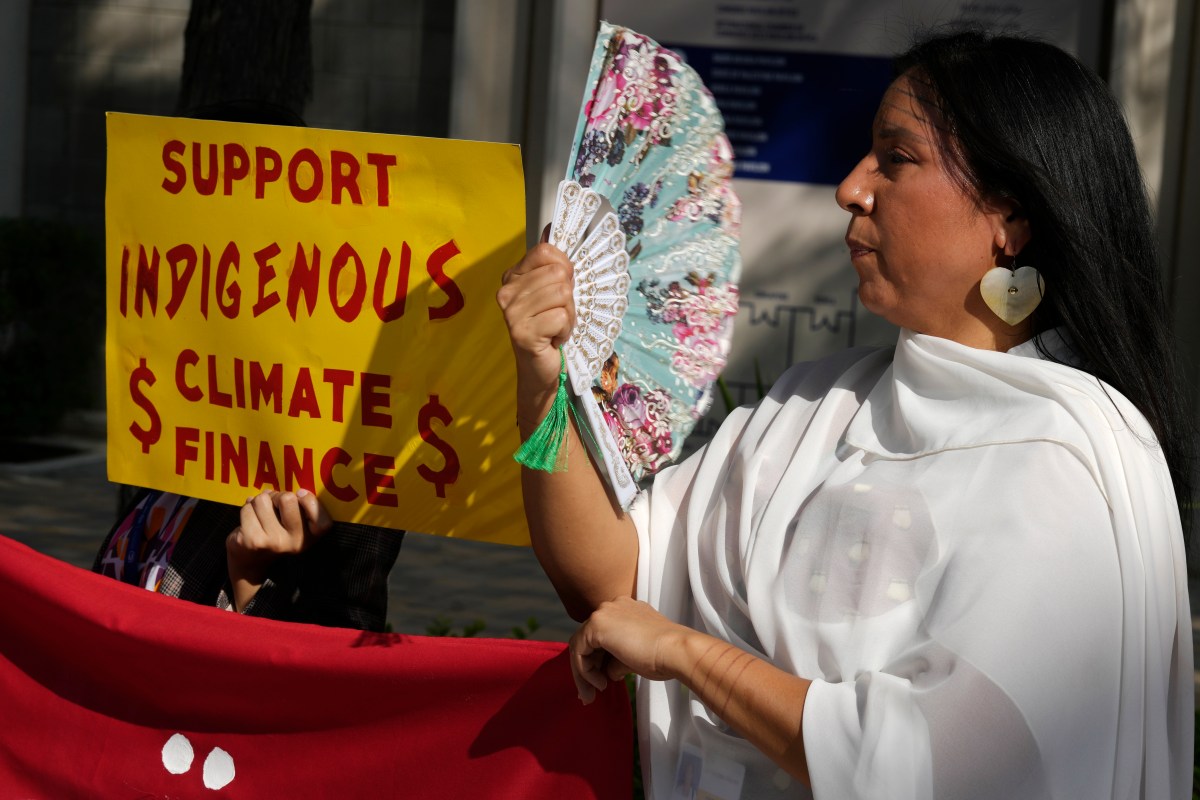
The gathering, held from Nov. 30 to Dec. 12 in Dubai, included a protest on Tuesday, Dec. 5, by Indigenous activists in support of Indigenous rights.
The protesters called for climate funds to be directed to Indigenous peoples and that a fund be created for prevention to avert loss and damage, The Associated Press reported.
And as the conference was starting, Māori healing expert Kim Eriksen-Downs spoke to leaders at the United Nations COP 28 summit to discuss the potency of Indigenous healing, Te Ao Māori News reported on Nov. 28.
Ericksen-Downs, from the town of Taupō on New Zealand’s North Island, was featured on a panel discussion with Richard Kay, New Zealand’s ambassador to the United Arab Emirates, and Slovenian Ambassador Natalia Al Mansour, at Dubai’s Expo City.
Eriksen-Downs and Kay were invited by Dr. Saša Božič, co-founder of the Green Heart Foundation, and featured in her book “One World, One Family,” which explores Indigenous wisdom from 11 tribes worldwide, including the Māori people, Te Ao Māori News reported.
“Respecting the rights, cultures, and self-determination of Indigenous peoples is a fundamental aspect of human rights and global efforts towards inclusivity, justice, and social sustainability,” Božič says in the book, according to Te Ao Māori News.
Eriksen-Downs, a seasoned healing leader, is part of Te Pūkitahitanga, an independent ministerial advisory group dedicated to preventing family violence and sexual violence, Te Ao Māori News reported.
“The focus for me was what Indigenous practices from te ao Māori could I share that are transformative in mental wellness and family and sexual violation, because it’s all connected,” she said, according to Te Ao Māori News reported.
My final thoughts
My final thoughts are in Western Australia, where the government has reached an historic agreement to reimburse up to $165 million to eligible Indigenous workers or their surviving relatives for decades of exploitation. It is a commendable step in addressing historical injustices.
The exploitation of Indigenous workers, mainly stockmen, between 1936 and 1972, is a deeply regrettable part of Australia’s history. Such exploitation should never have occurred in the first place.
To further promote reconciliation and rectify historical wrongs, it’s crucial for governments to continue acknowledging past injustices, invest in Indigenous communities, and implement policies that support economic and social empowerment.
Education and awareness programs can also play a vital role in fostering understanding and empathy among all Australians.

Our stories are worth telling. Our stories are worth sharing. Our stories are worth your support. Contribute $5 or $10 today to help ICT carry out its critical mission. Sign up for ICT’s free newsletter.