
Felix Clary
ICT + Tulsa World
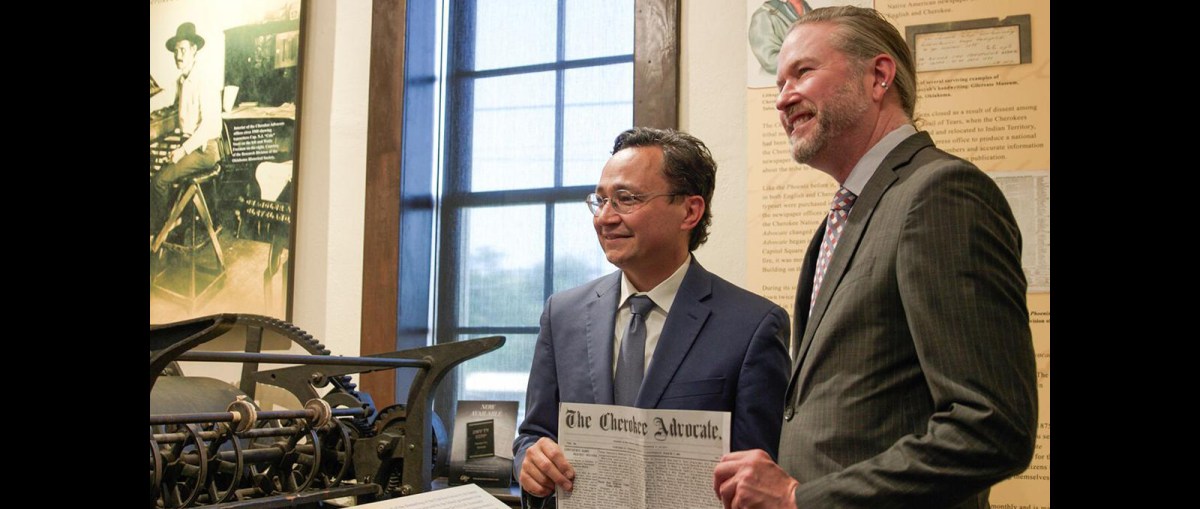
TULSA, Okla. – In a symbol of triumph over censorship and the erasure of Native languages, the historic press that published the Cherokee Advocate in Tahlequah is moving back into the hands of the Cherokee Nation.
The Gilcrease Museum, operated by the University of Tulsa, is among museums across the nation working to voluntarily repatriate items of tribal significance back to tribal nations. Cherokee Nation and Gilcrease Museum leaders celebrated the repatriation of the 149-year-old printing press Aug. 6 at the tribe’s Supreme Court Museum in Tahlequah, where the press is now housed.
“Like many tribes across Indian Country, the Cherokee Nation has been stripped of numerous historic belongings over the past century at the direction of the federal government,” Cherokee Nation Principal Chief Chuck Hoskin Jr. said in a press release. “It’s truly inspiring that Gilcrease Museum has voluntarily offered to return this historic piece of our identity to its origins, back into the hands of the tribe.”
The Cherokee Nation’s first newspaper began in 1828 in the capital of the tribe’s ancestral homelands, New Echota, Georgia. The Cherokee Phoenix was the first bilingual newspaper in America, with an English-language printing press also capable of publishing the Cherokee syllabary. After President Andrew Jackson forced the Cherokee Nation to migrate from their homeland, the Georgia state militia dumped the printing press into a well.
In their new capital in Tahlequah, the Cherokee Nation launched a new bilingual newspaper; the Cherokee Advocate published until the federal government closed it in 1906.
The modern Cherokee Phoenix, according to Executive Editor Tyler Thomas, also publishes many articles in both English and Cherokee.
“The ancestors and peoples who started the paper fought so hard to have a newspaper in general. When removal came about, they lost it, then fought again to establish it again in Indian Country and the present-day reservation,” he said in an ICT + Tulsa World interview.
Having the Cherokee Advocate printing press returned to the tribe was a “full circle moment,” Thomas said. It symbolizes an end to not only the censorship of tribal media, he said, but also the federal government’s efforts to erase Native languages.
“It stands as a symbol of that dedication to keeping citizens informed, and also informing the non-Cherokees about the efforts of the Cherokee Nation,” Thomas said. “Everything the nation has to offer contributes to the greater good of Oklahoma.”
A state named Sequoyah
Mark Trahant, author of “Pictures of Our Nobler Selves: A History of Native American Contributions to News Media,” said the Cherokee Advocate may have been closed due to an ongoing debate in 1906 related to the “twin territories.”
Oklahoma was at one time separated into Indian Territory and Oklahoma Territory. Congress wanted a united Oklahoma, but tribal nations drafted a constitution for a new state named Sequoyah.
“It was actually a really great constitution with lots of progressive ideas,” Trahant said. “But the government feared it would put more Democrats into the Senate because Oklahoma at the time was really democratic. So they blocked the admission of Sequoyah into the United States and started putting pressure on the tribes to be a part of Oklahoma.”
The government sold the Cherokee Advocate press in 1911 to the owner of the Fort Gibson New Era. The printing press eventually ended up in a news office in Wagoner and was purchased in the 1940s by art collector Thomas Gilcrease. In 1958, Gilcrease deeded his American artifacts collection to the city of Tulsa, and those items have since been housed in the museum named for him.
“Returning this vital artifact to the Cherokee Nation is an important step we can take as a government to restore the significant history the printing press brings to the Cherokee people,” said Tulsa Mayor G.T. Bynum in an official statement, as the press was returned in August. “We acknowledge and honor the resilience of the Cherokee Nation, and we are glad to be part of this reunification.”
The Cherokee Advocate returned as a monthly paper in 1977 and rebranded in 2000 as the Cherokee Phoenix, reporting on tribal government, current events, culture and history.

This story is co-published by the Tulsa World and ICT, a news partnership that covers Indigenous communities in the Oklahoma area.
Our stories are worth telling. Our stories are worth sharing. Our stories are worth your support. Contribute $5 or $10 today to help ICT carry out its critical mission. Sign up for ICT’s free newsletter.

