

Darsha Dodge
Rapid City Journal
A fight years in the making to save the historic Sioux San Hospital building took a major blow Thursday, April 6, as demolition began despite ongoing efforts to prevent the building’s demise.
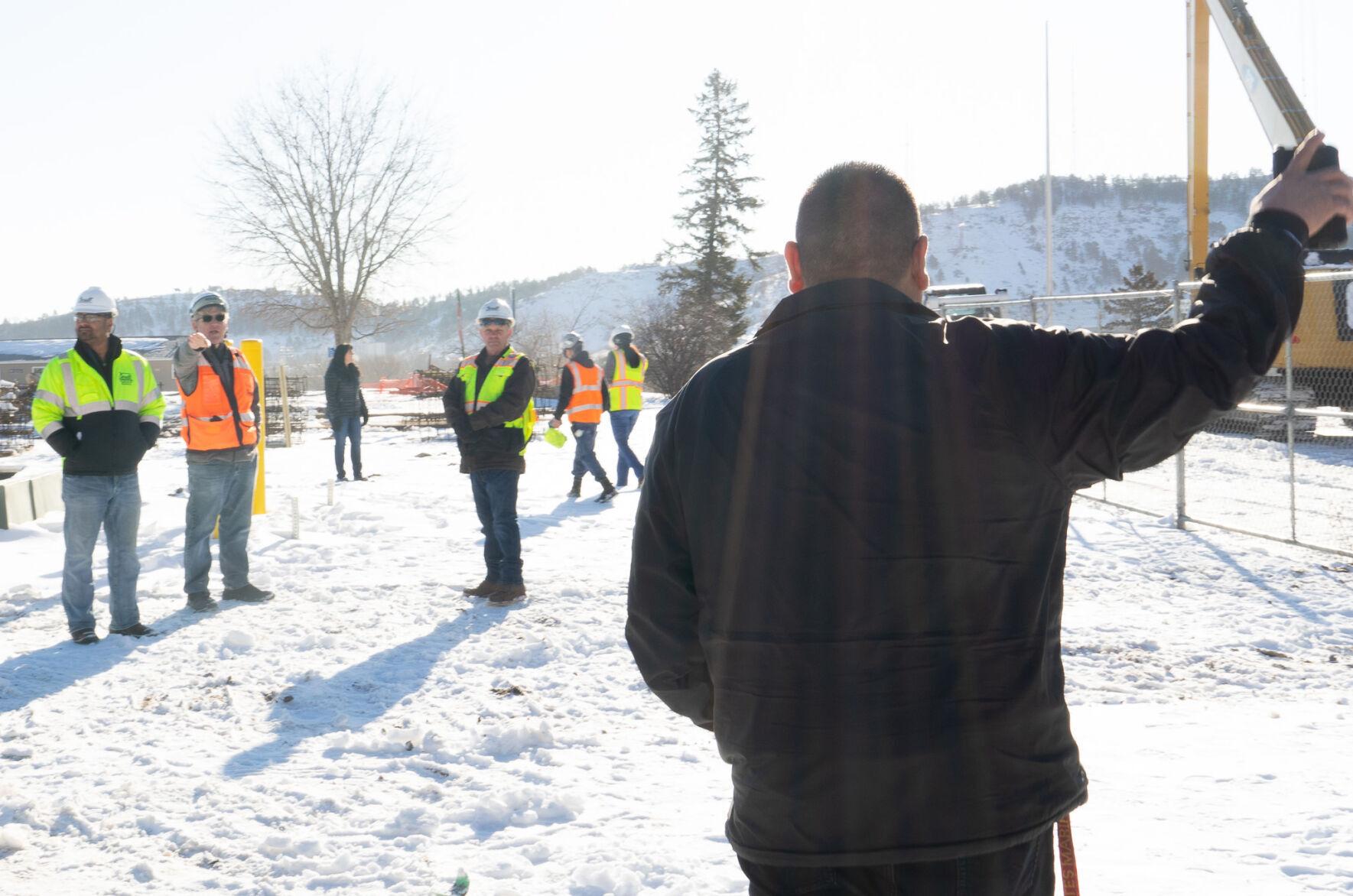
Around a dozen people showed up just in time to witness two excavators begin the weeks-long demolition and clean-up planned for the building. Clouds of dust and shards of twisted metal rained down onto the ground below as the grating sounds of heavy machinery echoed across the hilltop.
Oglala Sioux Tribe President Frank Star Comes Out arrived at the Sioux San Hospital building just after 8 a.m. Thursday. In a tense interaction with construction personnel, Star Comes Out said he and his attorney, Mario Gonzalez, had talked with IHS that morning and were told operations would be stopped.
A construction worker replied to Star Comes Out and said without a written stop-work order, demolition would continue.
“They’re not supposed to demo; they started early,” Star Comes Out said. “I don’t know if this was planned.”
After a brief pause, the demolition resumed. An elderly woman wiped tears from her eyes as she watched.
In a Facebook post Thursday afternoon, Star Comes Out condemned the actions of the federal government and called on IHS Director Roselyn Tso to stop the demolition until discussions can be had with tribal governments.
“I believe the action taken by the government was misleading, disrespectful and insulting to the president of [the] Oglala Sioux Tribe, Chairman of the Great Plains Tribal Chairmen’s Association, and the people,” Star Comes Out said. “I believe we need to be better communicators amongst each other and work together for the betterment of the people.”
Donna Gilbert, a leader in the movement to save the historic Sioux San Hospital building from the beginning, said she hand-delivered an injunction to the U.S. Attorney’s Office Wednesday.
No injunction was on the federal court’s electronic filing system as of Thursday afternoon, but that does not mean one wasn’t filed.
In late March, Gilbert requested an injunction to stop the demolition on the grounds IHS contracted out the project before making the plan public to Rapid City’s Indigenous community.
U.S. District Judge Charles Kornmann dismissed the injunction Monday because it wasn’t formatted with correct legal wording, it failed to certify the efforts made to give notice to the defendants, it failed to establish federal jurisdiction, and failed to include their phone numbers as required by law, according to his ruling.
The defendants argued they would lose $21,000 a day for any delays on the demolition, leading Judge Kornmann to require a $365,000 bond during any proceedings.
Gilbert told the Journal witnessing the demolition was emotional because of their impassioned efforts.
“I woke up [Wednesday] and said, ‘I’m not done fighting, and I need to go file another injunction and make those corrections,’” she said. “I filed a new injunction — not a re-file — and I hand-delivered the complaint and the summons to the second floor to U.S. Attorney Alison Ramsdell.”
Gilbert shared Star Comes Out’s frustrations around the lack of communication and transparency between IHS and the Indigenous people in Rapid City. She said in response to their March injunction, the government said the decision to take down the buildings had already been made, but later opened the project up for public comment, with Gilbert calling it “too late.”
“I feel like that public comment should have been posted on the Federal Register and should have stayed on there for a year… this whole project was behind closed doors,” she said.
Instead of being destroyed, Gilbert suggested repurposing the building into a homeless shelter or even a museum. Some people get assistance from the tribes to travel to Rapid City and stay overnight for early appointments, while others get discharged and don’t have a ride home immediately.
She said using part of the building as a cheap hotel could help alleviate those concerns.
“There’s a lot of different things that could have been done,” Gilbert said. “It was big enough to host different things.”
As an emotional Gilbert stood by watching the work, she said the fight isn’t over.
“I can only stand here and pray that the machines stop.”
Gilbert previously led a separate effort to invalidate the 638 contract, which the Great Plains Tribal Leaders’ Health Board used to assume control of the Rapid City Indigenous health care facilities.
Larry Brewer’s family moved to Rapid City after the 1949 blizzard. He had an uncle that went to the boarding school at Sioux San and later a cousin in the sanatorium with tuberculosis.
As an emotional Gilbert stood by watching the work, she said the fight isn’t over.
“I can only stand here and pray that the machines stop.”
Gilbert previously led a separate effort to invalidate the 638 contract, which the Great Plains Tribal Leaders’ Health Board used to assume control of the Rapid City Indigenous health care facilities.
Larry Brewer’s family moved to Rapid City after the 1949 blizzard. He had an uncle that went to the boarding school at Sioux San and later a cousin in the sanatorium with tuberculosis.
“It was where they brought our people to come die, basically,” Wohpe said. “I’m excited to see it come down, and they can build a whole new building on top of this that doesn’t have the memories and the energy and all this hurt and pain our people went through in these buildings.”
Claymore, saying she represents the younger Indigenous generation, wants the negative energy and memories gone.
The brown-and-tan brick building, which stood on a hill overlooking west Rapid City, was built in 1898 for use as an Indian boarding school. The school, like many across the United States, worked to assimilate Native children into mainstream society, often through abuse and punishment for speaking native tongues, having long hair or practicing cultural traditions.
At least 40 children died at the school, with names sometimes not recorded and families not identified. Many of the children were buried in unmarked graves.
The boarding school history is often called Rapid City’s “inconvenient truth.”
The school was closed for good in 1933 and functioned as a Civilian Conservation Corps camp for several years. Sioux Sanatorium opened in 1938 and was a tuberculosis clinic for Native Americans until the 1960s.
The hospital became part of the Indian Health Service in 1955, continuing IHS control until the tribes took over in 2019. The new, $120 million Oyate Health Center opened in February 2023.

Shalom Baer Gee contributed to this report.
This article was first published in the Rapid City Journal and was republished with permission.

