
You can help elevate meaningful stories from Indigenous nations when you support ICT during Arizona Gives Day! ICT is headquartered in Arizona, and covers the Indigenous world across North America. Help us reach our goal to raise $10,000 for reliable, compelling, Indigenous-led journalism in Arizona and beyond.
Chris Lomahquahu
ICT
SALT RIVER, AZ. — Martin Harvier took to the mound at the Salt River Fields at Talking Stick with more than one pitch in mind.
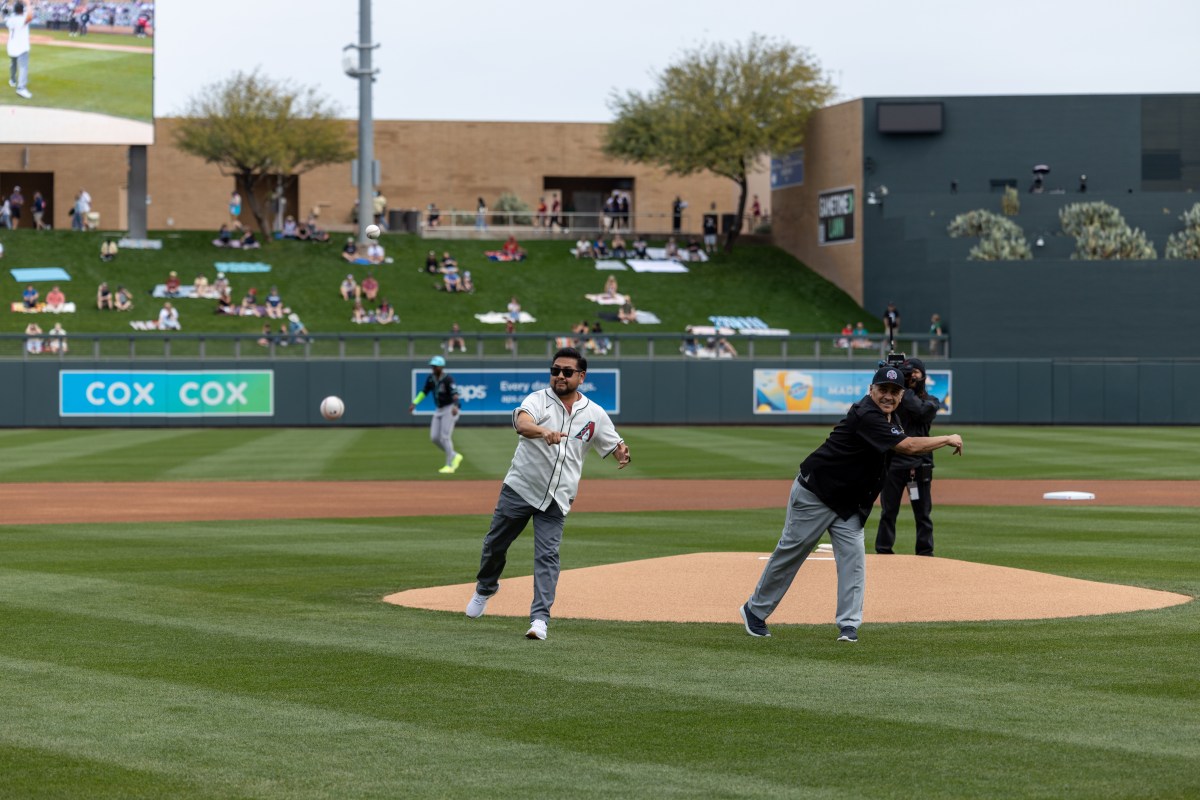
As president of the Salt River Pima-Maricopa Indian Community, Harvier was set to throw a ceremonial first pitch for the spring training home opener at the ballpark, which plays host to the Arizona Diamondbacks and Colorado Rockies.
SUPPORT INDIGENOUS JOURNALISM. CONTRIBUTE TODAY.
But he also needed to show visitors that Major League Baseball can draw tribal citizens and tourists alike to the scenic facility, the only tribally owned stadium in the U.S. to host two MLB teams.
Harvier aced both pitches.
“Our relationship with the Diamondbacks and the Rockies and the events that they put on here in the community — that’s a valuable partnership,” Harvier told ICT later. “It creates opportunities for community members to interact with the teams, including our youth, which gives them something to think about as a career in sports.”
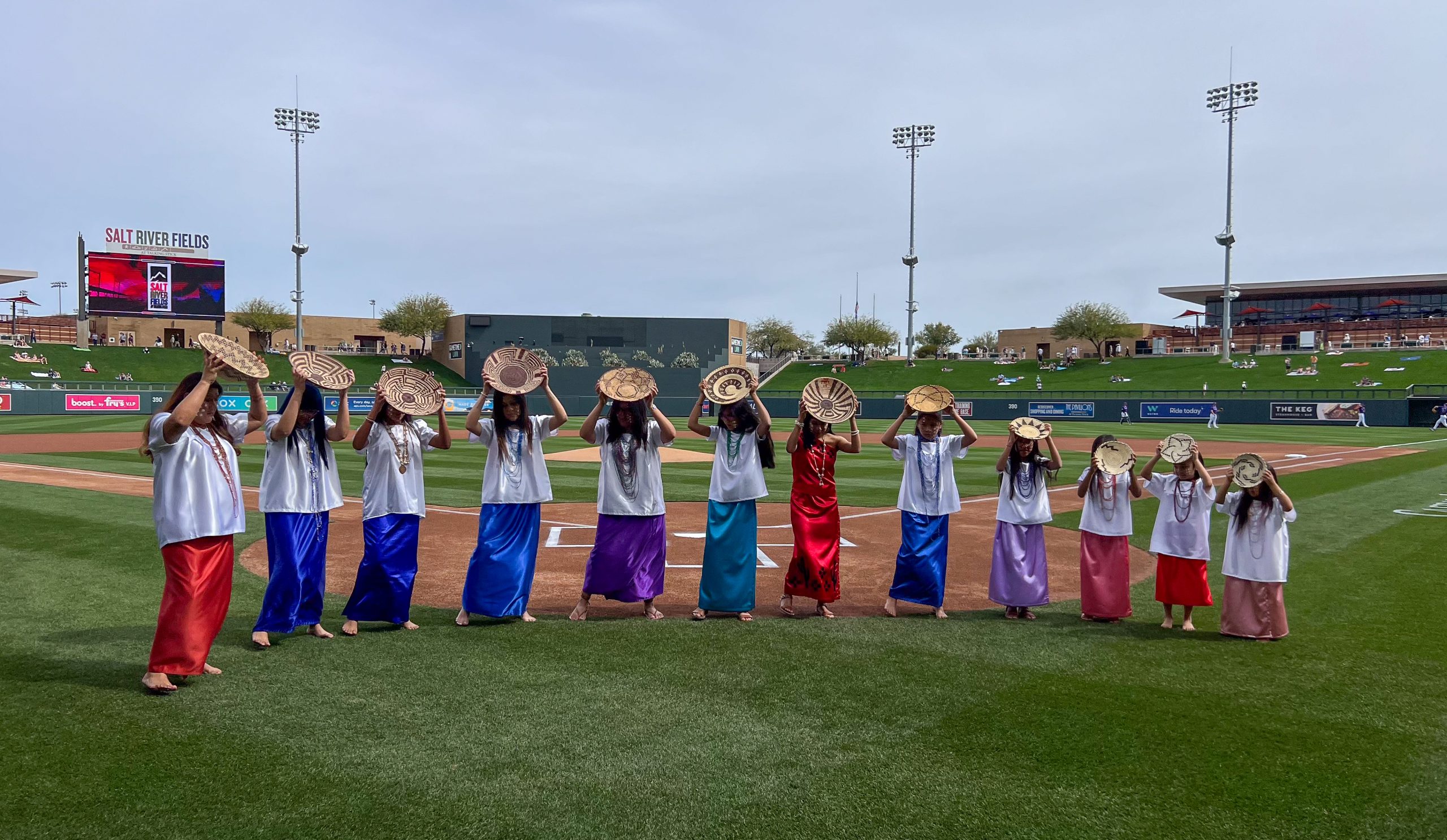
The spring training opening day events on Saturday, Feb. 23, featured O’odham and Piipaash culture, including a performance by traditional basket dancers, who performed on the field ahead of the national anthem and the ceremonial first pitch.

Local artisans were also featured, with live demonstrations of their work, including traditional O’odham basketry by Reann Brown, Alice Manuel and August Wood, and paintings by Dwayne Manuel. And former Miss Indian Arizona for 2022-2023, Sistine Lewis, sang the national anthem in the Akimel O’odham language.
The opening day events brought hundreds of visitors to watch the festivities and the game between the Diamondbacks and the Rockies, with the D’Backs falling to the Rockies 0-3. A few weeks later, a Fan Appreciation Day on March 18 drew hundreds more.
It is one of two stadiums in the Phoenix area, with Scottsdale Stadium hosting the San Francisco Giants for spring training, which ended March 26.
Salt River Fields also ranks number 1 in attendance for all MLB spring training facilities, and has set nine spring training attendance records, with more than 140 sellouts in nine seasons, according to the stadium website.
‘Inspired’
The Salt River Pima-Maricopa Indian Community partnered with the Diamondbacks and the Rockies to build Salt River Fields, which opened in 2011 as the first Major League Baseball venue built on tribal lands.
It is nestled east of Phoenix among the McDowell Mountains, Four Peaks, Red Mountain, the Superstition Mountains and Camelback Mountain.
Salt River Fields has been cited, along with Scottsdale Stadium, as among the five best spring training facilities in the country by USA Today, which noted the Salt River architecture was “inspired by traditional Native dwellings.”
“One of baseball’s largest spring training stadiums, the ballpark features mountain views and a bounty of concession options, located near Talking Stick Resort and Casino,” USA Today reported.
The Salt River complex includes the 11,000-seat ballpark, with 4,000 lawn seats; 12 practice fields; and buildings that include major and minor league clubhouses, training facilities and offices for each team, according to the stadium website.
The $100-million complex, which is spread across 140 acres near the tribe’s Talking Stick Resort and Casino, features a roof patterned after a traditional Native ramada and a rooftop hospitality space.
The logo, designed by local Salt River artist Royce Manual, incorporates a rattlesnake design to evoke the Arizona team’s logo as well as a mountain to represent the Colorado Rockies. Talking Stick is a reference to the traditional Pima calendar stick on which carvers recorded historical events and milestones, according to the website.
It was named “Ballpark of the Year” in 2011 and “Spring Training Ballpark of the Decade” in 2019 by Ballpark Digest, and has been recognized by the Baseball Hall of Fame & Museum as the first Major League Baseball facility on Native lands, according to the website.
It has also received a Leadership in Energy and Environmental Design, or LEED, gold certification, from the U.S. Green Building Council.
Harvier said the tribe decided to invest in the spring training facility in about 2008-2009, when the nation’s economy was in crisis. Many of the shops that were located at the Pavilions at Talking Stick had shuttered due to the slow economy, except for the Home Depot and Target that were still operating at the time.
Now, nearly 14 years later, the number of visitors to Salt River Fields continues to increase and the area is bustling with activity, with spring training in full swing.
“It just seems to be a really prime location to have spring training,” Harvier said, “being around 15 minutes from Sky Harbor International Airport, [with] freeway access and other nearby venues.”
Looking ahead
The Spring Training Opening Day at the facility was part of a three-game weekend for the Diamondbacks, who are the reigning National League Champions. The weekend featured back-to-back games on Feb. 23 and Feb. 24 between the Diamondbacks and the Rockies, with each team taking a turn as the home team. And then the Diamondbacks played another home game in the stadium against the Chicago White Sox on Feb. 25.
The benefits the tribe receives from the stadium go beyond the exposure and economic benefits, Harvier said.
“When you look at it, not just from the business side, but just from the community side, and how that connects with our community members,” he said.
The facility helps the tribe bridge partnerships with other businesses and is a way to showcase the community’s culture to those who are new to the area.
It also provides outreach to the local community. The Diamondbacks each year host an Inter-Tribal Youth Baseball & Softball Tournament in July, drawing Indigenous youth ball teams from across the state of Arizona.
“It’s created a larger opportunity for the kids who are playing ball to create relationships outside of just our sister tribes,” Harvier said. “I really look forward to the future because I see a lot more Native Americans playing at the collegiate level and even professionally.”
Harvier had hoped to practice before the game, but couldn’t get it in. He made it over the plate, anyway.
He was joined at the pitcher’s mound by Doran Dalton, assistant community manager for the tribal government.
“We see a good opportunity here for the community with the Arizona Diamondbacks and the Colorado Rockies,” Harvier said.

Our stories are worth telling. Our stories are worth sharing. Our stories are worth your support. Contribute $5 or $10 today to help ICT carry out its critical mission. Sign up for ICT’s free newsletter.

