
This article first appeared in the Daily Montanan.
Keila Szpaller
Daily Montanan
Before the Hope Hospice Center opened in Missoula in July, people working on the project toured different facilities in the country looking for ideas.
Betsy Wackernagel Bach, chairperson of the Partners Hope Foundation, said hospice supporters in Montana toured seven different places, and they quizzed those who had forged the path.
“We asked them: What did they like? What didn’t they like? What did they wish they had done?” Bach said.
Then, when the in-patient hospice in Billings closed, Amanda Yeoman Melro, executive director of Partners Hope Foundation, said she called to learn their lessons, and Billings was ready to share.
In their research, the team learned that it was just as important to plan for sustainability as it was to plan to open a hospice. They learned that families are as integral to the mission as their loved ones, even that it’s advisable to have multiple USB ports in a room and couches that convert into beds.
Now, four months after opening its doors to families across Montana, the Hope Hospice Center has served more than 100 patients and their families, exceeded a $15 million capital campaign by $200,000, and it’s embarking on its next phase, to connect with referral sources that will help keep the center open and make good on its mission.
“Hope Hospice Center is a community promise to care for our neighbors through all of life’s stages,” Yeoman Melro said.
Up next?
“We’re moving into sustainability,” Yeoman Melro said.
Indeed, sustainability is an intrinsic part of the project, Bach said; the team wanted to not only build a center, but ensure it could stay open, and it saw this value as key.
“Sustainability became our mantra,” Bach said.
Only in-patient hospice in western Montana
The Hope Hospice Center is the only in-patient hospice facility in western Montana, and since RiverStone Health Hospice Home closed in Billings in June 2024, it is one of just two in-patient hospice centers in the state, Yeoman Melro said.
The other is in Great Falls, Benefis Peace Hospice of Montana, part of the Benefis Health System.
The Missoula center serves people from across the state and beyond, Yeoman Melro said. For example, if a Missoula resident has a family member who lives out of state but needs help in Montana, that family member can be a patient here.
The recent closure and the demographics of Montana make the center especially important, Yeoman Melro said.
“Montana is a huge state, and our population is aging quicker than others, and a lot of our seniors — (an estimated 40%) — live alone,” Melro said. “We see a lot of people who don’t really have a lot of family around.”
In 2017, the Partners Hope Foundation formed, put together by a group of community members and medical professionals dedicated to opening a hospice center “owned by the community,” not a large medical system.
Yeoman Melro said a land donation by community philanthropists Terry and Patt Payne helped kickstart the project, and Bach said an article in The Atlantic about how corporate medicine was dragging down hospice care showed the importance of sustainability.
The idea led to a partnership with a nonprofit provider, Partners In Home Care, and it also helped lead to the Compassionate Care Fund, which collects donations and supports patients who can’t afford the cost of regular care.
The center takes insurance, and it offers a sliding fee scale for room and board fees for residential patients. Hospice care is most often covered by the Medicare Hospice Benefit, Medicaid Hospice Benefit, Veterans Affairs benefits, Indian Health Service and private insurance plans.
The center offers general in-patient care for patients who need intensive 24-hour medical management; residential hospice for those who need more support than caregivers at home can offer; and respite care, a five-day admission that gives a primary caregiver temporary relief.
In July, supported by 800 donors, the center opened on the west side of town a couple of blocks off of Reserve Street, a main thoroughfare in Missoula.
It has 12 individual patient rooms, plus other spaces in 15,000 square feet, such as a room for children; snack bar offering soup and cookies 24 hours a day; living area with fireplace, library and educational resources; staff offices; and more.
The center opened with six patient rooms in operation, and Yeoman Melro said the goal is to be full by July 2026 with all 12 rooms occupied. It operates with 18 staff members, plus volunteers, who Melro said are critical to the operation.
Two nurses and one aide are on duty throughout the day, part of the support from Partners In Home Care, which has a medical director, nurse practitioners, pharmacist, nurses, social workers, chaplains, CNAs and administrators.
At the time the center opened, Corin Schneider, CEO of Partners In Home Care, said the highly skilled team was committed to delivering comprehensive, “whole-person” medical and emotional support for patients and loved ones.
“As Montana’s population continues to age, the need for inpatient hospice services is greater than ever,” Schneider said.
A homey place that looks and feels like Montana
Now that the center is open, the next phase is developing referral sources, Yeoman Melro said. Outreach meetings are taking place with physicians and medical groups, all part of the plan for sustainability.
Ongoing fundraising is important to maintain a reserve fund, refill the Compassionate Care Fund, and support some of the beautification and operational needs of the center, such as for sprinklers on the grounds in common areas.
“This is a startup. These are really expensive to run,” Yeoman Melro said.
Most hospice centers are owned by hospitals or other private providers or existing businesses, but this one is “owned by the community,” or stewarded and supported by community members, Yeoman Melro said, including a board of directors of 19.
(The center was designed to be able to expand in the future as well; for example, the HVAC system can handle another 12 beds down the road, Yeoman Melro said.)
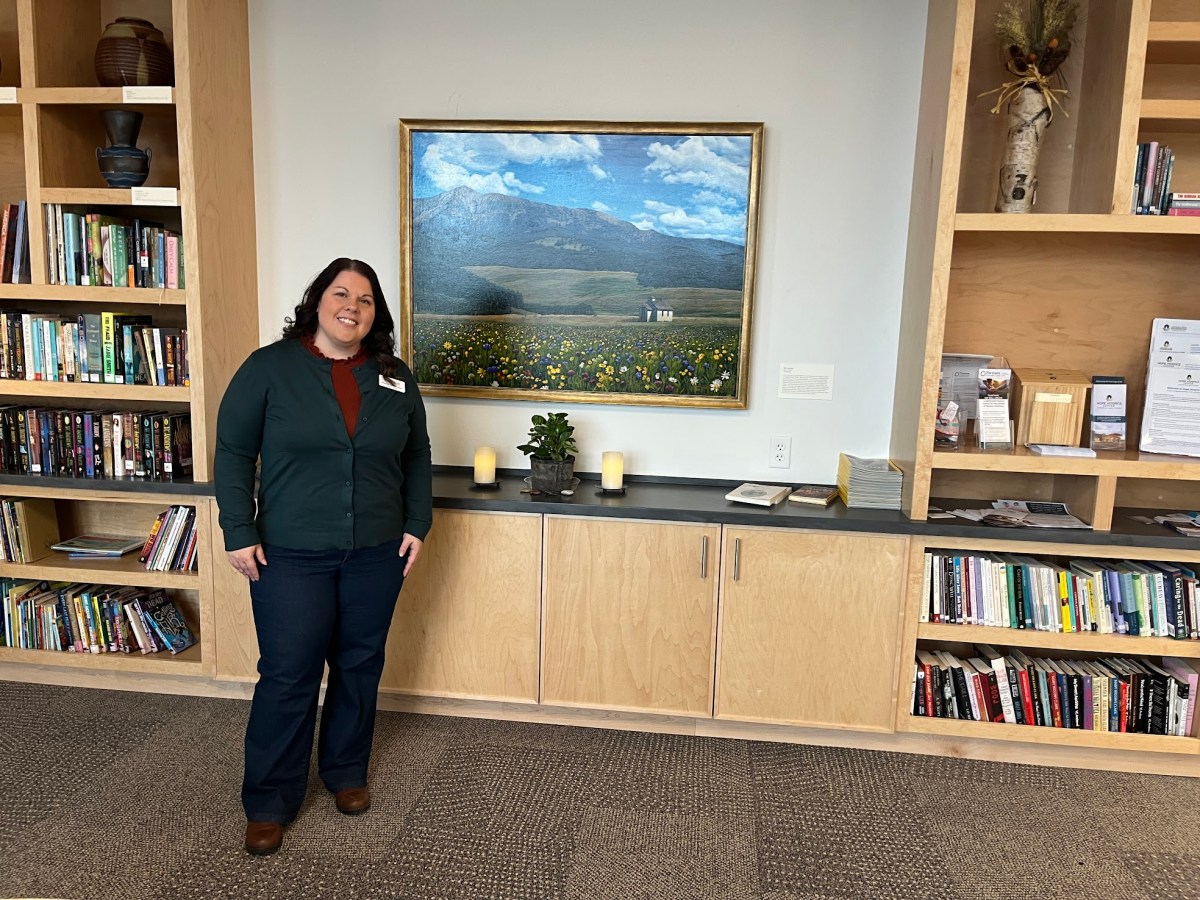
The center was designed to look and feel like Montana, showcase artists from the state, including Indigenous ones, and be more homey than a clinical space, she said.
It has windows that let in natural light, natural wood features, and pieces of art throughout by Montana artists, including Stephanie Frostad, of Missoula, and Aspen Decker, based in Arlee.
Decker was and named one of the state’s top emerging artists this year by the Montana Museum of Art and Culture, which curated additional pieces for the center.
The center has rooms for both patients and families. For example, a spa room has a wash bowl and a bathtub that are easy for patients and caregivers to use, and in that space, caregivers can clean wounds or help with other needs.
“Sometimes you just need a haircut and a shave,” Yeoman Melro said.
Yeoman Melro said one thing the team learned from other hospices is they had “no place to pause,” no place for families to reflect after their loved ones die, so the Hope Hospice Center created an area with that idea in mind.
It has items for people of all denominations, a room for a chaplain to visit, and a fan for smudging ceremonies, she said.
Bach, board chairperson, said support for families evolved as the team did its research. They found hospice is as much about family care as it is a transition for someone who is at life’s end, and they’ve heard families feel cared for there, and the space feels warm.
Now, they want to get the word out, both that the center is taking patients, and also, that people shouldn’t assume they can’t afford it, given the insurance options and Compassionate Care Fund, Bach said.
“People need to know that we’re open,” Bach said.

