

Sandra Hale Schulman
Special to ICT
The latest: Rock star movie producer is big in Japan, group shows off moods, Native films at SXSW, open bidding for art.
MUSIC: On the cover of Rolling Stone
Stevie Salas, Apache, has been active in film production for several years. He produced the award-winning “Rumble: Indians Who Rocked the World” and more recently ‘Boil Alert.” But his career started as a rock guitarist for big names like George Clinton, Justin Timberlake, Buddy Miles, T.I., Mick Jagger and Rod Stewart. He’s written books, been a TV host, a music director, and record producer. He sold over two million solo albums worldwide and has been cited as one of the top 50 guitarists of all time.
Now he’s getting back to his stage roots as part of the group Inaba Salas, fronted by Japanese singer Koshi Inaba. The duo had to cancel their last tour in 2020 due to the pandemic, but they regrouped for a new album, “Atomic Chihuahua,” and tour titled “Never Goodbye Only Hello.”

The tour title means they are grateful to all the people they have met through their long years of musical activities, and they’ve been met with astounding success – a number one record and cover of Rolling Stone Japan – actually two covers, one in black, one in white.
Salas said, “Over the years I’ve been in Rolling Stone here and there. For things like listed as a Producer for the Was (Not Was) What up Dog record when Rolling Stone listed it as one of the top 50 albums of the decade. Once I was actually edited out of a great photo of me with Bernard Fowler, Keith Richards and Ronnie Wood and that one bummed me out. But I was in and out of the mag during my career with no real significance until 2020 when our 2nd Inaba Salas record was coming out and was #1 on the Billboard chart I finally made the cover. Now to my surprise 5 years later today Inaba Salas is #1 again and I just saw this cover posted on Instagram. Ok all you people out there, I’m living proof… It’s never too late, you are never too old and you can never be too ugly!”
ART: Setting a mood
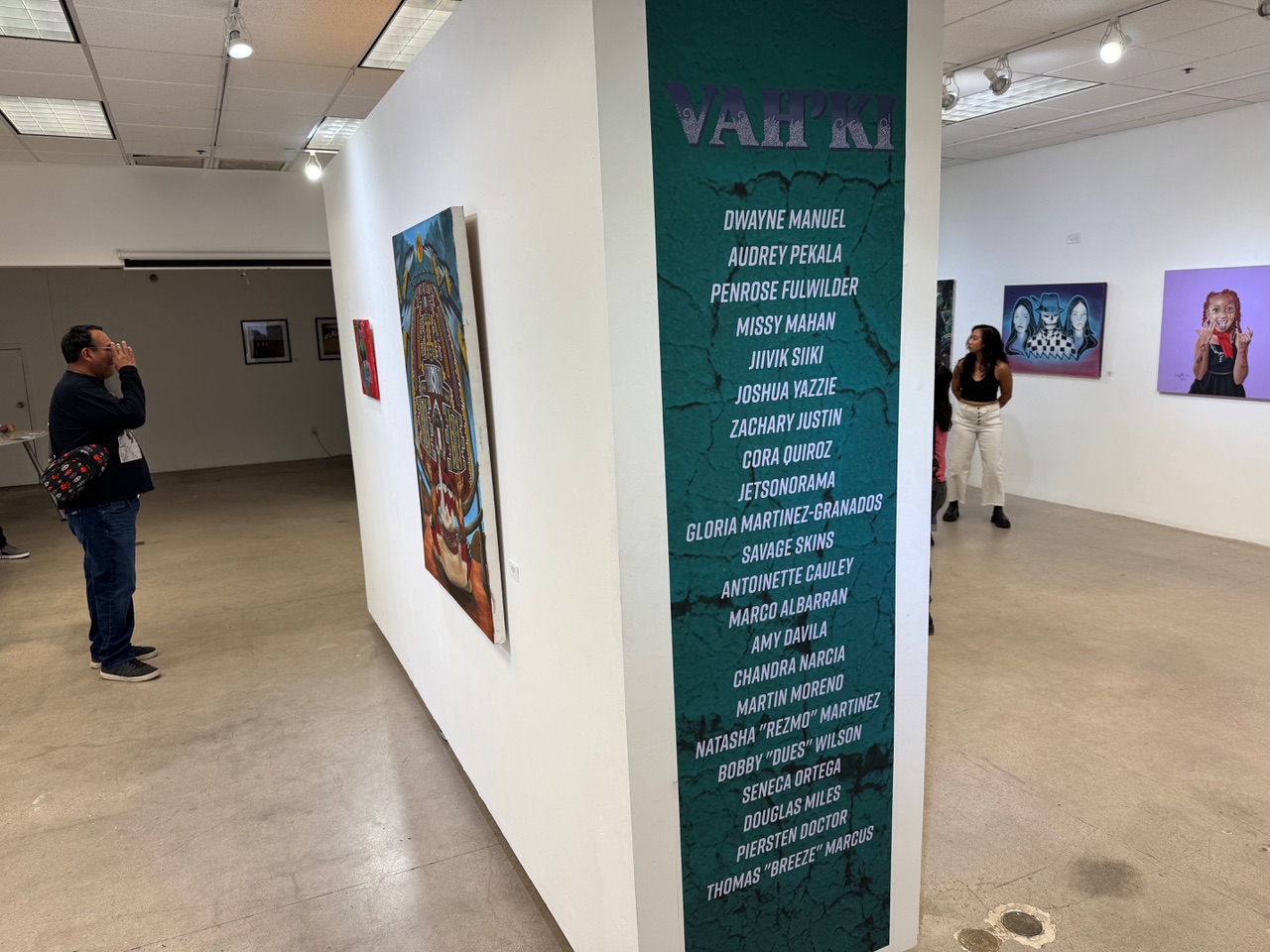
An evolving space in Phoenix since 2020, the mood room gallery at Park Central, has a stellar group show, “Vah’Ki,” through the end of March.
“Vah’Ki” (ancient house or pit house) is an O’odham word that refers to specific ancestral villages that once flourished throughout the area’s valley. The Vah’Ki was a place of gathering for ceremony, trade, games, politics and more.
The mood room is a gallery concept that seeks to address the needs of 21st century artistic practice. More than just a white cube for art, the mood room was founded in 2020 to connect the events and services while expanding support that cultural creatives need to grow their personal visions into transformative art experiences. The mood room is part of Artlink’s ART+FORM project. Read about the project here.
Artlink is accepting proposals for exhibits as well as educational programming, artist talks, community happenings, musical events, spoken word and poetry nights, fashion shows, dance performances, open mics and more.
FILM: SXSW Native film screenings
The annual music and film extravaganza SXSW in Austin screens some intriguing Native films this year.
“Tiger” by director Loren Waters; “The Beguiling” by ishkwaazhe Shane McSauby; “XR Project Ways of Knowing: A Navajo Nuclear History” by Kayla Briet; and “Remaining Native” by Paige Bethmann.
Bee’s film is a coming-of-age documentary told from the perspective of Ku Stevens, a 17-year-old Native American runner, struggling to navigate his dream of becoming a collegiate athlete as the memory of his great-grandfather’s escape from an Indian boarding school begins to connect past, present and future.
“My feature film ‘Remaining Native’ is going to premiere at SXSW alongside some other incredible Indigenous films,” Bethman told ICT. “We are planning on being in solidarity with each other at the festival and connect with local Austin Indigenous communities as a way to combat the ever-present erasure of Native peoples in Texas and our efforts to break down the film industry barriers that exist in Indigenous cinema.”
ART: Cherokee art wanted
The Cherokee Nation recently reauthorized the Cherokee Artist Recovery Act and allocated $1 million for the procurement of Cherokee artwork through 2026. Opportunities are now available, including a public bid for general 2D and 3D work, as well as a request for proposals for a Cherokee Freedmen monument on Capitol Square.
The historic legislation, passed in 2022, was the largest art investment in the tribe’s history, providing $3 million to support the Cherokee art community. To date, it has purchased 521 pieces of art from 170 Cherokee artists.
Both opportunities can be found online at www.CherokeeBids.org. The request for proposals for the Cherokee Freedmen monument, No.153246, closes at 5 p.m. on April 4, 2025. The general art bid, No. 153240, is due by 5 p.m. on May 16. You can also contact Amy Eubanks at amy.eubanks@cn-bus.com with questions or to submit a digital bid.

This story has been corrected to show that Paige’s last name is Bethman and her film is “Remaining Native,” and to fix a spelling error in “Beguiling.”
Our stories are worth telling. Our stories are worth sharing. Our stories are worth your support. Contribute today to help ICT carry out its critical mission. Sign up for ICT’s free newsletter.
