

Sandra Hale Schulman
Special to ICT
The latest: A new music video by top Canadian singers focuses attention on residential school atrocities, a film honors Ponca Chief Standing Bear’s legacy , and Aboriginal bark ark gets a rare exhibition
MUSIC: New video raises call to ‘Bring Them Home’
In a powerful new duet, “Bring Them Home”, two Indigenous singers from Canada deliver some raw truths in a video filmed inside the ruins of a residential school in Wikwemikong First Nation.

Rising star Zigz Gaud, Wikwemikong First Nation, joined with multiple Juno-winning recording artist Crystal Shawanda, Ojibwe Potawatomi, to raise awareness of the ugly history of abuse of children in Canada’s residential schools and draw attention to the unmarked graves where thousands of children have been discovered.
Zeegwan Gaudet, who goes by the stage name Zigz Gaud, grew up in Toronto in an area known as the Melita Co-ops. He discovered his talents for music as a young teen while rapping with his cousins.
Shawanda shot to fame when she was signed to RCA Nashville Records in 2008. She has gone on to win multiple Juno Awards, including Aboriginal Album of the Year in 2013. Her rise as a country singer is documented in a CMT series, “Crystal: Living the Dream.”
FILM: ‘I Am A Man’ highlights Ponca chief’s legacy
The busy Cherokee Nation Film Office along with the state of Nebraska are helping filmmaker Andrew Troy, Chiricahua Apache, bring the story of Ponca Chief Standing Bear to the big screen.

The narrative feature, “I Am A Man: The True Story of Ponca Chief Standing Bear,” will begin filming in historically significant locations around Nebraska and the Cherokee Nation in Oklahoma.
The film was one of the first recipients of the Cherokee Nation’s film incentive program and also received grants, tax incentives and other support from the Nebraska Film Office; the Tulsa Office of Film, Music, Arts & Culture; and the cities of Norfolk and Fremont, Nebraska.
“‘I Am a Man’ is an important Native American story that needs to be told. We are proud to offer our film incentive to such a project,” said Jennifer Loren, senior director of Cherokee Nation Film and Original Content, in a statement. “CNFO looks forward to becoming a hub for Native American storytelling, and this is just the beginning.”
The Ponca Tribe of Nebraska and the Ponca Tribe of Oklahoma have approved the historical drama, which depicts his 1879 trial in which he helped establish the rights for Native Americans to be considered as “human beings” under U.S. law. Prominent Native actors will be starring in the film alongside celebrity actors portraying U.S historical figures.
In 2021, the feature film was an early recipient of the Cherokee Nation Film Incentive and has also received grants, tax incentives and other support from agencies in Nebraska.
“The key plot of our story exists in the heart of the community surrounding Fort Omaha and the actual location where Standing Bear and the Ponca tribe were detained in 1879,” filmmaker Troy said in a statement. “Not only do we get to make a film about Standing Bear’s journey that can reach a worldwide audience, but in doing so, we get to help uplift local communities, provide training and possibilities for ongoing jobs, and encourage tourism in and around Ponca and Cherokee lands.”
SUPPORT INDIGENOUS JOURNALISM. CONTRIBUTE TODAY.
Troy said the film also provided the opportunity for filming on tribal lands with Indigenous cast and crew.
“Working with the Cherokee Nation also gives us the opportunity to film on the tribe’s reservation with Cherokee, Ponca and other Native people who are interested in being involved in the film industry,” Troy said. “It is that much more special to me knowing that I have the trust and support of so many Native people who stand behind this script.”
Troy is directing the film from his Academy of Motion Picture Arts & Sciences 2021 Nicholl’s semifinalist screenplay. The film is based on the book, “I Am a Man,” by Joseph Starita.
ART: Rare bark paintings depict Aboriginal life and lore
Abstract depictions of people, birds, crocodiles, sharks, and kangaroos on sheets of tree bark tell the story of Yolŋu homelands in the first major exhibit of Aboriginal Australian bark paintings to tour the United States.
The show, “Madayin: Eight Decades of Aboriginal Australian Bark Painting from Yirrkala,” debuts Feb. 4 at American University Museum in Washington, D.C., and continues through May 14.
The show offers a unique glimpse into a rarely seen art movement, and was organized by the Kluge-Ruhe Aboriginal Art Collection of the University of Virginia in partnership with the Indigenous-owned Buku-Larrŋgay Mulka Centre in Australia.
Noted as a must-see exhibit by The New York Times, “Madayin” is considered the largest and most important exhibit of Aboriginal Australian art in 30 years.
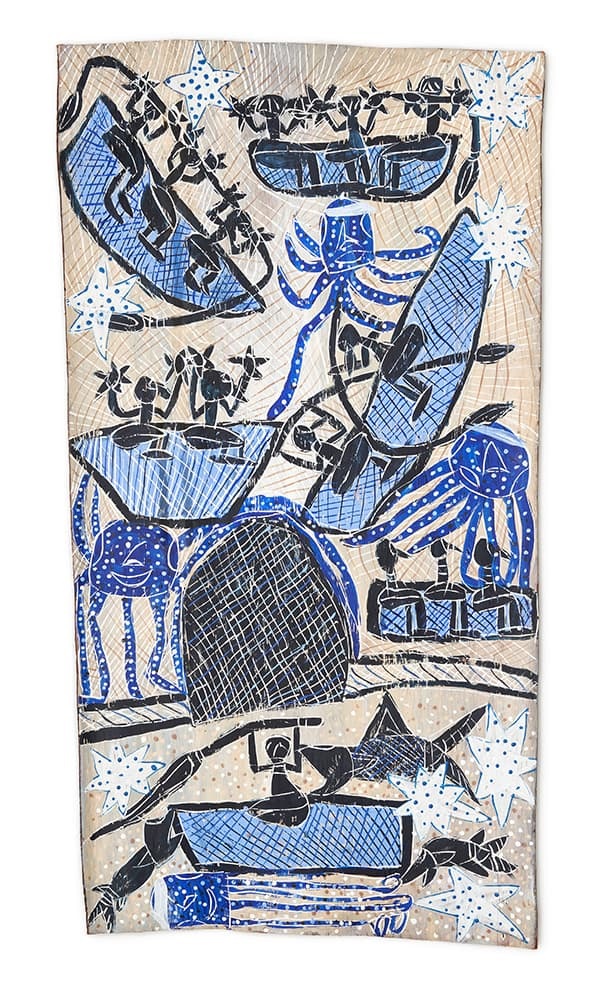
“’Madayin’ represents one of the most extraordinary art movements of our time,” said Jack Rasmussen, AU Museum’s director and curator, in a statement. “The dreamlike paintings represent the northern Australians tribe who have painted their clan designs on bodies and ceremonial objects. Not just decorative, the sacred patterns contain ancestral knowledge.”
The Yolŋu describe them as “madayin” — a catch-all term that means both sacred and beautiful. Bark paintings use natural pigments painted on sheets from the eucalyptus tree with a fine, human-hair paintbrush.
There are more than 80 paintings, and some are more than 12-feet high. A video of Yolŋu clan leaders sing visitors into the exhibit, while floor-to-ceiling videos produced by Yolŋu filmmaker Ishmael Marika are shown on walls.
“The land has everything it needs. But it couldn’t speak. It couldn’t express itself. Tell its identity. And so it grew a tongue. That is the Yolŋu. That is me,” one of the show’s artists, Djambawa Marawili, said in a statement.
“We are the tongue of the land. Grown by the land so it can sing who it is. We exist so we can paint the land.”

Our stories are worth telling. Our stories are worth sharing. Our stories are worth your support. Contribute $5 or $10 today to help ICT carry out its critical mission. Sign up for ICT’s free newsletter.