
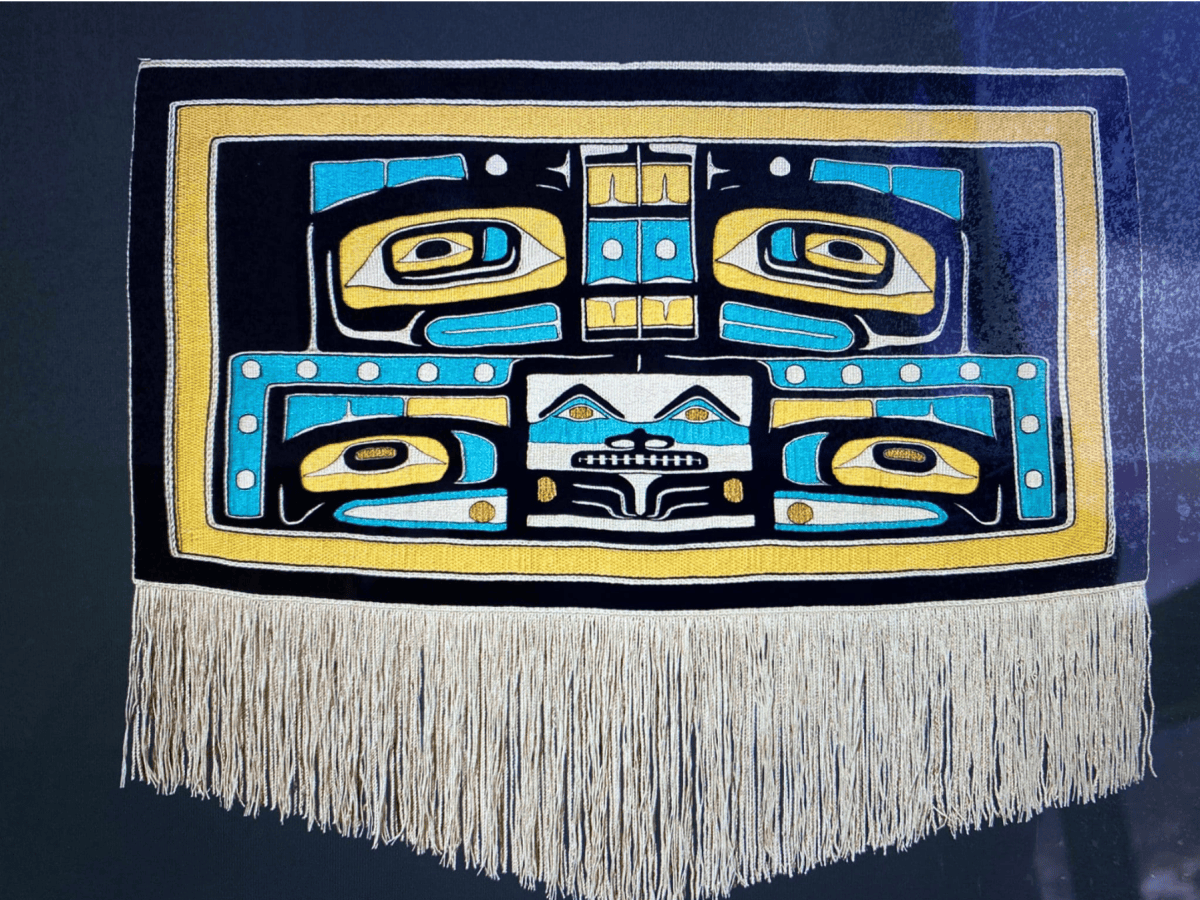
The Rasmuson Foundation has awarded 14 Indigenous artists with recognition and cash awards in three categories. They are some of the 36 Alaska artists being recognized by the foundation’s 2023 Individual Artist Awards. The awardees were selected by an international panel of artists and experts from a pool of 417 eligible applicants.
“Artists tell our stories and offer new ways of seeing,” said Gretchen Guess, Foundation president and CEO, in a prepared statement.“ We are so grateful for the dedication, talent and vibrancy of Alaska’s creative community.”
The foundation increased award amounts this year to 25 $10,000 Project Awards, 10 $25,000 Fellowship Awards and one $50,000 Distinguished Artist Award.
The foundation’s sole $50,000 Distinguished Artist award went to Anna Brown Ehlers, Tlingit, as “an established artist of recognized stature with decades of creative excellence and accomplishment in the arts.”
Ehlers is a master at Chilkat weavings used in ceremonies and Tlingit culture. She makes robes, tunics, dancing aprons, leggings, bibs and vests in the ancient art form.
The Rasmuson Foundation said, “Her weavings are danced, displayed, gifted and studied at memorial potlatches, totem pole raisings, traditional gatherings, canoe journeys and ceremonies. She is a creator of at.óowu (sacred objects), a master artist or aanyádi of her peoples.”
Ehlers is also a teacher of more than 300 people “in settings from university classrooms to youth culture camps and mentoring dozens of apprentices in her Juneau home. In addition to using traditional cedar bark and wool, Ehlers experiments with gold wire and silk fibers. She wove one of the largest Chilkat robes ever made, 8 feet by 7 feet, a formline killer whale the size of the actual newborn animal.”
Author Lily Tuzroyluke, Iñupiaq, wrote an essay about Ehlers published on the Rasmuson Foundation website entitled, “Ancient art form brings meaning to the present, tradition into the future.” Tuzroyluke wrote, “Anna Brown Ehlers is a culture bearer born in Juneau into the Whale House, the Gaanaxteidí (Woodworm) Clan, of the Yéil (Raven) moiety, her ancestry deeply rooted in Klukwan, an ancient Tlingit village historically known for Chilkat weaving. Ehlers continues an ancient and exemplified form of art valued by her Tlingit peoples and other Indigenous tribes of the Pacific Northwest.
“…In the service of others, Ehlers has been recognized with an array of prestigious awards, grants, fellowships and honors including the 2017 National Endowment for the Arts National Heritage Fellow, 2006 United States Artists Fellow, 2006 Alaska Governor’s Native Artist Award and 2001 First Peoples Fund Community Spirit Award. In 2023, the University of Alaska Southeast honored Ehlers with an Honorary Doctorate of Fine Arts for her significant and lasting contribution to the university and the State of Alaska.
$25,000 Fellowship awards (descriptions from Rasmuson website)
Shgendootan George is one of a handful of living weavers who has woven a full-sized Chilkat dancing robe. She will use her fellowship to create a series of robes including four dance robes in four distinct styles (Ravenstail, button blanket, cedar bark and Chilkat) to tell the history of the 1882 Navy bombing of Angoon.
Ossie Kairaiuak, Yup’ik, will create a large-scale dance and storytelling performance called “Ellanguarput: Our Pretend World” to celebrate the Yup’ik ancestral traditions within the modern-day world, using Yup’ik songs, masks and dances. He hopes to inspire healthy human conversations about how we develop our humanity and art.
The artist group Katurte, Yup’ik for “to come together,” includes Nicolette Corbett, a Yu’pik artist and mother from Bethel, and Katie O’Connor, an Iñupiaq artist from Nome. The two will collaborate to create the first Alaska Yup’ik alphabet coloring book for children ages 5-12.
Darlene Lind, Alutiiq/Sugpiat, is one of a handful of Alaska Native artists who create bronze sculptures. Lind shall create and hand carry a maquette of an Alaska Native healer to a foundry in Tacoma, Wash., to be cast in bronze.
Kunaq Marjorie Tahbone, an Iñupiaq artist from Nome, grew up learning how to prepare and store seal meat and oil for her family and community and to process seal hide to create maklaks and kamiks, two styles of traditional boots. She wants to work with local hunters to hunt seal on sea ice so she can complete the circle as a hunter-gatherer and artist to help revitalize her community’s traditional way of making.
Robert Mills, a Tlingit artist from Kake, is exploring the why of his art and the history of his people. Mills will build a traditional Tlingit tribal house in the Southeast home of Kake to improve community connection to heritage. The tribal house — Kake’s first in more than 100 years — will function as a workspace, cultural center.
$10,000 awards for artists, makers and culture bearers in specific, short-term projects
Brian Adams, Iñupiaq, a photographer who loves Alaska and wishes to elevate his community, will travel to Canada, Greenland and Russia to document the lives of Inuit people through portraiture and photo essays for his second book, “I am Inuit.” He intends to push himself and add depth to his work as he learns about Inuit cultures across the Arctic.
Mariza Ryce Aparicio-Tovar is a displaced person of Indigenous descent who explores themes of loss and recovery of identity. Aparicio-Tovar’s family came to the United States from Mexico legally in the 1970s Aparicio-Tovar will create an album of original music titled “600 Years,” exploring her rage, grief and visceral responses to past and present-day colonization.
Lyndsey Brollini, Haida, is a weaver and multimedia storyteller, who sees access to cedar and access to weaving teachers as two challenges in cedar bark wearing. She will expand her knowledge of Haida weaving techniques and the histories of basketry design by traveling to other communities in Southeast Alaska to shadow weavers as they teach, gather materials and weave hats and baskets. She’ll document her work in photography and film as learning tools for others.
Music by Wasabi Sharla Hausmann, an Iñupiaq, Koyukon and Paiute musician, acknowledges systemic violence, food insecurity and injustice, and she uses her voice to amplify these concerns and to make fun music. Wasabi will purchase instrumentals, samples and studio equipment. She will pay Iñupiaq singers and drummers who will contribute to the album and language bearers who will help translate English lyrics into Iñupiatun.
William Kozloff, Unangan from St. Paul and Athabaskan from Tanacross, will create an Alaska Native graphic novel to showcase the richness and complexity of Native identity. Drawing on his personal experiences and research, he will create a rich visual narrative to explore themes of race, religion, colonization and conflict.
Danielle D. Larsen is a contemporary illustrator and painter with Unangan-Aleut, Koyukon-Athabascan, Iñupiaq and European roots. She will explore and create new work for an exhibit at the Bunnell Street Arts Center in Homer. Larsen is most known for her colorful, large-scale paintings of traditional Alaska food inspired by her father, John E. Larsen, Jr. from King Cove, Alaska.
“Wáats’asdiyei Joe Yates, an Alaska Native filmmaker, will create a short narrative film, “My Message to You,” from a child’s point of view about the difficulties that parents experience in passing on their culture. ‘The award will help pay for gear, stipends for artists and musicians and post-production work. He plans to show his film film festivals, libraries and schools to help create connections with others who are doing the work to preserve their culture.

Like this story? Support our work with a $5 or $10 contribution today. Contribute to the nonprofit ICT. Sign up for ICT’s free newsletter.
