
Pauly Denetclaw
ICT
WASHINGTON — Helicopters, sirens, and barricades, Secret Service agents and Capitol Police, have been building their presence in Capitol Hill in preparation for the State of the Union address by President Joe Biden.
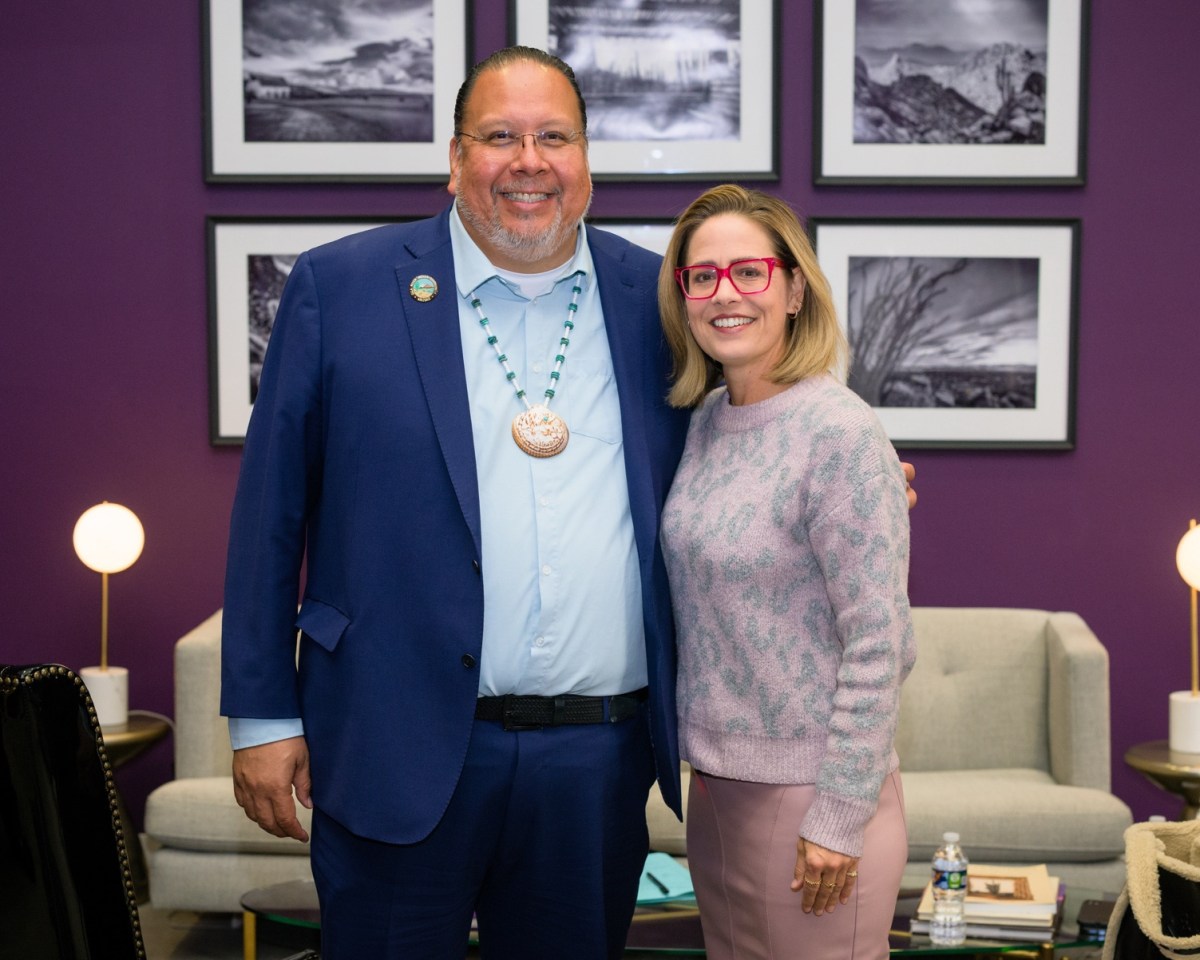
In attendance this year will be Gov. Stephen Roe Lewis of Gila River Indian Community as a guest of his friend Arizona Sen. Kyrsten Sinema.
“The federal government has a trust responsibility to tribes,” Lewis told ICT. “For tribal leaders, such as myself, to be there is more than a symbolic presence. It’s a very real presence when we’re dealing with all of these issues regarding infrastructure, regarding issues that affect tribal sovereignty itself.”
(Related: Live blog: 2023 State of the Union)
This is Biden’s second State of the Union address, a yearly speech that outlines the wins from the year prior and sets the president’s agenda for the next year. The Speaker of the House invites the president to give a speech to a joint session of Congress.
Sitting alongside first Lady Jill Biden, among the featured guests, will be Lynette Bonar of Tuba City, Arizona, a nurse and medical executive involved in bringing the first cancer center to sovereign lands. It is expected that several of the featured guests will be mentioned by name during the president’s address.
Navajo Nation President Buu Van Nygren will also be in attendance as a guest of Sen. Mark Kelly from Arizona.
“There are many tribes that are represented in Washington right now — President Biden is being true to his word to Indigenous people,” Nygren said in a statement to ICT. “I’m especially honored to attend his second state of the nation address as the guest of Sen. Mark Kelly. It’s the start of a great collaboration on behalf of our people.”
In 1829, the State of the Union focused on the forced removal of the Cherokee Nation and President Andrew Jackson scoffed at the idea of Indigenous nations having tribal sovereignty over their lands.
He wrote that tribal self-government would not be permitted and encouraged them to move west of the Mississippi.
The State of the Union over the past decade has been quite different. Most State of the Union addresses hardly mention Indigenous people or the issues facing Indigenous nations, despite that, Sinema hopes that Biden’s speech includes a statement on continuing to work collaboratively with them.
“One of the things that I hope to hear the President speak about is the importance of collaboration, mutual respect, between sovereign nations and tribal communities and the communities that surround them and work in partnership with them,” Sinema told ICT. “As we know, this is important all across the country but it’s particularly important in the southwest, as we face a 1200 year historic drought. The Governor and I both understand how important it is that we work together in collaboration to find a path forward not only for the governor’s community, but also for the entire state of Arizona and the entire region.”
Lewis added that he hopes these conversations turn into real world change for tribal nations across the country.
“When we talk about equity, and especially with tribes, it’s important not just to talk about it but to implement that,” Lewis said. “In Arizona, we’re addressing issues, such as the I-10, we’re addressing issues of access to water, but also conservation of water. There’s all of these generational infrastructure issues that need those federal resources and to make sure that at least the sovereign tribal nations get those long overdue federal resources.”
Both Sinema and Lewis highlighted the collaborative efforts between Gila River and Sinema’s office in working together to address important issues.
“The partnership that Governor Lewis, on behalf of his community, and I have forged has really set an example, I hope, not only for other states across the country but for every other tribal communities across the country,” Sinema said. “We can see that we can work together with mutual respect, with partnership, to find solutions to some of the thorniest challenges that we face in our country. In Arizona, as we know, one of those greatest challenges is our drought.”
Sinema was a lead co-author of the Bipartisan Infrastructure law that was signed into law by Biden in the fall of 2021. The law provided historic funding for infrastructure in Indian Country including, $3.5 billion for water and sanitation, $2 billion to expand high-speed broadband and $2.5 billion in funding for water rights settlements.
Last year, Sinema worked with Senate Republicans to get two Arizona water rights settlements unanimously passed for the Hualapai Tribe and White Mountain Apache Tribe.
This is the type of collaboration that Sinema and Lewis would like to see across the nation and hopes the Biden administration takes notice of how collaboration can yield results.
“I couldn’t be more proud of the leadership demonstrated by Gov. Lewis in the work that his community has really done in stepping up to the table and ensuring that we are hand in hand in protecting Arizona’s water future,” Sinema said. “Again, couldn’t be more proud of it and really hope that other folks across the country, my Senate and House colleagues see this as a model and begin to engage in the same type of equitable partnerships in their own communities as well.”
Rep. Josh Brecheen, Choctaw, from Oklahoma tweeted: “High gas prices, unaffordable grocery bills, a $31 trillion+ national debt, a crisis at our Southern Border… That’s the real State of the Union under President Biden’s failed leadership. #SOTU.”
Kansas Rep. Sharice Davids, Ho-Chunk, is bringing Jessica Kidd, a community college graduate and commercial truck driver from Overland Park, Kansas, a suburb of Kansas City.
Oklahoma Rep. Tom Cole, Chickasaw, sent out a column stating that the Biden administration is attacking America’s emergency oil reserves.
“Since assuming office, President Joe Biden has taken actions that have dangerously and significantly reduced our nation’s energy independence and caused energy prices to reach unprecedented prices,” Cole wrote. “Even worse, while trying to reduce high fuel and energy prices caused by his own doing, the president has wrongfully and dangerously drained our Strategic Petroleum Reserve to its lowest level in 40 years for political expedience rather than meaningful effect.”
Oklahoma Sen. Markwayne Mullin, Cherokee, tweeted “The real State of the Union” that included a 34-second video.
“Since he’s been in office, 4.5 million illegals have came across our southern border,” Mullin said in the video. “Do you realize that’s a population of more than 24 states. This isn’t about immigration. This is a national security issue… The American people need to hear what our plan is moving forward. I, for one, will be asking these same questions to him.”
The State of the Union is tonight at 6 p.m. Pacific Time and 9 p.m. Eastern Time.

ICT is a nonprofit news organization. Will you support our work? All of our content is free. There are no subscriptions or costs. And we have hired more Native journalists in the past year than any news organization ─ and with your help we will continue to grow and create career paths for our people. Support ICT for as little as $10. Sign up for ICT’s free newsletter.
